21 - Principle Four: Money Directs the Way
2022 No 21
For where jealousy and selfish ambition exist, there is disorder and every evil thing.
--James 3:16
By this point, I trust that you are beginning to recognize that migration is always complicated. We so very much want to put people into boxes so we can describe them, categorize them, create a plan to minister to them, and perhaps even plant a church among them. Unfortunately, it does not work that way. Migration is different for almost anyone you meet. If you go into any village in any African country, you will hear stories of their children who live in distant lands. They are students, business owners, government workers, farm laborers, and taxi drivers. But there will be many whose whereabouts are unknown. Some have died, some are trapped in places of transition, and a few have become slaves in the hands of organized crime.
Every step on the migratory pathway takes money. It is our fourth principle of migration. Money directs the way. You simply cannot separate financial resources from migration. That first step on any journey may have been inexpensive. All the other steps cost money, often a lot of money. As long as migration is voluntary, people will go where they can afford. Initially, the migrants are making the decisions. But as we have seen and will examine in the posts to come, most sub-Saharan migrants ultimately surrender any semblance of that control to others.
We will begin to examine these different migration routes in the days ahead. To get from Africa to Europe, one can fly directly. We call these Direct Routes. Or one can go through Turkey and into Greece. It is called the Eastern Mediterranean Route. One can go through Morocco or the Canary Islands towards Spain. That is called the Western Mediterranean Route.1 One can also cross the Sahara Desert into Libya and cross into Italy. That is called the Central Mediterranean Route. Then, of course, there are many far eastern and far western routes. One can find African migrants in the Americas as well as Asia. Each of these migrants may have come from the same village. But the thing to recognize is that they all required a financial commitment.
Initial Routes
There are costs associated with every migratory step, even for initial movements. I often state that migration is like water running down a hill. It generally takes the path of least resistance. Sometimes there are few options, and people are compelled to go where the river takes them. This can be especially true for forced displacements. One could stay at home and suffer the consequences or one can get in line with everyone else. In many cases, however, people do not have the option to even get in a line. Consider the plight of Syrian refugees. Those in the interior with the means to escape became refugees. Those who did not have resources may have left their village, but they are still in the country.²
Water running down a mountain canyon has few options. It goes down, goes fast, and can move huge boulders along the way. But in lower elevations, the water spreads out and can take multiple pathways. Have no doubt that at each point, water still moves from point A to point B along the path of least resistance. Such is generally the case for migrants, including each of us. We know where we want to go, and we make our plans in the most economical and efficient ways possible. The point here is that almost all initial routes (and many subsequent routes) are opportunistic choices that involve networks of friends and relatives. Each of these migrants has some measure of resources that allows them to go someplace. Once again, these are simple movements. And they represent three-fourths of all global migration!
Subsequent Routes
Subsequent routes, on the other hand, are much more dynamic. Don't misunderstand; even these journeys retain a measure of volitional choice and, like initial routes, require resources. The difference is that other motivations come into play in these secondary movements. There is something about human nature that wants to believe that the grass is always greener in front of us than it will ever be behind us. The idea gets reinforced by the success stories of others. Few are promoting their stories of failure. And when it does happen, they are quickly discounted as unique to that one individual. As followers of Christ, we like to think that we see things differently. We know that our best life is found in our Lord, not in reckless pursuits. But that is difficult for unbelievers to accept. Human nature has a way of imagining that things will get better if I can only move from “here” to "there."
In Africa, we can easily see how this human nature becomes shaped by local contexts. For example, African culture is often lived in the present. (Particularly for young adults.) It is why it is so difficult for them to plan for the future. In their eyes, opportunity "today" is always better than possibility "tomorrow". There is a strong temptation to grab what is offered in the present, even if it comes with a higher risk.3 We have a lot of expressions of this in western culture, and most of them don’t work very well for us either. Have you ever heard someone say that you have to play the cards dealt to you? I used that once with my dad, and he told me to stop playing games and go to work! He said it would yield better results. Or have you heard the cliché that the grass is greener on the other side of the fence? Perhaps... but the water bill is always higher!
Please take care at this point. Before we judge our fellow migrants, we must understand that African life is hard. Many dream of the day when they can live in the moment and invest for later in life. Most, however, do not have such luxury. Most are in survival mode. That is why their culture is so very much rooted in the present. This can, in some respects, have its advantages. I have found that non-western cultures tend to value relationships over time and people over money. Unfortunately, movement, even in short steps, can bring subtle changes to these values.
Ask any African university student about the difficulty of moving back home to the village. They will tell you that the pace is too slow. In the village, many of their friends will sit for hours and drink tea. Returning students will say that their life is now too busy to do that. Even when they go home for a visit, they are ready to get back to the city after a few weeks. (Sound familiar!) Now, who changed? The same thing happens for future movements. The move to the city may have been a big deal initially. But after a while, that movement became comfortable. So, when another opportunity arises, a subsequent step is not that hard.
No One Moves Without Money
I want to return to the premise of this post. It is a reality, a principle that these subsequent steps take money. How much money one has will always dictate the direction of movement. My days are filled with interactions with migrants and those who minister to them. I have heard hundreds of stories. The common denominator to all of them is money. Each will tell how much it cost to get from where they were to where they are today. They will also share, often without asking, how much it will cost to get to where they want to go. It truly is a common and consistent theme and gives evidence to some more significant trends. Allow me to explain.
It is not a stretch to say that most migrants in Europe are legal, employed or in school, and doing relatively well. They arrived by what we tend to call "direct routes". The only reason they could do so was that they had access to resources and network connections. Most came out of the top tier of African wealth. In the same way, those who take the Eastern Mediterranean route also have financial means. One cannot get into Greece without having passed through Turkey. Nearly all of those in Turkey arrived via an airline and held some kind of visa. To do that, they spent more than the annual salary of 90% of all their fellow countrymen.
The same can be said for many of those in Morocco. They arrived on a student visa. Or they came on a tourist visa and then overstayed... because they wanted to catch a boat to Spain. Like those in Turkey, they had to spend money to do that. The remainder came through the Central route; that is to say, they came across the desert. But even that cost money. Most migrants have spent between $1,000 and $1,500 by the time they have reached Libya. They generally came from the regions where an average adult male makes less than $800 per year.4 They will spend another $3,000 or more to get across the Mediterranean.
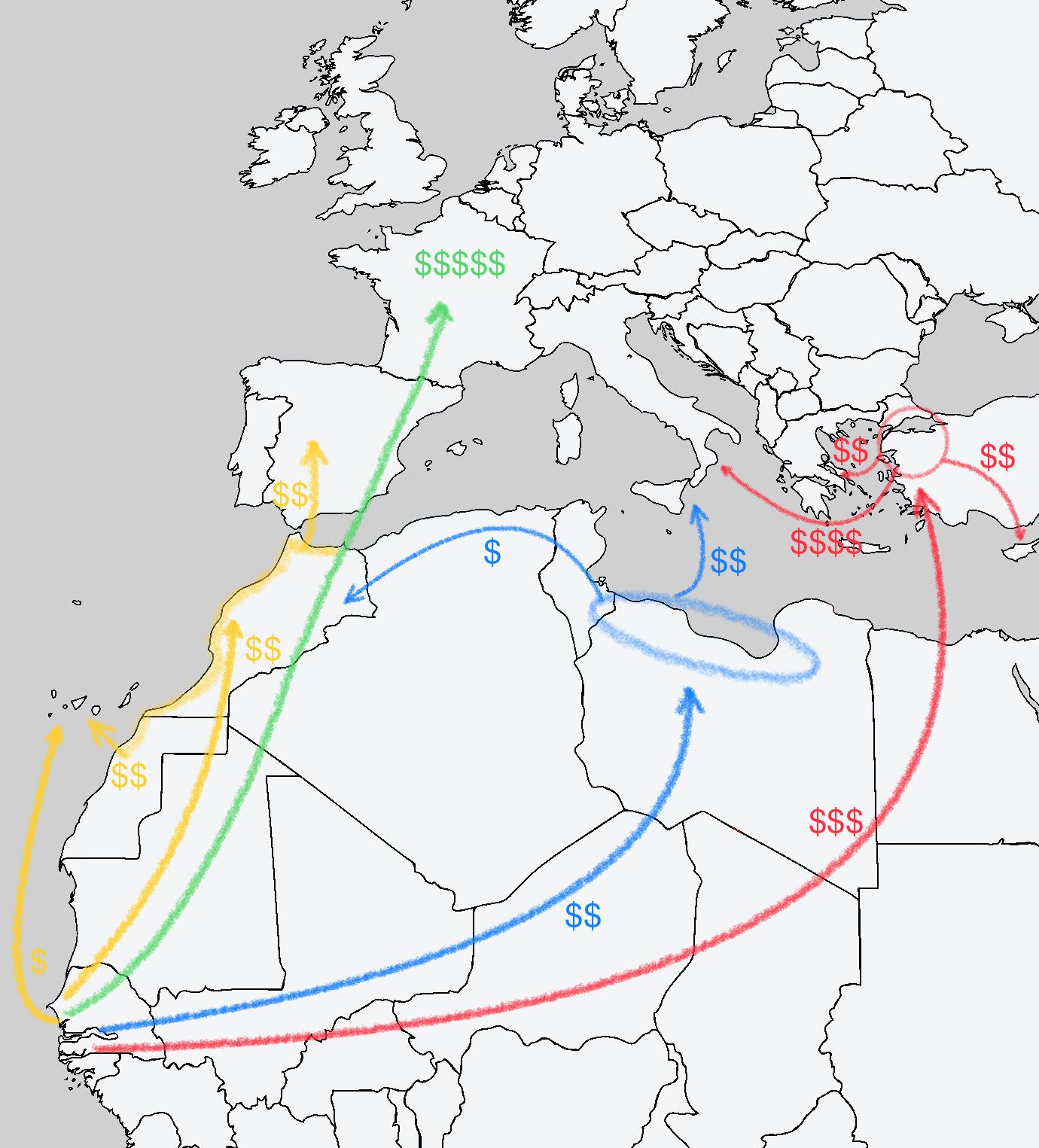
So, where do these resources come from? If you are rich, it comes from your parents' bank account. If you are not rich, then it is from someone loaning you the money, someone selling their property, or advanced by a smuggler/trafficker.5 Often, the first step does not cost that much and is made voluntarily. Almost always, one gets pushed into the faster moving waters, and in so doing, they lose not just their money but their capacity to direct their future steps.
Conclusion
If you have been keeping up with the previous posts, you will hear a recurring theme. That has been intentional. Churches and faith-based organizations are seeking to understand the global dynamics of migration. There are intense pressures to standardize this complex phenomenon as they seek to develop strategies for engagement. Such is possible, but only at higher altitudes. The macro-view reveals at least five principles present in every migratory situation. First, migration is a common event… everyone is moving. Second, people move for a reason. Third, everyone needs the help of others to get from one place to another. In this post, we recognize that fourthly, money does more than secure help; it dictates how others control the movements. Those with significant resources can make choices. Those with limited resources either do not move or are swept into flows that take them to places they never intended.
In our next post, we will discuss the final principle. It is one of control. Even in the best of situations, external forces will always direct migration. But control is an illusion. Why? Because the objectives of the migrant are seldom the objectives of those to whom the migrant must depend. Independent networks are in it for the money; criminal networks often follow much darker pathways. Both can leave migrants stranded, victimized, and desperate.
____________________
1Karen Jacobsen, "The Perils of Migration out of Africa", WBUR - Boston NPR News https://www.wbur.org/hereandnow/2015/09/10/migration-perils-africa (accessed March 31, 2022).
2 UNHCR, "Syria Refugee Crisis - Globally, in Europe and in Cyprus", United Nations High Commissioner for Refugees https://www.unhcr.org/cy/2021/03/18/syria-refugee-crisis-globally-in-europe-and-in-cyprus-meet-some-syrian-refugees-in-cyprus/ (accessed March 31, 2022). One cannot imagine the poverty and suffering that comes from displacement. But if you look at this article, they give examples of migrant backgrounds. Of the six given, they list a scientist, a lawyer, an architect, an English Literature graduate, and a former restauranteur.
3 David E. Maranz, African Friends and Money Matters: Observations from Africa, vol. 37 (Dallas: SIL International and International Museum of Cultures, 2001).
World Bank, "ProvcalNet: An Online Analysis Tool for Global Poverty Monitoring",
4 World Bank http://iresearch.worldbank.org/PovcalNet/home.aspx (accessed November 25, 2021).
5 2021 Trafficking in Persons Report, (Washington D.C.: Office to Monitor and Combat Trafficking in Persons, 2021), 27.