49 – Stay Until I Can Go
2023 No 49
You shall go to the priest who is in office at that time and say to him, ‘I declare this day to the LORD my God that I have entered the land which the LORD swore to our fathers to give us.’ Then the priest shall take the basket from your hand and set it down before the altar of the LORD your God. You shall answer and say before the LORD your God, ‘My father was a wandering Aramean, and he went down to Egypt and sojourned there, few in number; but there he became a great, mighty and populous nation. And the Egyptians treated us harshly and afflicted us, and imposed hard labor on us. Then we cried to the LORD, the God of our fathers, and the LORD heard our voice and saw our affliction and our toil and our oppression; and the LORD brought us out of Egypt with a mighty hand and an outstretched arm and with great terror and with signs and wonders; and He has brought us to this place and has given us this land, a land flowing with milk and honey.
—Deuteronomy 26:3-9
The children of Israel had wandered in the wilderness for some 40 years when Moses wrote the book of Deuteronomy. Now they were standing on the east side of the Jordan river, looking across the waters, imagining a land filled with milk and honey. It was the promised land. It was so close that they could taste it. And when they would possess the land, Moses commanded them to take the first fruits as an offering to the Lord. They would then celebrate their migration across the desert and how the Lord had preserved their lives. It would not be until the book of Joshua that they would actually cross the river. In the meantime, they would have to remain patient… and faithful. Neither would prove to be easy.
It is all too easy to judge migratory movements. Somehow, we have the sense that migration is good when we do it but become suspicious of others when they make similar choices. To be sure, some migratory journeys are poorly conceived, wrongly motivated, and have horrific consequences. Just a review of last weeks news will offer a painful reminder.1 Much of modern migration originates in poor government policies, parasitic smuggling networks, and downright evil agents of human trafficking. To these, we must stand opposed. Our prayer is that this blog series helps shine a light on these practices and serves to equip faith leaders to make a difference.
But we must also concede that our Lord initiates many movements. For some, it is to put them on a pathway leading to salvation. For others, it is to bring a blessing to their lives and to use them to provide for their families. For yet others, it is for His service and the extension of His kingdom. (I certainly consider myself in that last category!) Remember that when people move, they take their faith with them. We cannot deny that much of the expansion of God’s kingdom in modern times has been at the hands of migrants. Such is undoubtedly evident in Africa today.
Throughout this blog series, we have sought to understand migration at the 40,000-foot level. To do this well, we occasionally drop to the ground to engage the people up close. The challenge is that things that appear clear, distinct and unified from a distance become individualized up close. In migration research, people do not always fit into clearly defined categories. Such is often the case along the Western Mediterranean Route.
For many of the people we meet, Morocco was only intended to be a place of transition, a pass-through point. They never planned to spend significant time in the region, but their circumstances have left them stranded. Many arrived legally, overstayed their visas… and became illegal. But... they diligently pressed through the processes and have obtained residency status. Others came illegally, survived without proper documents, and may find legal residency. And then, of course, some arrived legally and are simply biding their time. Morocco is such a melting pot of migration that one can find people of almost every status on the streets of every city. Allow me to introduce you to a few.
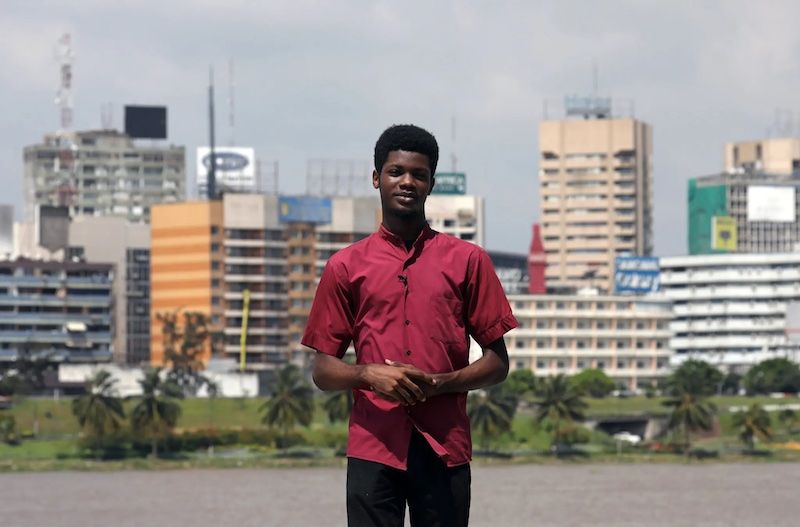
Daouda
Daouda is from Côte d’Ivoire. He came to Morocco on a scholarship and completed his undergraduate degree in information technology. He served as an intern with a travel company in Casablanca during his last year of school, and they offered him a job when he graduated. When I met him, he had been working for the company for over two years. He enjoys his work, even though his salary is low. But he makes enough to pay his rent, buy groceries, and send some money home to his mom.
Daouda is active in the local international church. I met him through a young man named Thomas from Cameroon. Together, they run the tech ministry. God used them in powerful ways during the COVID pandemic to broadcast the Sunday services on Facebook. Daouda has shared that he loves his time in Morocco but does not see it as his long-term home. He also does not see himself returning to Côte d'Ivoire. There are few jobs there, and he sees his ability to care for his family to be better if he works abroad. When asked where he would like to go, he says it is a toss-up between France and England. But if he goes, he shared with me, it will be legally.
The company he works for has contracts across Europe, and it is common for positions to open in other countries. He believes that if it is the Lord's will, one of those slots will open for him. Until then, he plans to stay in Morocco and save his money. I have also noticed that he has his eye on a young lady at church. She is also a university student with great potential to find a job in Morocco. It would not surprise me if the two were to become more serious in their relationship.
Let's pause for a moment and ask ourselves an important question. How is Daouda any different from any of us reading this blog? How is he unlike our own children? He is a young man who moved under the direction of the Lord and followed the pathways placed before him. His strong commitment to his faith seems to be motivated for all the right reasons. The only difference between Daouda and the others we have met in recent posts is circumstantial. He just happens to be in a place where he can rest comfortably until a legal pathway forward opens. And with that intention, he is very much a part of the Western Mediterranean Route.
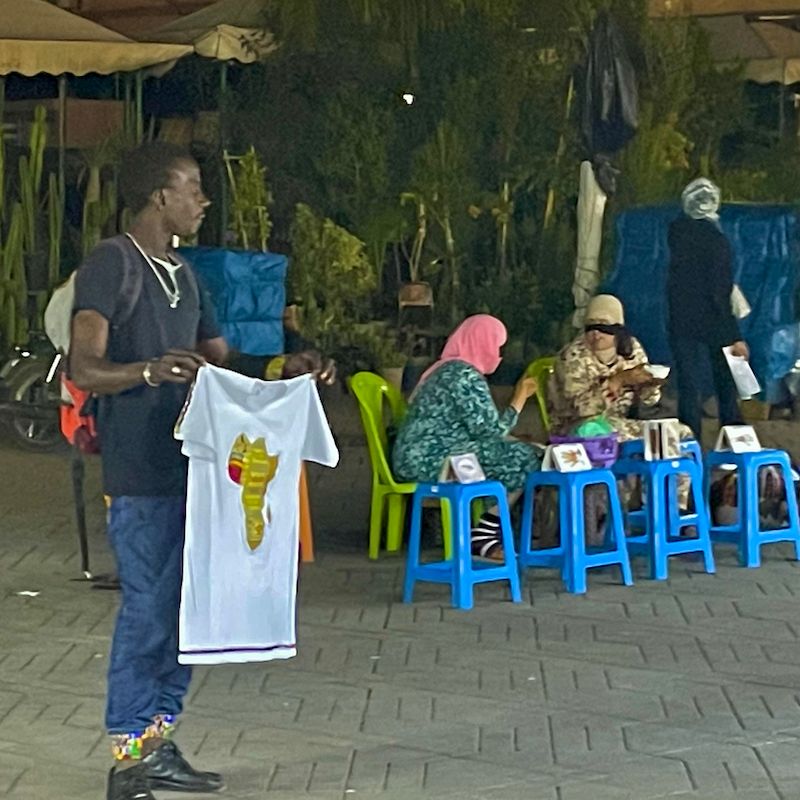
Samoura
I met another gentleman in the Medina of Marrakech. His name is Samoura. It was a pleasant visit and he was more than willing to share his story with me. He came to Morocco across the desert of Algeria. He was from the area of Timbuktu in northern Mali. Unrest in the region since 2012 forced his family to relocate to Bamako. He has an uncle there who buys goods from the US and then imports them to Africa for resale. That uncle helped Sam get to Morocco with the intention of selling his goods in the markets.
As Sam told the story, it seemed that the journey was not that difficult. Although he came through the desert, he said that things went smoothly. He entered Morocco with a valid passport and visa... and quickly secured a boutique in the local market. His uncle ships stuff to him, often directly from the US. Because of the number of tourists, he has a steady business. He told me that if things went well, he hoped to expand their market into parts of Europe.
Sam is a Muslim, so he can easily assimilate into Moroccan society. He is also very open to new ideas, meaning that he can adjust to different cultures very quickly. He was very complimentary of the Moroccan government, perhaps because it was such a contrast to much of West Africa. And while it was apparent that much of his "friendliness" was an effort to make a sale, he was genuinely interested in learning about who we were and why we were asking so many questions. He shared that although he wanted to go to Europe or perhaps even the United States one day, he was content to stay in Morocco for as long as was necessary.
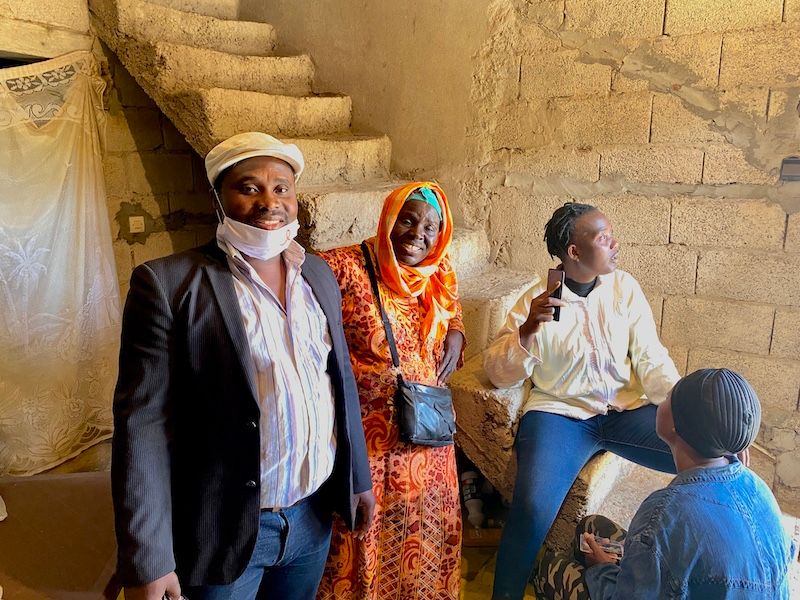
Oumar
Oumar is a Mourid from Senegal. He initially came to Agadir to sell designer bags to tourists. Agadir is a city with beautiful beaches and is popular with Europeans seeking to escape the cold of winter. He arrived in 2002 when he was a much younger man. As was the custom, his goal was to work in Morocco until he could be promoted and moved on to Europe. Obviously, that did not happen.
Oumar was involved in an accident on his motorbike during his third year in the country, seriously injuring his left leg. Even after it healed, he could only walk with a crutch. That meant that he was not a good candidate to move forward and that life would be difficult if he returned to Senegal. Consequently, he decided to stay in Morocco and became a trainer and guide for the new Mourides arriving each year. Along the way, he gained a strong reputation not just with the migrants but also with the authorities. He was a man who could get things done and who could keep the migrant community in check.
There is a migrant community in central Morocco that is setting new standards. It is like a small city or village in the countryside. Most of her inhabitants are illegal, but the government allows them to live there without harassment. They farm the land, serve as laborers for local Moroccans, and have created pathways for new migrants to settle into the society. Oumar has become their mayor and functions in a similar role as chief back in Senegal. He anticipates that the government will one day grant residency to community members. They are working hard to do things properly, knowing they are always being evaluated by the authorities. They have a small mosque in the village and shared that they were also open to having a church. More than anything, they want to be a place that is safe and secure for all sub-Saharan migrants who have decided to make Morocco their home.
Conclusion
Milk and honey are difficult to come by during troubled times and in desolate places. Sure, one can find cows and bees in sub-Saharan Africa, but to have milk requires green grass and quiet fields. Honey requires the blossoms of fruit-bearing trees and flowers. For the children of Israel, each was a memory and a dream during their desert days. But, after 40 years, it was a dream come true.
For many migrants, North Africa may not have been their intended destination, but the milk and honey of Morocco cannot be discounted. Most everyone will testify that the best way to arrive is legally… on an airplane. Not everyone can pull that off. But those who learn how legally to remain can do well. The Moroccan people are gracious, and pathways exist to live peacefully with the government. More importantly, our Lord has taken up residence within her borders, He has planted His church on her soil, and His Spirit is moving among her people. Many have arrived searching for life and have found it in Christ.
Because Morocco is such a pass-through point for migrants on the Western Mediterranean Route, she clearly becomes a strategic location for our Lord to reach people with the gospel. And while those in the West may imagine that we could be instrumental in that process, it will more likely be believers among the migrants who will do the job. The church is undoubtedly present across the region, and her members have compassion for their neighbors. Such is especially true for those neighbors who share their culture and vision. Our role (the West) is to support, encourage and pray for our sister churches. Such begins with understanding… and that is why this blog exists.
1 Davide Ghiglione and Alexandra Fouché, "Italy Migrant Boat Shipwreck: More Than 100 People Feared Dead", BBC https://www.bbc.com/news/world-europe-64784208 (accessed February 28, 2023).
2 For security purposes, this is a generic photo used to represent Daouda. Alex Hawgood, "A Student Who Makes African Emojis", New York Times https://www.nytimes.com/2019/12/11/style/a-student-who-makes-african-emojis.html (accessed February 28, 2023).