83 - A Historical Context of the Balkans
2025 No 83
I had no rest for my spirit, not finding Titus my brother; but taking my leave of them, I went on to Macedonia. —2 Corinthians 2:13
Introduction
In Paul’s second letter to the Corinthians, we get the sense that he was searching for a young pastor named Titus, and that search had taken him north to Macedonia. Paul did not know that he would have to go even further north into Dalmatia… i.e., modern-day Croatia... to find him.1 It was not a difficult journey, for travel was made easy by what was known as the Pax Romana, or the Peace of Rome. Around 135 AD, the philosopher Epictetus wrote, “There are neither wars nor battles, nor great robberies nor piracies, but we may travel at all hours, and sail from east to west.”2 Perhaps this helps us to understand how the gospel, and people, could travel so quickly along this “Balkan Route” during the first century.
This territory has always been pivotal to world economic history. The Silk Road was a key transit route between Europe and Asia from the second to the fifteenth century.3 It ran as far east as Constantinople. To get there, European merchants had to pass through the Balkans to purchase their goods. During the Ottoman Empire, the Balkans represented a porous boundary zone between the economies of the Christian West and the Islamic East. Even during the Soviet era, movements… licit and illicit… were common. In other words, the Balkans have been a transit route for over two millennia. We should not be surprised that it continues to serve in that capacity today.
As we continue our study of the Eastern Mediterranean Route (EMR), we come to our final segment on the Balkans. Do not think that last is the least! In the early days of the migration crisis of 2015, the Balkans were "the" route of entry to Europe. Most of the refugees from Syria, Iraq, and Afghanistan passed through Bulgaria, Serbia, Croatia, and Slovenia on their way west. The numbers could have easily exceeded a million people. We could be tempted to dive directly into those movements, but without a review of the history, we would miss much of the context, and fail to understand the Balkan response.
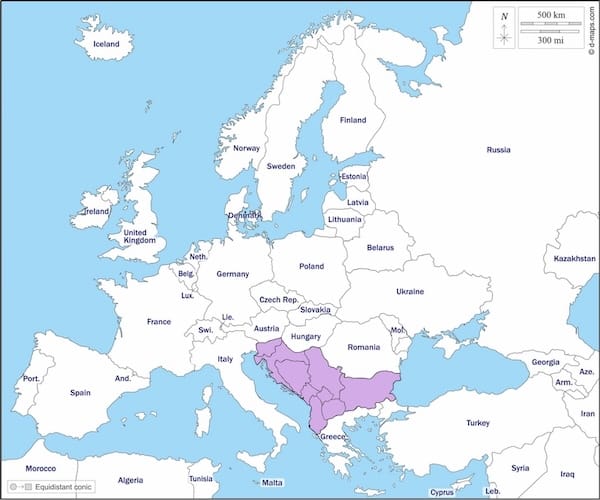
Balkan Geography
To understand the EMR, it is helpful to have a general understanding of the geography of the Balkans. The region derives its name from the Balkan Mountains, which stretch from the southeast to the northwest along the western edge of the Adriatic Sea. However, the area's identity is defined as much by political factors as by geography. The borders of “the Balkans” can shift depending on which powers control the region, leading to various states and nations emerging over time. Therefore, it's best to view the region in terms of political control and ethnic identity.
It is also good to remember that migrants do not think in terms of geographical labels. They simply seek to go from one place to another, and they search for the pathway of least resistance. Our focus on geography is only to give us context, and to help us understand how and why people would move in this direction.
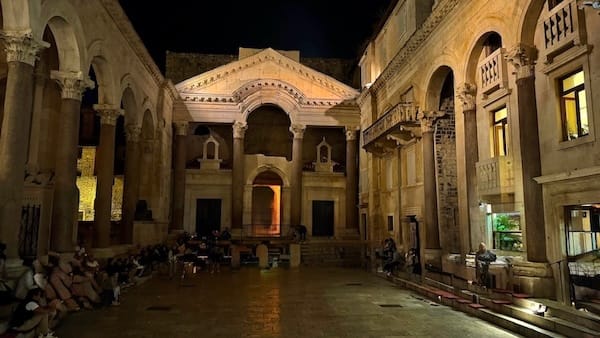
Roman to Christian
In the early days of the Greek and Roman Empires, the region was crucial for controlling the land routes to the Middle East and beyond. Safe passage between the West and East was essential, which required a corridor between the Adriatic and Black Seas. This arrangement provided protection from the nomadic tribes to the North. Roads were constructed and maintained to facilitate commerce and ensure smooth military movements. The byproduct was ease of movement.
Christianity emerged along the Adriatic in the first century and maintained a strong presence for centuries.4 This period was marked by intense persecution followed by significant religious freedom. The ruins of the basilica built in Salona (title photo), just a few miles from Diocletian's palace, highlight the dynamic nature of the region. However, as Roman power began to decline and "barbarian" tribes from the North gained control, Christianity started to wane in its influence.5 Fiercely independent and economically coerced to accommodate all religions, the populace would become eclectic in their faith.
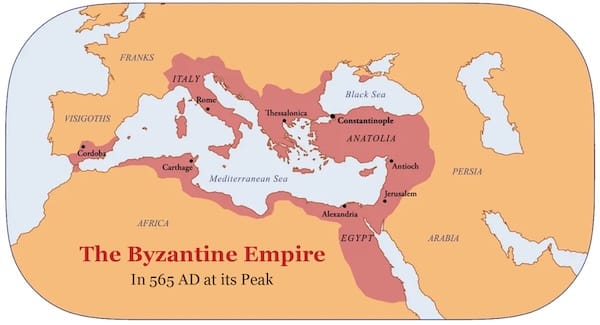
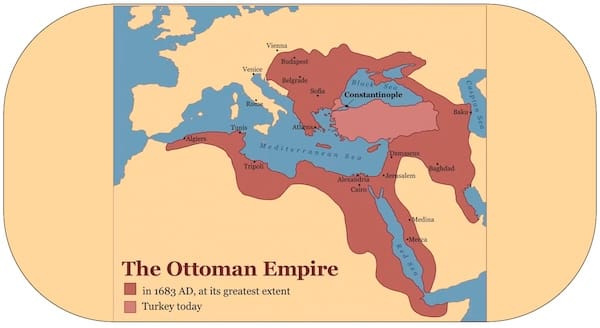
Comparison of Byzantine and Ottoman Empires 6,7
Christian to Muslim
As Rome struggled to control its vast territories, Emperor Diocletian divided the empire into two parts. The Western "Roman" Empire remained centered in Italy, while the Eastern "Byzantine" Empire found its headquarters in Byzantium… renamed Constantinople… modern-day Istanbul.8 The Balkans were part of a unique district governed by Galerius (Diocletian's son-in-law) and served as a land bridge between the two districts.
The Western Roman Empire would ultimately collapse in 476 AD. The East continued for another thousand years and was eventually conquered in 1453. It would fall to the ever-expanding Islamic forces from the East. As they took a foothold in Turkey, they became known as the Ottomans. If you reference the map above, you will see that they controlled vast territories.
By the mid-1300s, the Ottomans began making incursions into the Balkans, and by 1521, Belgrade had fallen.9 This does not mean the entire region was forced to adopt Islamic beliefs. The Ottomans were, at their core, Sufis.10 Tolerance within this order allowed Christianity to remain... only under subjugation to their Islamic masters. Thus, the Balkans served as a border between the Christian West and the Islamic East. They functioned as a buffer zone where peace and harmony were paramount. It lasted for nearly five centuries. But… even Muslim control would eventually come to an end.
Muslim to Communist
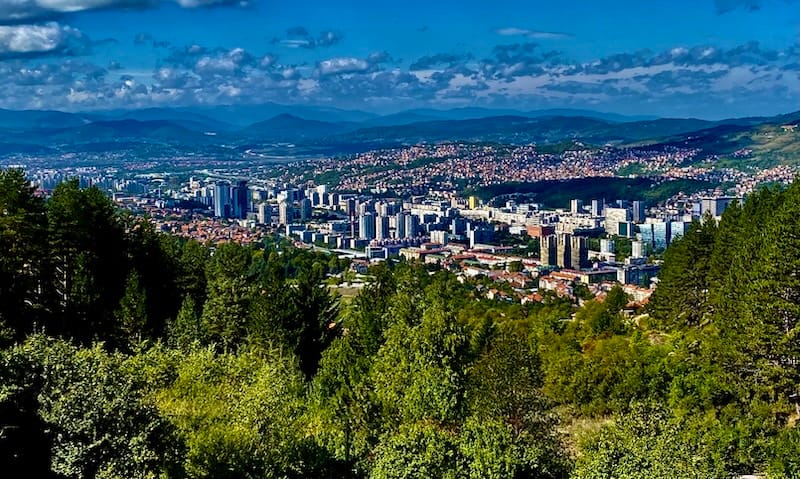
The Balkan secession from the Ottoman Empire was a gradual process, not a sudden event. It only became definitive when the Ottomans collapsed at the end of World War I. For centuries prior, however, Islamic overlords had experienced tension and occasional warfare with the European Habsburgs of Austria/Hungary. Being on the frontier of a weakened empire allowed various Balkan states (the people themselves) to declare independence, often with little consequence. Greece gained independence in 1821, followed by Serbia and Montenegro in 1878, Bulgaria in 1908, and Albania in 1912. In an ultimate show of defiance, these newly independent states declared war on the Ottomans in 1912 and 1913. Both conflicts were successful.11
History records that World War I led to the destruction of both the Ottoman and Habsburg empires. In a world increasingly focused on other matters, the vacuum allowed independent and isolated Balkan states to unite to form the Kingdom of Serbs, Croats, and Slovenes in 1918. It would later be named Yugoslavia, meaning "the land of the South Slavs." Borders may have been drawn to reflect cultural identities, but the land's ethnic and religious diversity made integration challenging.
One of the anticipated benefits of forming the Yugoslavian Republic was that the unified, independent States could possess the strength to thrive on the global stage. However, as a worldwide depression wreaked havoc (1929-1939), they became economically dependent on Germany. Ultimately, they could not avoid aligning with the Axis powers during World War II.12 When the conflict ended, the entire region fell under the influence of communist ideologies from Eastern Europe.
Communist to Nationalist
Post-war Yugoslavia was a racially diverse territory, home to Serbs, Croats, Slovens, Montenegrins, Bosnians, Macedonians, as well as Germans, Italians, Hungarians, and Russians. The area was also religiously diverse, including Christians, Muslims, Jews, and atheists. Migration through the region had become the norm. It was a melting pot constantly on the brink of boiling over. The only thing that kept it together was the iron grip of communism... and a man named Tito.
Josip Broz Tito was born in 1892 to a Croat father and a Slovenian mother. As a soldier, he was severely wounded during World War I and became a German POW. In the Second World War, he led the resistance movement against Germany. As a war hero, he served as prime minister and then as president until he died in 1980. While Tito held Marxist ideologies, he resisted Stalin's influence and led Yugoslavia under a model of socialist self-management.14 With his mixed heritage and strong personality, Tito maintained harmony among the competing ethnic divides within Yugoslavia. As noted above, his leadership was likely the only thing that kept the republic unified.
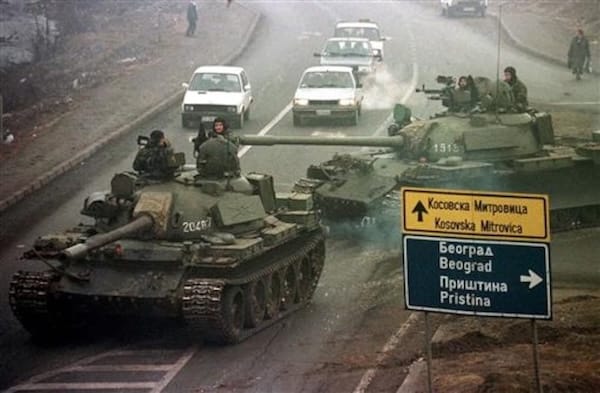
After Tito died in 1980, Serbian Communist leader Slobodan Milošević rose to power. He was a strong nationalist, pushed for Serbian majority control, and began to exclude other ethnic groups from the political processes. As the Soviet Union collapsed, member states within the Yugoslavian Republic began to seek independence from external control, particularly that of Milošević. He would use Serbia's military strength in an attempt to maintain unity, but the effort was unsuccessful. The resulting conflicts between 1991 and 2001 were marked by nationalism, ethnic conflict, violence, and genocide. When the dust settled, Yugoslavia was dissolved, and the United Nations recognized seven independent countries: Bosnia and Herzegovina, Croatia, Kosovo15, Montenegro, North Macedonia, Serbia, and Slovenia.
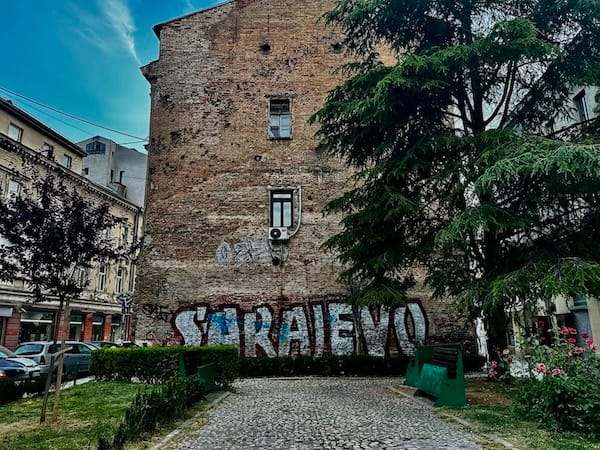
The challenge in the region is that these Baltic Nations were created around specific ethnic groups. Nationalism, by its very nature, complicates life for those in the minority. Wartime violence, primarily when directed against "non-nationals," leads to forced displacements. Hundreds of thousands of lives were lost in the above wars, and millions were displaced. Most sought refuge, often moving to areas where their ethnic group predominated. As a result, entire regions became mono-ethnic, harbored anger for past offenses, and remained resistant to incoming immigrant populations.
Tensions remain high, particularly in areas like Bosnia-Herzegovina and Serbia. In Bosnia for example, three predominant ethnic groups have established distinct lines of demarcation.16 A similar situation exists in Serbia, where the province of Kosovo recently declared independence. Throughout the region, nationalistic sentiments are palpable. Peace is maintained only if nationals understand their place and do not cross territorial or cultural boundaries. Non-nationals are welcome to pass through as long as they do not stay for very long.
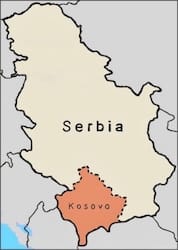
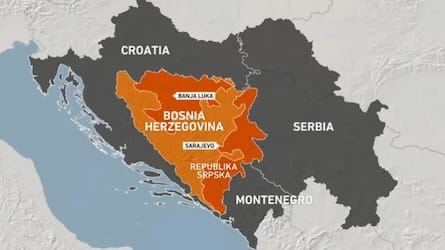
Ethnic Divisions Within Serbia and Bosnia
Nationalist to EU
In the years following the fall of the Soviet Union, many of the former communist bloc countries negotiated to join the European Union, mainly due to the economic advantages. In 2004, eight central and eastern European countries, including Slovenia, became EU members. Bulgaria joined in 2007, and Croatia followed in 2013. Today, Albania, Bosnia and Herzegovina, Serbia, and Kosovo are candidates for EU membership. However, joining the EU requires these countries to establish systems for protecting the rights of minority ethnic groups.17 Such is easier said than done.
The Schengen Agreement, signed in 1985 and implemented in 1995, allows for the free movement of EU citizens across internal borders. These open borders do not automatically apply to every member, particularly those who are new. Every EU admission must meet certain conditions to be included in the Schengen Area. Croatia joined the Schengen Area in 2023, with Bulgaria and Romania joining on January 1, 2025. They are now the new border countries. As we will explore in our next post, this will impact the landscape of the Western Balkan Migration Route.
Conclusion
Historical introductions are just that… introductions. It is not uncommon to see a news account of migrants passing through Serbia and facing abuse at the Hungarian border. If you are studying African migration, it might seem odd that migrants would go from Turkey to Bosnia and Italy rather than take a shorter route through Serbia. Unless you are just a geo-political wiz, understanding what is happening can be challenging. And yet, our goal is to understand.
This introduction is designed to provide more than just information; it seeks to provide a context that will make the next post more meaningful. So, if you have made it this far, let me summarize a few takeaways.
- The Balkans have been a transit route for thousands of years. Water takes the path of least resistance; if a historic river channel is in place, it will follow that path. There are long-established migrant routes through the region, with corresponding support systems. Smuggling networks are deeply embedded, following centuries-old economic pathways.
- The Balkans have been a land of conflict throughout its history. The people understand displacement, and they bear the recent scars of subjugation, separation, suffering, and sorrow. Thus, they have compassion for the migrants who pass through their space.
- The Balkans are intensely nationalistic. While over a dozen ethnic groups live side by side in the region, they maintain their homogeneity and do not intermix easily. They are agreeable to the arrival of immigrants… as long as they keep moving and their passage remains profitable.
- Integration into the EU ecosystem will be complex for member Balkan states. Being on the edge of the EU will make them attractive to immigrants, require substantive levels of border control, and require a capacity to offer support to refugees. For the Balkans, managing migration will take a complete paradigm shift from the past.
And so... you now have an introduction to the final leg of the Eastern Mediterranean Route. In our next post, we will dive deeper into the contemporary migration challenges of the Balkans.
1 See 2 Timothy 4:10
2 Epictetus and Thomas Wentworth Higginson, The Works of Epictetus. Consisting of His Discourses, in Four Books, the Enchiridion, and Fragments, A new and rev. ed. (Boston,: Little, Brown, and Company, 1890), 226.
3 Dmitry Voyakin, "The Great Silk Roads", UNESCO https://en.unesco.org/silkroad/content/great-silk-roads (accessed January 2, 2025).
4 Charles Frazee, "Between East and West: The Balkan Churches in the First Christian Centuries", Metropolitan Andrey Sheptytsky Institute for Eastern Christian Studies https://sheptytskyinstitute.ca/wp-content/uploads/2020/10/Star-from-the-East-The-Balkan-Churches-in-the-First-Chirstian-Centuries.pdf (accessed January 2, 2025).
5 "Ancient Times and the Early Christian Period", croatia.eu https://croatia.eu/index.php/en/home-en/history/ancient-times-and-the-early-christian-period. See also Jenõ Szűcs and Julianna Parti, "The Three Historical Regions of Europe: An Outline," Acta Historica Academiae Scientiarum Hungaricae 29, no. 4 (1983): 4. And, John Allcock and Loring Danforth, "The Ottomans of the Balkans", Britannica https://www.britannica.com/place/Balkans/The-Ottomans (accessed January 2, 2025).
6 Jarus Owen, "Byzantine Empire: Map, History and Facts", LiveScience https://www.livescience.com/42158-history-of-the-byzantine-empire.html (accessed January 2, 2025).
7 Georgios Giannakopoulos, "Five Things You Need to Know About the Ottoman Empire", The Conversation https://theconversation.com/five-things-you-need-to-know-about-the-ottoman-empire-192137 (accessed January 2, 2025).
8 "Roman Empire", Wikipedia https://en.wikipedia.org/wiki/Roman_Empire (accessed January 2, 2025).
9 Francis Trix, "Islam in the Balkans", Encyclopedia.com https://www.encyclopedia.com/religion/encyclopedias-almanacs-transcripts-and-maps/balkans-islam (accessed January 2, 2025).
10 Talha KÖSEOĞLU, "Politics of Sufism in the Ottoman Empire: A Comparative Analysis," Bellek Journal of Hatay 2 (2022).
11 Michael Ray, "Balkan Wars", Britannica https://www.britannica.com/topic/Balkan-Wars (accessed January 2, 2025).
12 Richard Crampton and John Allcock, "The Great Depression", Britannica https://www.britannica.com/place/Balkans/The-Great-Depression (accessed January 2, 2024).
13 Photo Courtesy of Radu Sigheti, "The Kosovo War", Reuters https://www.reuters.com/news/picture/the-kosovo-war-idJPRTXBQBD/ (accessed January 2, 2025).
14 James Robinson, "The Life and Death of Yugoslav Socialism", Jacobin https://jacobin.com/2017/07/yugoslav-socialism-tito-self-management-serbia-balkans (accessed January 2, 2025).
15 Kosovo declared independence from Serbia in 2008. While recognized by the United Nations, Serbia contested its independence.
16 Mersiha Gadzo, "Why Is ‘Republika Srpska Day’ Controversial in Bosnia?", AlJazeera https://www.aljazeera.com/news/2023/1/9/why-is-republika-srpska-day-controversial-in-bosnia (accessed January 2, 2025).
17 EUR-Lex, "Countering Racism in the Candidate Countries", European Union https://eur-lex.europa.eu/legal-content/SV/ALL/?uri=LEGISSUM:l33087 (accessed January 2, 2025).