99 - The UK Route: One Journey from Waiting to Worship
How blessed is the man whose strength is in You, in whose heart are the highways to Zion! Passing through the valley of Baca they make it a spring; the early rain also covers it with blessings. They go from strength to strength, every one of them appears before God in Zion.
–Psalm 84:5-7
2026 – No. 99
Our journey into the Northern Routes will have to be brief. I am convinced we could devote a dozen posts to this subject and still only begin to scratch the surface. My goal here is more modest. I want our readers, who already keep their finger on the pulse of global migration, to be reminded of how and why people make these secondary decisions to move to the UK. And I want them to notice what God is doing in and through them along the way.
Psalm 84 describes people whose strength comes from God, individuals who carry “highways” in their hearts. They go through dry valleys and somehow find springs there. It is a song of pilgrimage, written for those still on the journey. Those who have not yet arrived… but are moving with purpose. That language resonates deeply with the Northern Routes.
By the time we left our previous post, you should have had a clearer picture of these secondary movements.1 At its core, the story is not complicated. People have grown tired of waiting. Many have become convinced that building a future where they are has become impossible. Even those who have been granted refugee status in France often find themselves stalled by daily realities and conclude that movement, however risky, feels more hopeful than staying.
Their questions evolve over time. Initially, they focus on arrival and safety, then shift to broader concerns about life. “How do I live here?” “How do I build a life?” “How do I raise a family in this place?” These are not merely theoretical questions. They are practical and personal. When these questions go unanswered for extended periods, a quiet sense of discouragement gradually takes hold.
In many ways, the French state supports onward movement. Migration, particularly undocumented migration, continues to challenge social systems and administrative resources. Although authorities might not actively encourage people to leave, their policies and practices often unintentionally make it harder for individuals to see a reason to stay.2
Since news about the channel crossings from France to England is so widespread, adding another report here might not add much new information. Instead, it might be more meaningful to tell a story. What you’ll read next is really a blend of several stories. This approach helps us present the full picture and keeps identities secure. What I’m sharing comes straight from our fieldwork and many conversations with men and women on both sides of the Channel. These aren’t just stories or facts… they’re real journeys.
And together, we’re now stepping onto this shared path.
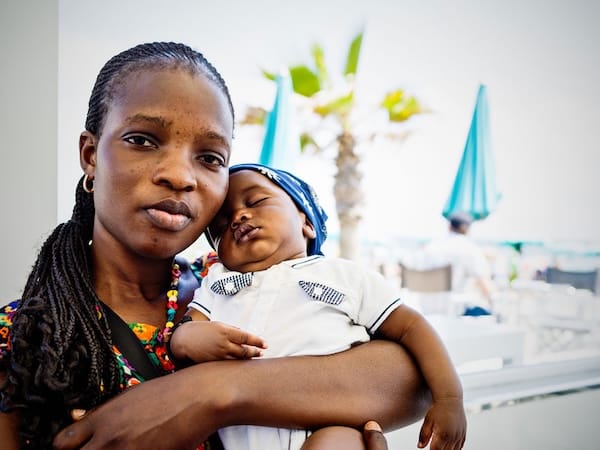
Life Between Camps and Crossings
I want you to meet Anna.
Anna is a young woman who traveled from northern Nigeria to Senegal, then through the Canary Islands, into Spain, and finally to France. As a Christian, she qualified for refugee status due to the violence faced by believers in her home region. The journey was long and exhausting, filled with uncertainty at every step. It eventually brought her to a place she hoped might allow her to start anew. France.
She was assigned housing in Lille, a large city in far northwest France. At first, things seemed manageable. She received a small stipend, a work permit, a housing subsidy, and access to French language classes. For nearly two years, she navigated daily life as best she could, learning to adapt to a new culture. Along the way, she felt the quiet weight of isolation that often comes with displacement. Progress was slow, but it seemed possible.
Over time, the support she relied on started to dwindle. Financial aid suddenly stopped one day. Finding a good job was hard, and the language barrier remained a persistent challenge. Anna moved in with a young man. It wasn't a decision she felt at peace with, but she believed she had very few options. When she became pregnant, the relationship quickly fell apart. The father chose to leave rather than accept responsibility for her or the child.
France had provided Anna with safety, but it hadn’t offered her a community. The Nigerian population there is small and dispersed, and she struggled to find people who shared her language, faith, and sense of home. In contrast, England… just across the channel… was a place her friends spoke about with familiarity. Several had moved there, joined churches, and begun rebuilding their lives. They were not alone. According to most estimates, nearly 275,000 Nigerians now live in the UK.4 Over time, Anna’s desire to move was driven by a longing to belong somewhere again.
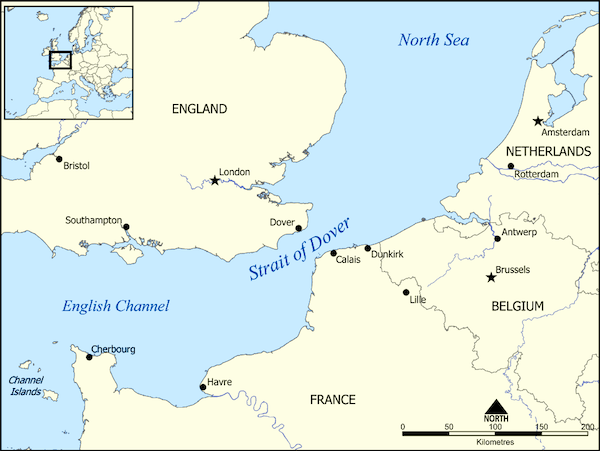
The Crossing: Risk, Routine, and Reality
Reaching the UK from Lille is not especially difficult. Each year, many thousands attempt the journey across the English Channel. Along the way, there are individuals who promise to manage the logistics of the crossing. They are not hidden figures. They are easy to find... especially online.5
But not all are there for the Africans.
In practice, there are two main smuggling networks operating along the northern French coast. One network launches boats from the area around Dunkirk. These routes are typically controlled by Iraqi-Kurdish criminal groups and primarily serve migrants from Iraq, Syria, Afghanistan, and parts of East Africa. The operations are tightly organized, often coordinated through Belgium, and maintained through intimidation and... at times... violence.6 Their cost reflects that control, and many recent crossings now depart from this same stretch of coastline.
The second network operates further south, in the rural areas surrounding Calais, roughly 30 miles south of Dunkirk. Here, the arrangements tend to be more informal, relying on looser ethnic and social networks. This is where many sub-Saharan Africans attempt the crossing.7 The price difference is noticeable. Crossings from the Calais area are often reported to cost between € 1,000 and € 2,000, while more tightly controlled routes operating out of Dunkirk commonly charge between € 3,000 and € 5,000.8
Most migrants travel long distances to reach these launch zones and stay in smuggler-controlled camps while waiting. When conditions appear favorable, they are quietly moved toward the coast and then transferred to boats for crossing.
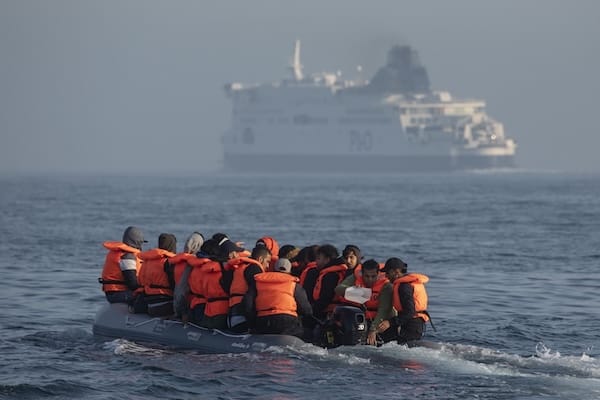
The vessels used are almost always large inflatable rafts, commonly sold for recreational use… never designed for open-sea travel. A small outboard motor is attached, along with a basic fuel supply, sometimes supplemented by an extra tank secured to the floor. Depending on the raft, thirty to sixty people may be packed along the edges or crouched in the center.
Launches rarely occur from harbors. More often, they take place at night or in the early morning, along quieter stretches of beach. People are instructed to wade into the water and climb aboard. In some cases, the raft is pushed off by hand. In other cases, it is launched farther out and collects passengers already standing in the surf. The priority is to avoid detection rather than to ensure safety. Once the motor starts, the raft turns north and moves steadily into open water.10
Out on the Channel, the crossing reveals its fragility. The rafts sit low in cold water, drifting through strong currents and busy shipping lanes with minimal equipment. Boats can deflate, take on water, or capsize when conditions change. Overcrowding increases the risk of panic, and cold temperatures quickly lead to exhaustion or hypothermia when people fall into the water. Most boats lack radios, navigation tools, or enough life jackets, forcing rescue services to respond under very difficult conditions. In 2024, at least sixty-nine people are known to have died trying to make this crossing, making it the deadliest year on record for the Channel.11
How many are unofficially lost remains unknown.
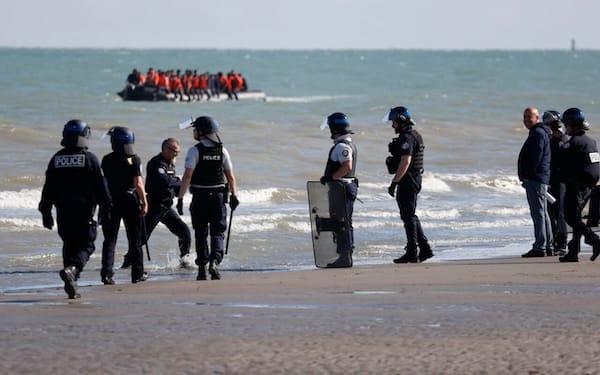
French police maintain a constant presence along the coast. They patrol forests and beaches, dismantle camps, block access roads, and intervene when boats are being prepared on shore. Engines may be confiscated, and rafts deflated before launch. Once a boat enters the water, however, their authority essentially ends. Police do not pursue vessels at sea, and enforcement typically stops at the water’s edge. The result is a pattern in which crossings are delayed and redirected rather than prevented, with departures shifting to quieter beaches and darker hours.
Other helpful videos in this footnote. 13
Arrival Without Resolution
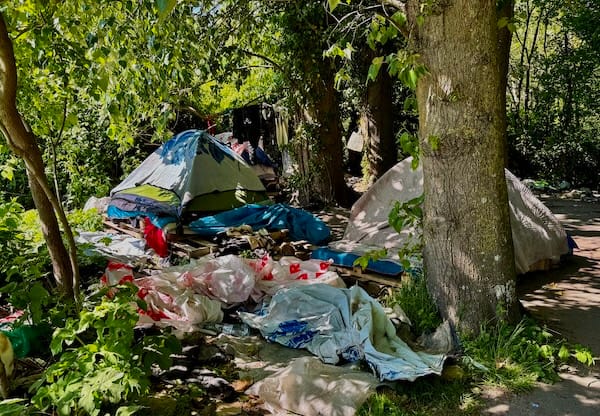
Because Anna lived in Lille, she did not have to move into a camp. That mattered... especially as a woman with a small child. Camps are harsh places, and she knew they would not be safe for a baby. We have been in those camps and can attest to their primitive nature and their danger.
Through a friend, Anna was introduced to a smuggler. They met and settled on a price. The cost would be 1,800 euros for her and the baby. He would arrange transportation from Lille on the day of the crossing and assured her it would be safe. Anna was aware of the stories and the risks, but she also felt her options were shrinking. Over time, she collected the money through small contributions from friends, help from family back home, and the sale of what little she owned. When she finally had enough, she called the smuggler. A date was set. If the weather cooperated, she would leave in three days.
One important detail to understand is that this was not Anna’s first time in a boat. Earlier in her journey, she had crossed from Senegal to the Canary Islands. That Atlantic route is among the most dangerous in global migration, and we have written an entire series on the Western Migration Route because of it.14 Survivors consistently speak of fear, exhaustion, and the loss of life they witnessed along the way. In 2024 alone, roughly fifty thousand people made that journey to the Canary Islands.15 Those who survive it carry that experience with them.
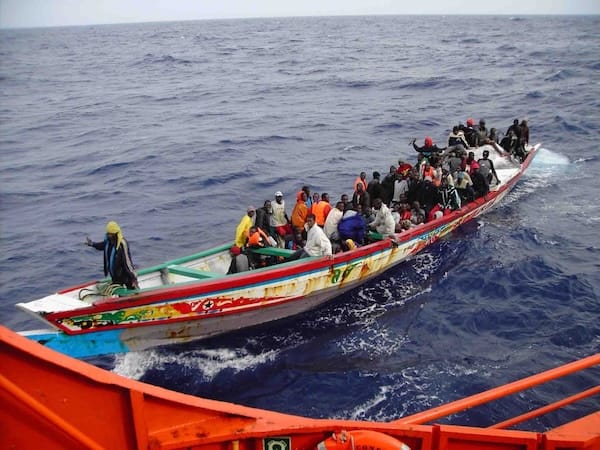
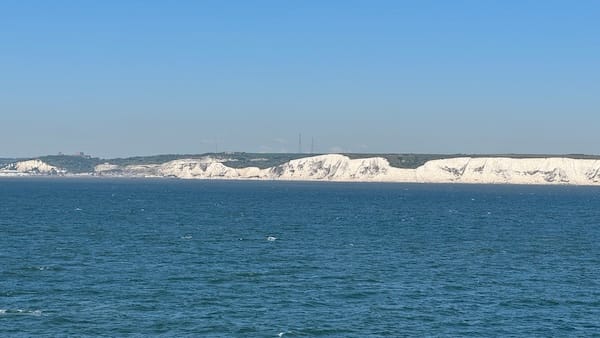
Because of that history, warnings about the English Channel's dangers often land differently than people expect. For someone who has already spent a week or more at sea, witnessing others fall ill or die on a voyage of nearly a thousand miles… a crossing of roughly thirty miles to the UK does not feel like the same kind of risk. Standing in Calais, you can see the white cliffs of Dover. Anna was not careless. She respected the sea and understood its dangers, but she did not approach the Channel with the same fear she once had of the Atlantic.17
She left Lille on a Friday evening. As planned, a car arrived to take Anna and her baby north toward Calais. The drive only took a few hours. She was taken to a warehouse outside the city, which served as a temporary gathering point. She had packed warm clothes for both of them, and once they were dressed, they joined a group of about twenty others. Most were men. Their backgrounds surprised her. Many came from East Africa: Somalia, Eritrea, Sudan, and Ethiopia. Only a few were from West Africa; most of them were from Ghana.
Later that night, around ten o’clock, they were loaded into three trucks and driven toward the coast. The destination was Oye-Plage, just north of Calais. When they arrived, they joined another group of about thirty people. It was a dark, moonless night. She could only see outlines of people moving through the dunes, lit occasionally by flashlights. On the beach, a raft was already waiting. Because she was traveling with a baby, she was placed near the front, closer to the middle of the boat. She was told this position would be more stable and less exposed to wind and spray.
What stayed with her was the presence of the police. She could see them on the dunes above the beach, their lights visible in the distance. They did not intervene. One of the men near her said quietly that nothing would happen, that the police were only watching. He said that they were glad to see the Africans leave. Whether or not that explanation was fair, the result was the same. The boat was allowed to launch.
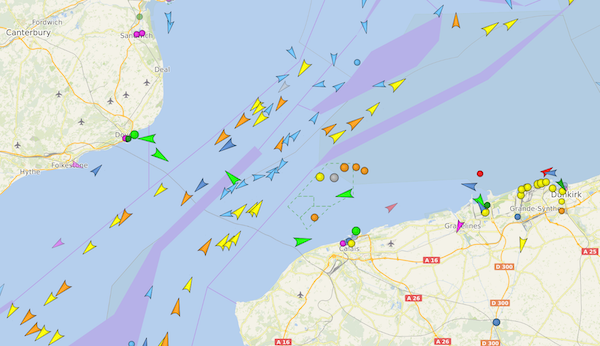
They were told the crossing would take about eight hours. In practice, it often takes longer. The English Channel appears narrow on a map, but it is one of the busiest shipping corridors in the world. On an average day, approximately 500 commercial vessels pass through these waters.19 Large cargo ships, ferries, and tankers travel constantly in established lanes, leaving little flexibility for small boats. For those in inflatable rafts, this means sharing the water with vessels that move faster, sit higher, and may never see them.20 The rafts often slow or stop to allow ships to pass, which stretches the crossing and adds to fatigue.
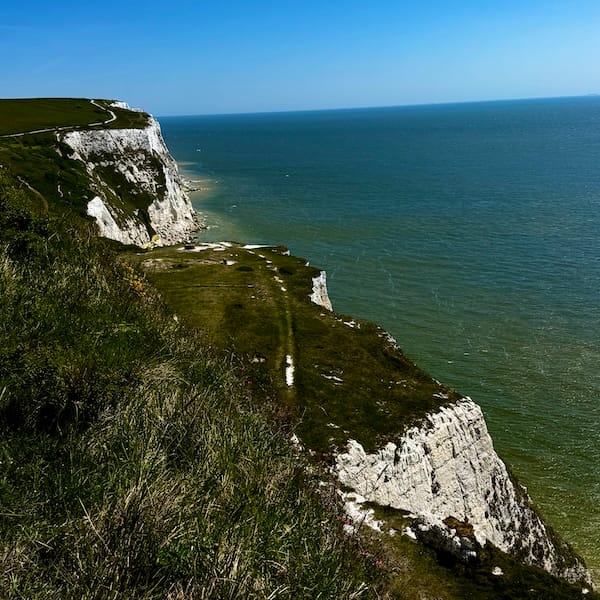
There is another common misunderstanding about these journeys. The boats are not really trying to land on English beaches; they only aim to reach English waters. The coastline is steep, rocky, and closely monitored, with very few spots where a small raft can come ashore safely. The boats themselves are not designed for controlled landings. They carry minimal navigation gear and are often launched with just enough fuel to reach the edge of UK territorial waters. Once that boundary is crossed, the journey typically ends. The raft is detected, or a distress call is made, and the situation shifts from movement to rescue. Passengers are transferred to official vessels and brought ashore through a port, most often Dover. For those on board, “arrival” usually means interception at sea rather than stepping onto land.21
Faith Before Resolution
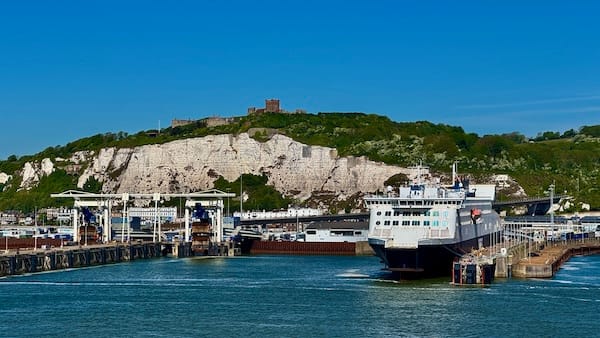
That's what happened to Anna. The sea was calm, and the crossing was fairly smooth. After about six hours on the water, they were spotted. It took longer for help to arrive. They boarded a rescue boat, and then they were transported to Dover.
Once ashore, individuals are taken to a short-term processing center near the port. There, basic identity checks are performed. Names are recorded, fingerprints and photos are taken, and medical needs are evaluated. For many, this is the first time in days or weeks that they are warm and indoors. The process can last several hours and is rarely seen as welcoming. It is organized, yet impersonal.
Most people are then processed into the asylum system. Some are transferred on the same day to initial accommodations, often government-contracted hotels spread across the country. Others may spend a brief period in holding facilities before being moved again. Families are generally kept together, but placements are determined by availability rather than preference. Consequently, people are frequently sent to unfamiliar locations, far from the communities they hoped to join.
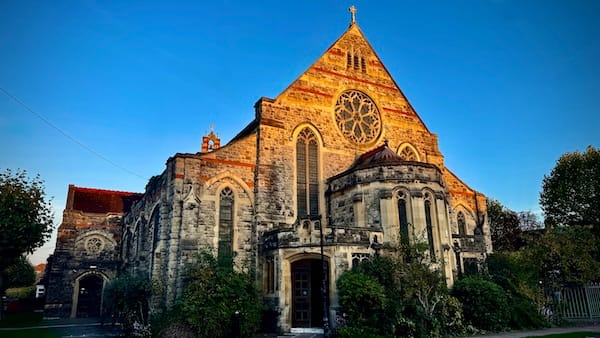
Anna’s experience was different. She had friends in the UK, including a cousin who came to meet her. Instead of being sent to a hotel, she left Dover with her family and took the metro to Harrow, a suburb of London. She moved in with her cousin, at least for a season. The very next Sunday, she was in church, surrounded by other Nigerians. For the first time in two years, she felt something she hadn’t felt since leaving home. It was not certainty, and it was not resolution, but it was a sense of being welcomed. It finally felt like the beginning of home.
Conclusion
Here's the challenge of telling the story of the Northern Route, especially when it's reduced to images of small boats and breaking news headlines. The crossings attract attention because they are dangerous, visible, and politically charged. But behind every statistic is a human life shaped by waiting, loss, and the hope that life might start to move again. What seems reckless from a distance often feels, up close, like the only way forward.
Psalm 84 provides words for this kind of journey. It describes people who carry the road within them, people whose strength isn't in reaching the destination but in God Himself. They go through the valley of Baca, a place of dryness and sorrow, and somehow find springs there. The psalm doesn't deny the hardship of the valley... it simply affirms that God encounters His people there.
Anna’s story reflects that truth. Her journey did not end when she reached England. It continued through processing centers, temporary arrangements, and uncertain next steps. And yet, before anything was resolved, something deeper took shape. Friends and family welcomed her. She found community at church. She moved, as the psalm says, from strength to strength… not because the road was finished, but because God was present on it.
Most of us understand that longing, even if our paths look different. We are all, in our own ways, people on the road… searching for places where life can be built, where effort leads somewhere, and where waiting does not feel endless. The difference is not the desire itself, but it is the valleys we are asked to cross and the options available to us along the way.
In the next post, we will follow a quieter northern route. It does not cross open water and seldom makes the news. It moves through forests, frozen borders, and forgotten crossings… from Africa into Russia, through the Baltic states, and north into Finland. It is another pilgrimage marked by waiting and movement, loss, and faith. And once again, it will remind us that the highways God places in human hearts often run through valleys before they ever lead to Zion.
1 See M. Augustus Hamilton, "98 - Northern Routes: Why the North Becomes a Second Choice," M2M3, accessed Feb 13, 2026. https://m2m3.org/blog/98-northern-routes-why-the-north-becomes-a-second-choice/
2 Andrew Harding, "Cross-Channel Migrant-Smuggling Gang Exposed by Undercover Filming," BBC News, accessed 12/16/2025. https://www.bbc.com/news/articles/cly48nmmzdro.
See also, Sophie Watt, "Channel Crossings: Life in “Microcamps” on the French Border, and How They Are Changing Crossing Attempts," accessed 12/16/2025. https://theconversation.com/channel-crossings-life-in-microcamps-on-the-french-border-and-how-they-are-changing-crossing-attempts-260843.
3 Julila Behrman, "African Women Who Migrate to France Have Fewer Children," accessed 12/22/2025. https://www.ipr.northwestern.edu/news/2022/african-women-who-migrate-to-france-have-fewer-children.html.
4 2021 Census Statistics — Nigerians in the UK (Office for National Statistics, 2023).
5 Peter Walsh and Mihnea Cuibus, People Crossing the English Channel in Small Boats (Migration Observatory, University of Oxford, 2025), https://migrationobservatory.ox.ac.uk/resources/briefings/people-crossing-the-english-channel-in-small-boats/.
6 Harding,
7 Sophie Watt, "I’ve Spent Time with Refugees in French Coastal Camps and They Told Me the Government’s Rwanda Plan Is Not Putting Them Off Coming to the UK," The Conversation, last modified 2024/03/27, accessed 12/16/2025. https://uk.news.yahoo.com/ve-spent-time-refugees-french-095420415.html.
8 Harding and Watt,
9 Luke Evans, "The Path to the Small Boats Crisis Is Littered with Death," last modified 2023/11/22, accessed 12/22/2025. https://www.opendemocracy.net/en/beyond-trafficking-and-slavery/the-path-to-the-small-boats-crisis-is-littered-with-death-uk-france-migrants/.
10 Dan Sabbagh, "Dinghies at Dawn and a Determination to Arrive: On the French Coast Waiting to Cross to UK," 2025/07/10, 2025, https://www.theguardian.com/uk-news/2025/jul/10/dinghies-at-dawn-determination-french-coast-channel-crossing.
11 Refugee Council UK, "Refugee Council Calls for Decisive Action as Record Number of Channel Deaths Reached in 2024," The Refugee Council of the UK, accessed 12/16/2025. https://www.refugeecouncil.org.uk/stay-informed/statistics-and-research/deaths-in-the-channel-what-needs-to-change/.
12 Pascal Rossignol, "French Police Watch Migrants Leave Normandy for Britain," accessed 12/22/2025. https://www.telegraph.co.uk/news/2024/07/11/french-police-watch-migrants-leave-normandy-channel-britain/.
13 ARTE.tv Documentary, “UK: Migrants in the Channel,” YouTube video, 42:32, posted February 7, 2024, https://youtu.be/EQ5hJEkUsh0
ITV News, “ITV News Filming Shows the Scale of Channel Crossings,” YouTube video, 4:03, posted by ITV News, May 1, 2024, https://youtu.be/nKP_Tt5pYTQ?si=CSX5FjJ25Waac8I6
ARTE.tv Documentary, “UK: Migrants in the Channel,” YouTube video, 42:32, posted February 7, 2024, https://www.youtube.com/watch?v=FcP3nnQzXhc
Andrew Harding, "Small Boats Documentary, Small Boats — Life and Death on the English Channel," BBC / YouTube, accessed 12/16/2025. https://www.youtube.com/watch?v=TDEpDTHxvQQ.
14 See M. Augustus Hamilton, "40 - Introduction - the Western Route," M2M3, accessed April 8, 2023. https://m2m3.org/40-introduction-the-western-route/.
15 Frontex, "Migratory Routes," Frontex, accessed 12/16/2025. https://www.frontex.europa.eu/what-we-do/monitoring-and-risk-analysis/migratory-routes/migratory-routes/.
16 Marion MacGregor, "Canary Islands: More Migrants Risk Deadly Atlantic Route," last modified 2022/04/05, accessed 12-22-2025. https://www.infomigrants.net/en/post/39667/canary-islands-more-migrants-risk-deadly-atlantic-route.
17 Ross Cranston, "Channel Crossing Accident: Transcript of Day 1 – Monday, 3 March 2025," The Cranston Inquiry, accessed 12/16/2025. https://cranston.independent-inquiry.uk/transcript/day-1-3-march-2025/.
18 VesselFinder, "Vesselfinder," accessed 12/22/2025. https://www.vesselfinder.com/.
19 Guinness World Records, "Busiest Shipping Lane," accessed 12/16/2025. https://www.guinnessworldrecords.com/world-records/busiest-shipping-lane.
20 Cranston,
21 Migration Watch, "Channel Crossings Tracker," Migration Watch U. K., accessed 12/16/2025. https://www.migrationwatchuk.org/channel-crossings-tracker.
22 H. M. Chief Inspector of Prisons, Report on an Unannounced Inspection of the Short-Term Holding Facilities at Western Jet Foil, Lydd Airport and Manston (25–28 July 2022) (London: HM Inspectorate of Prisons, 2022), 3–13, https://tinyurl.com/37wce7y2.
See also, David Neal, An Inspection of the Initial Processing of Migrants Arriving Via Small Boats at Tug Haven and Western Jet Foil (London: Independent Chief Inspector of Borders and Immigration, 2022), 9–14, 17, https://tinyurl.com/3kx7k7nf.
See also, Watt, "Channel Crossings: Life in “Microcamps” on the French Border, and How They Are Changing Crossing Attempts."