M-Moments: Ministers Without a Map
Therefore, those who had been scattered went about preaching the word. —Acts 8:4
Rethinking Theological Education in the Diaspora Age
The twenty-first century has become the century of human movement. More people are on the move now than at any point in human history, whether driven by war, labor, education, or a heartfelt desire for a better life. Many of these migrants are believers, and increasingly, churches are being planted not in traditional centers of power but in transit zones, immigrant neighborhoods, and refugee camps. These are the new diaspora churches.
Diaspora churches are not peripheral; they are central to the unfolding story of global Christianity, dating back to Acts 8. They are led by pastors and missionaries who themselves are migrants… many of whom never set out to become ministers. Their spiritual journeys and pathways into leadership defy the categories that have historically defined a call to ministry, thereby creating unique challenges in theological education.
Global theological institutions now face a pressing challenge: how to provide resources to leaders who are already leading, planting churches, and bearing gospel fruit… without having gone through the traditional processes that modern theological education was designed to serve.
The Traditional Model of Formation and Sending
The traditional evangelical model for ministerial formation is biblical, pragmatic, and effective. One can easily trace the journey along a spiritual timeline with designated responsibilities. The local church is expected to guide the processes of salvation, discipleship, and ultimate spiritual maturity. They are called upon to validate a call to ministry… and to recommend forward movement. The larger church body then takes responsibility for theological education, ordination/commissioning, and introduction into the world of vocational ministry.
Traditional theological institutions are integrated into the process of ministry preparation—offering training at the precise moment when students are ready, affirmed, and prepared to study.
In this model, ministerial candidates are always looking forward, seeking to complete the next step in the journey. They know that as in football, you cannot score a goal if you cannot advance the ball downfield, one first down after another.
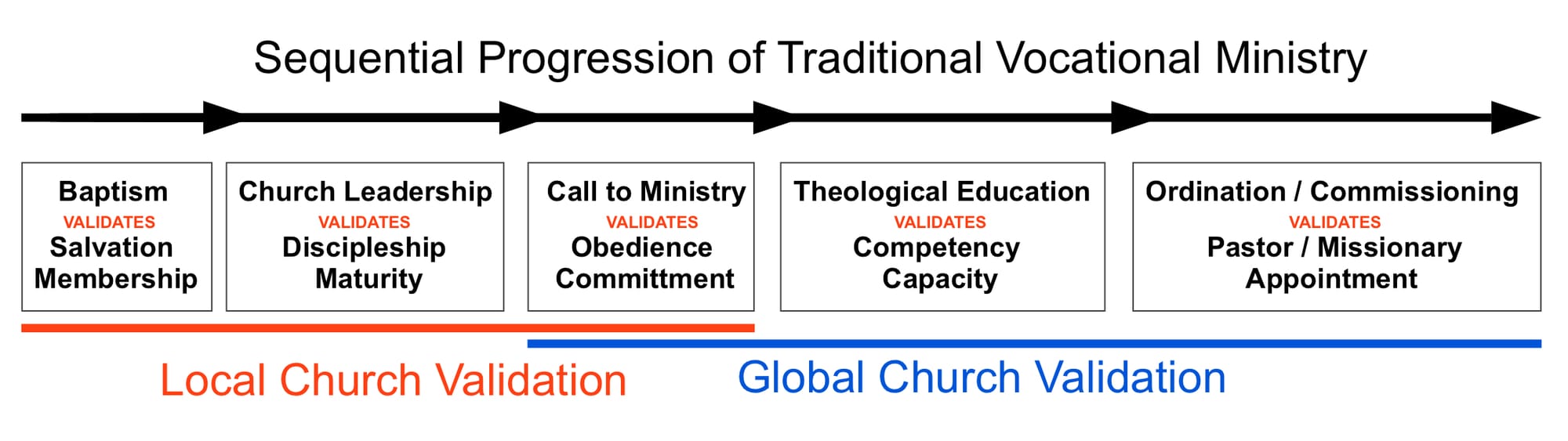
This system works because it assumes stability: a stable church, a stable call, a stable community to nurture and affirm gifts, and a stable institution to train. The pathway is sequential, gradual, and relationally rich. It holds tremendous advantages:
- Biblical progression from salvation to service.
- Church-based affirmation and accountability.
- Access to world-class theological instruction.
- A structured environment for developing doctrine, ethics, and ministry skills.
However, this model, despite its strengths, assumes a progressive and sequential history. And in diaspora contexts, such history is the exception, not the norm. I have spent extensive time in that world, and I would like to give you a view from the other side.
The Diaspora Model—Formation in Reverse
For diaspora pastors and missionaries, ministry often begins long before preparation. In many cases, these leaders don’t pass through the structured stages of discipleship and formal training. Instead, they come to faith while on the move… through trauma, in camps, over encrypted phone calls, or by the witness of a fellow traveler. Their growth is informal, fragmented, and often lonely.
Even among those who left home as believers, very few had the privilege of a solid Christian upbringing. Many came out of spiritual weakness and immaturity. Along the way, their faith grew stronger, and their care for fellow believers became a burden on their hearts. They may have come from legacy church structures where strength was found in denominational numbers, but they now find themselves in spiritual deserts… spaces where all believers must gather, regardless of ethnic or denominational lines.
The call to ministry for diaspora pastors and missionaries emerges not from church affirmation, but from God’s pragmatic nudging in the midst of the urgent needs around them.
They begin preaching, pastoring, and planting churches out of necessity. And only later… sometimes years later… do they realize they are ministers. At that point, they find themselves leading communities without a sending church, without theological training, and without denominational support.
This model is not inferior. It is reactive, contextual, and Spirit-driven. But it also presents an enormous challenge as these leaders try to catch up on everything their Western counterparts were given at the outset. They lack:
- A nurturing church during their spiritual infancy.
- Ecclesial recognition or mentoring of their gifts.
- Access to theological instruction in their language, context, and along a structured timeframe.
- A network of peers that affirms their legitimacy and equips their long-term ministry.
Western educators must not pity these leaders… but they should respect them. Additionally, they must acknowledge the reality that the traditional model of ministerial development does not always apply in diaspora contexts.
The Challenge Facing Traditional Theological Education
Western theological institutions are extraordinarily effective within the framework they were designed to serve. They have contemporary delivery models, manageable financial structures, and integrated support systems. But all of these are built on a hidden assumption: that students are entering from within an established church pipeline.
What modern seminary would not require a statement of faith and evidence of calling for admission? Most require letters of reference from the Christian community to attest to their moral character. Transcripts, writing samples, doctrinal affirmations, and language proficiencies must all be in order. And then, there are the financial commitments.
Those who cannot meet the standard are often asked to take a step back and spend more time in the pipeline, and to try again later. Why? Because in a traditional construct, each of these elements are necessary and the sequence is highly valued.
Diaspora leaders, however, are not in that pipeline. They’re already in the field. They are not aspiring students—they are functioning ministers.
Diaspora pastors see the traditional “game” through a different lens. For some, it’s a playbook they’ve never studied. For others, it’s a game with different rules altogether. What looks like progress to them may be disqualified by a referee outside their world enforcing unfamiliar lines and formations.
For these pastors, the entry points to theological education feel alien, inaccessible, and at times, irrelevant. The problem is not that they don’t want to deepen their theological formation. The rub is that the current system assumes they have met the preconditions, and often treats them as if they are novices to the ministry.
The academy must recognize:
- It is very difficult to reverse engineer pastoral/missional formation.
- The need for theological education is real. But for most it is not a “next” step. It is just one of many components, and possibly not the highest priority.
- These ministers cannot be pressed into a traditional mold. Relabeling existing models as “non-traditional” does little to change the underlying challenges. New processes must be developed to fully equip these servants for the work.
Let me be clear. Traditional institutions don’t need to abandon their models, they must expand them. They must create “pre-entry” on-ramps that meet diaspora leaders where they are… already in the trenches. The offerings must provide what many of them missed in the earliest stages of their spiritual journeys… in contextually relevant ways.
Conclusion: Framing the Problem, Not Solving It
In the West, when we say “football,” we picture helmets, first downs, end zones… a game of structure and strategy where progress is measured in yards. It is a linear game, moving in only one direction. Lack of forward progress represents either failure, or penalty. But for the rest of the world, “football” means something entirely different: fluid movement in both directions, improvisation, instinct, and goals that emerge from creative play.
Theological education has long been designed for one version of the game. But today, ministry is being played out on a global field… mostly with a round ball, often barefoot, typically with no referees (or coaches) at all. Most importantly, it is seldom linear. If we insist on enforcing one rulebook or style of play, we risk missing what God is doing.
The challenge before us is not to change the game, but to understand that multiple variants are being played, and the same Spirit is present on every field.
Traditional theological education is a major league opportunity for most. But, for the diaspora, it remains elusive. It must now undertake the challenging task of reimagining its approach to global ministry formation. That means shifting from academic thresholds to ministry partnerships, from assessing readiness to walking alongside, from waiting for students to apply to going and asking how we can serve.
This post does not offer a solution. It presents a mirror.
The diaspora church is not waiting. It is already growing. The West has much to offer, and the work of the Kingdom will be greatly enhanced by its contributions… particularly in the diaspora. The issue is not one of value. It is whether contemporary theological institutions will find a way to come alongside and whether they are willing to be changed in the process.
As this conversation continues, three questions may serve as starting points for reflection:
- Are we prepared to recognize and validate ministry formation that happens in the field before it ever enters our classrooms?
- What would it take for our institutions to release their role as primary arbiters of ministry preparation and instead step into the field as co-laborers… especially when that field challenges our assumptions?
- If God is already at work forming leaders in unexpected places, how can we faithfully come alongside, willing not just to support, but to be shaped in the process?
These are not rhetorical questions. They are invitations… to listen, to learn, and to perhaps play the game differently.