31 – A Journey Across the Desert
2022 No 31
He found him in a desert land, and in the howling waste of a wilderness; He encircled him, He cared for him, He guarded him as the pupil of His eye.
—Deuteronomy 32:10
In our last two posts, we examined three individuals who have illustrated the sub-Saharan context of migration. Two young men came from the Sahel region. One had been forcibly displaced, and the other was simply searching for a better life. We also looked at a recent nursing school graduate who was being trafficked out of Nigeria. All three have landed in Agadez, on the southern edge of the Sahara Desert, in northern Niger. In this post, I want to help you gain an understanding of what migrants experience during a desert crossing.
As noted in previous posts, trade routes between the Sahel and the Maghreb have existed for millennia. The ancient salt routes are ingrained into the culture of the Tuareg desert culture. There have even been efforts to create paved highways across the desert and into Algeria and Libya.1 There are sections of those routes that are complete, making the drive across the desert somewhat possible. The challenge is that these roads are also heavily patrolled, pushing clandestine transit along other, much more dangerous routes. These routes through the desert have been well documented and garnered much media attention over the years.² This is a well-informed article if you would like to learn more.
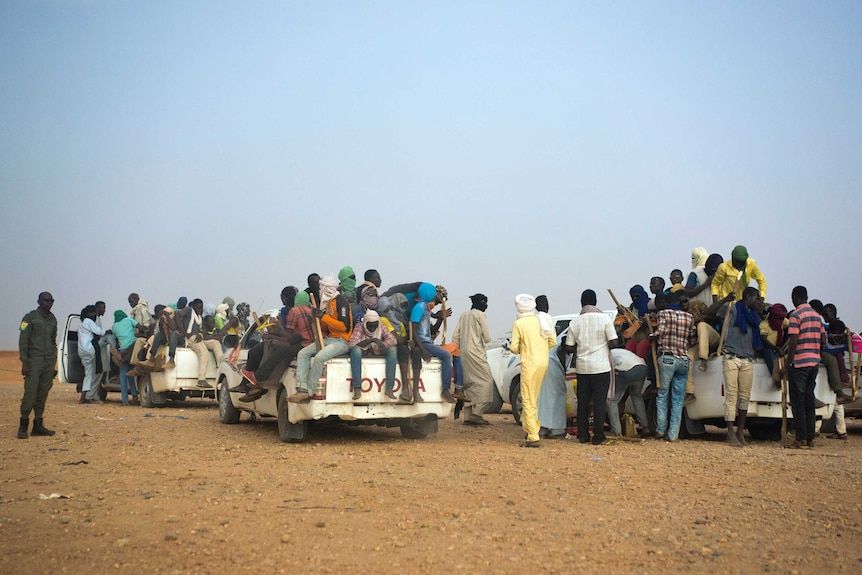
Twenty-Five People in a Hilux
A joke in West Africa asks how many people you can put in a bus. The answer is always "one more"! The same is almost true with the number of migrants you can put into the back of a Toyota pickup. After nearly two weeks of waiting, Abdoulaye, Mamadou, and Blessing were taken to a field outside Agadez.
It truly is hard to imagine what this leg of the passage entails. The typical desert vehicle is a Toyota, 4x4 Hilux pickup. The trip is expected to take 3-4 days and will cover over a thousand miles of desert. For a journey to be successful, there must be enough fuel for the truck and enough water for everyone on board. As one might imagine, those take up both weight and space. In the mind of a smuggler, one is necessary; the other is optional. They try to put 25 people in a truck to make as much money as possible. That means every vehicle leaving Agadez will not have enough water for the trip. They say people can live in the desert for three days without water. There may only be enough water for two days when the truck leaves Agadez to save weight.
The pickups typically travel in convoys. That is more for security than anything else. If one of the Hilux were to break down, there would be no room in the other trucks for the migrants. The driver will get picked up, but the migrants will be left to die. If someone falls out, they cannot stop to pick them up, and the other trucks have no room. They are left to die. The number of people lost in the desert cannot be calculated. Some estimate the number to be more than one out of five.3 How many that may be is unknown, simply because there is no way to know how many actually depart.
But let us get back to Abdoulaye, Mamadou, and Blessing. They arrived at the field of departure early in the morning. There were probably a dozen pickups, and buses were dropping people off. It was a bit of pandemonium. Drivers told people to get into different trucks in what seemed like random order. Men were mixed with women, and children were placed wherever there was a space… even if it meant separating them from their mothers. On average, there were 25 people for each truck. The people in the middle stood, and those on the edges sat with their legs hanging on the outside. They used sticks between their legs to hold them in the truck. The smugglers told them to interlock their arms and for those in the middle to hold on to the shoulders of those on the outside. They could only bring what they could carry in a small sack. Our three migrants were all in the same truck.
The average cost per migrant for the trip was around $150. Add it up, and that was about $50,000 total for this trip. Although the entire operation was illegal, the smugglers had more than enough money to pay the local authorities to look the other way. They left around 3:00 AM. There was a lot of ground to cover in a short time. The trucks drove very fast. Things were not too bad for those at the front of the line. But for those in the back, the dust kicked up by the other trucks was suffocating. When the sun rose, the temperatures rose to nearly 45 degrees Celsius. (115 Fahrenheit) The first day was excruciating.
The convoy occasionally stopped to refill their fuel tanks or swap out drivers. Such gave the passengers time to go to the restroom, stretch their legs and perhaps drink a little water. In Abdoulaye's truck, it was evident that some people were already in trouble. Even though there was water to drink, dehydration had weakened two men. They may have been sick before they left. People made room for them in the middle of the truck and tried to shelter them from the sun. But when the pickup stopped for the evening, they had both died. They buried their bodies in the sand and continued the trip.
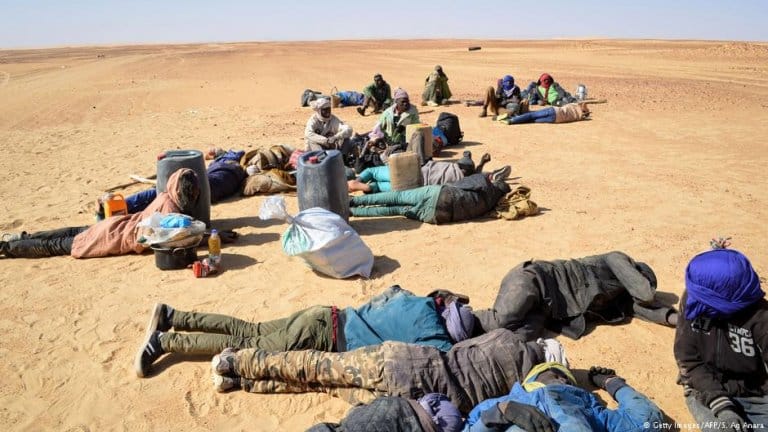
Trouble in the Desert
Sometime around midnight, their truck began to slow down. Soon they were at the end of the convoy, and the other trucks were getting further and further ahead. By morning, it was apparent that they were in serious trouble and that they had been left behind. The driver stopped the truck at the base of a sand dune to give it a little protection from the wind. One of the two drivers seemed to have had a lot of experience, and he tried to assure everyone that things would be ok. One of the migrants in the truck was a mechanic, and they soon found the problem. Sand had clogged the air filter, and some had even gotten into the engine. They were able to clear the filter, but the damage was already done. The truck didn't have enough power to catch up with the convoy. Abdoulaye suggested they pray, and they all asked God's mercy to see them across the sand.
Having Blessing in the truck was a true gift of God for Abdoulaye and Mamadou. After the prayer, she introduced herself to them and shared that she was a Christian and a nurse. She told them that the most important thing they could do was stay hydrated. But that was a problem. The supply of water on the truck was running low. The one driver told them that to survive, they would have to ration their water and take only enough to wet their tongues. He put a little diesel fuel in some of the water, also. He told them that this would take away their thirst. Someone suggested that they could put urine in their bottles to extend the water. In the end, however, everyone knew that they were in trouble. Blessing told Abdoulaye and Mamadou only to drink clean water and not drink their urine. Her counsel probably saved their lives.
There were still three more days of road and sand ahead of them. Although the truck smoked a bit, the damage did not seem too severe. They continued the journey throughout the day, and according to the drivers, they made good progress. They parked the truck for about six hours at the end of the second day. At that point, they were told that they were over halfway to their destination in Libya. The pause gave time for the drivers to work on the truck and for everyone to get some sleep. They needed to be back on the road before sunrise.
When they woke up, they found three other people had died during the night. Everyone was getting weak, and they knew they might not make it at all if they did not reach the end of the road soon. As they came over one of the dunes that crossed the road, they saw one of the pickups in their convoy. Evidently, the driver had not seen the drop-off on the back side of the sand dune until it was too late. The Hilux had rolled over, killing most of the people in the truck. They stopped and found two people who were still alive, although they were injured and seriously dehydrated. The others who survived the wreck had taken all the water and were trying to walk out of the desert. They were nowhere in sight. They took what diesel they found and continued their journey.
By the time they stopped that evening, the two men they had picked up had died, along with four others in their group. Of the original 25 people in the truck, there were now only 16. Mamadou had grown quite ill at this point, and both Abdoulaye and Blessing started giving him some of their ration of water. That is probably what saved his life. The driver said they were getting close, and the best thing to do now was to keep driving. As they drove through the night, they would pass the wrecks and broken-down trucks of the past. They knew that probably two dozen people had died for every vehicle they saw. But by that time, they were getting numb themselves. All that they could think of was survival.
The Water of Life
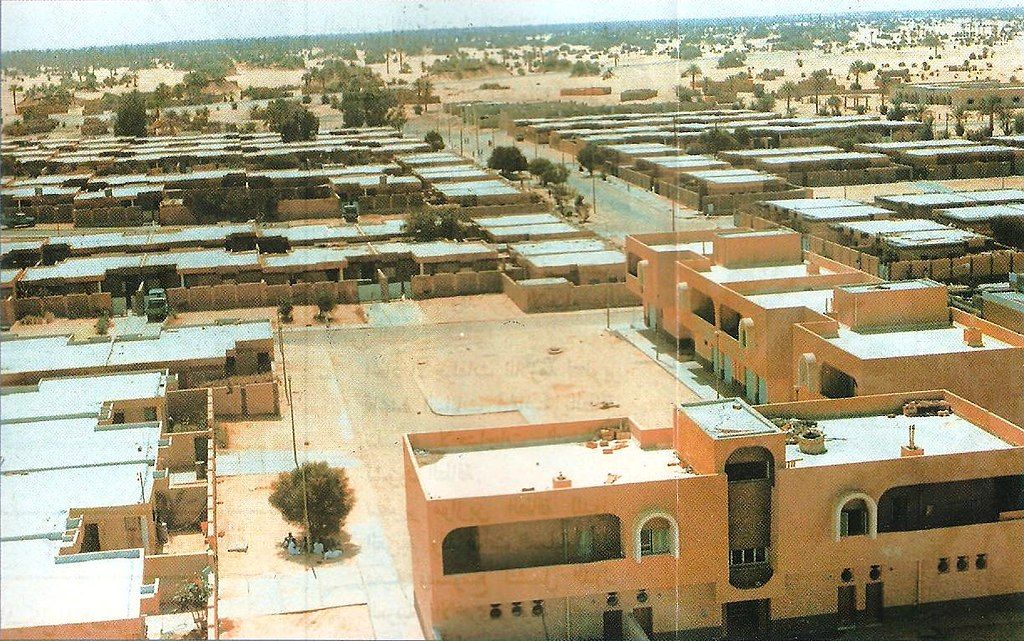
The next day brought hope. Around noon, they saw a line of trucks headed their way. It was the convoy returning to Agadez. The drivers greeted each other with shouts of joy. They stopped long enough to replenish their water and eat some food. They were only about six hours away from the village of Qatrun, their destination in Libya. It was a small town at the site of an ancient oasis. It looked like they would make it shortly after dark. There was a collective sigh of relief when they saw the city's lights. They had survived a horrendous journey.
Once in town, their driver took them to a series of buildings where they met up with the other migrants who had been in the convoy. They were given water and a little bit of bread to eat. Some men took Blessing away. Abdoulaye and Mamadou didn't know where, but they assumed it was to be with the other women. They would never see her again. The other migrants told them that a bus would come and take them on to Tripoli. Anyway, that was the plan. But, not everyone would get on the bus. Why? Because the bus cost an extra 70,000 CFA ($100). Mamadou did what he had been told to do; he called their agent back in Bamako. He then sent the money to the smugglers, paying for their tickets to the coast. Others were not so lucky.
Some did not have the money and evidently did not have anyone to call. Abdoulaye and Mamadou watched as the smugglers forced one man to call his family in Senegal to beg for money. While his mother was on the phone, they started beating him. As he cried in pain, the smugglers told his mother how to make the transfer on the phone. Others did not do as well. Stories were told stories about those who had been shot or tortured as an example to others. In the end, everyone who got on the bus to Tripoli had to pay extra, or they would be stranded in Qatrun.
Within a day, Abdoulaye and Mamadou arrived in Tripoli. They, along with others, were ushered into yet another building. It was hardly a place fit to live. It was here that they would spend the next three months. It was here that they would experience the horrors of Libya.
Conclusion
One of the greatest challenges for the church today is somehow to see distant events through the eyes of our Lord. For those in the West, we have been so desensitized by the fictionalized storytelling of the media that violence and suffering have little impact on our hearts. Or, we view things with a "documentary" mindset, and stories such as those above simply become an additional layer in our base of knowledge. For our non-Western readers, there is a temptation to compare Abdoulaye, Mamadou, and Blessing with the stories of so many others, and in so doing, the situation in the desert gets lost.
But our Lord can see each individual in a truck. He understands and feels their suffering, and weeps at their losses. These are real people, and there are others in the desert today... even as you are reading this post. There may be very little that you can physically do about the situation, but the church can certainly pray. And she can begin to understand a bit of the history of those who live just outside of her walls. Discovering how to see through our Lord's eyes enables the church to love and serve her neighbors with the hands and feet of Christ.
1Sahara Overland, "Trans Sahara Routs", Sahara Overland https://tinyurl.com/2pv8re9t (accessed June 26, 2022).
2Nichole Sobecki Ty McCormick, "Highway through Hell", Pulitzer Center https://tinyurl.com/bdhjz22r (accessed June 26, 2022).
3Marzia Rango Phillipe Fargues, Migration in West and North Africa and across the Mediterranean (Geneva: International Organization for Migration, 2020), 152.