55 - Crossing the Atlantic: A Whole New Pathway
2023 No 55
And I heard a loud voice from the throne, saying, “Behold, the tabernacle of God is among men, and He will dwell among them, and they shall be His people, and God Himself will be among them, and He will wipe away every tear from their eyes; and there will no longer be any death; there will no longer be any mourning, or crying, or pain; the first things have passed away.”
—Revelation 21:3-4
Introduction
When we first began this blog series, we knew that our greatest challenge would be to keep the posts simple and maintain the critical details necessary for a thorough review. The balance between popular and academic writing styles often hinges on the content. (And indeed, the author!) I must confess that this has undoubtedly been a challenge in this endeavor. We are now at post number fifty-five. If this were a book… and each post was a chapter… we would be well into our third or perhaps even fourth volume! Such is a testimony of the breadth and depth of sub-Saharan migration. It is also a testimony to your fortitude!
Occasionally, it becomes necessary to pause and review the map. Looking back to see where you have been allows one to put the current location into context. Many have joined this blog recently. Expecting new readers to "catch up" by reading a couple of books worth of material is a bit unfair. But that rear-view context serves a purpose in that it allows everyone to see where we are going. Staying up with this material over the course of two years is a commitment. Without an end goal in sight, one may grow weary.
Looking back, we are reminded that we live in a world of over 8 billion people. Population growth will continue in the decades ahead, much of it in the non-Western, majority world.1 Half of our world now lives in urban settings, and by 2050… 25 years, that percentage will grow to two-thirds.² Some of that will be due to rural/urban birth rates; much will be due to migration. Currently, over a billion people are on the move.3 That is one in eight. My experience tells me that the number is much higher. Regardless, these three realities (population growth, urbanization, and migration), have created incredible challenges for the local church and her missional efforts.
Churches established in the last fifty years face substantive changes in their communities. Those in rural contexts are losing young families as they move to more prosperous cities. Those in urban contexts are becoming overwhelmed by the masses who are arriving and the social difficulties they bring. Missional efforts were once focused on rural, homogeneous people groups in regions relatively unreached by the gospel… and typically without any church expression. Today, churches and organizations must retool as they engage an urban, heterogeneous community in places where the church is thriving.
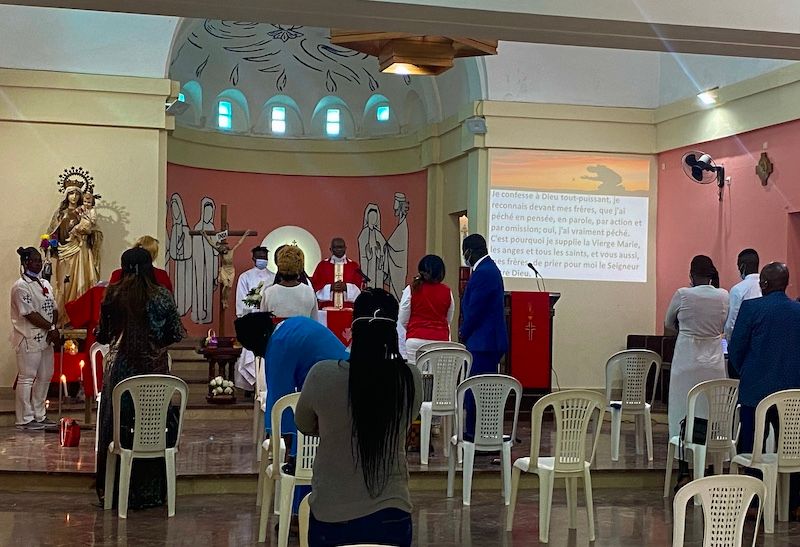
Principles Behind Migration4
Changing strategies requires solid information and an understanding of the basic principles at play. Such is certainly true when we begin to ask how to lead churches to best engage migrants with the gospel. Five realities direct most migrants.5 They are:
Everyone is on the move. Much of our world is migratory; that is to say, they do not live in the city of their birth. Migration is not an aberration; it is the norm.
Everyone moves for a reason. Seldom if ever, do people go through the effort of relocation without a good cause. Not surprisingly, those motivations evolve. Perhaps the first move was to go to school, the second was to find a job, and the third was to get a better job. Some movements are voluntary; others are involuntary. But… everyone has a story for why they left home.
No one moves alone. Migration is not an isolated event. Movement requires help, and the more distant the journey, the more assistance is needed. Rural to urban movements often have the support of friends and family. Transcontinental movements require complex networks along the way. Most are legal, but others can be quite nefarious. Getting from point A to point B may not have needed much support… but getting to point C and beyond can be very difficult to do alone.
Money directs the way. People only go where they can afford to go. You may have always dreamed of going to Hawaii, but if you only have enough money for a bus ticket, you won't get much further than California! Even for those with resources, migration routes are controlled by systems designed to collect those resources. The more money one has at their disposal, the more choices they have.
Migrants are never in control. You may think you control where you will go, how you will live your life, and what your destination may be. Unfortunately, there are always circumstances and systems that may directly challenge your desires. Very few migrants are fortunate enough to maintain control of their destiny. Most are like a leaf in a stream, going where the currents take them.
These are global principles. But observing how they play out in real life across the entire world can be a bit overwhelming. Thus, we chose to narrow our focus to sub-Saharan movements.
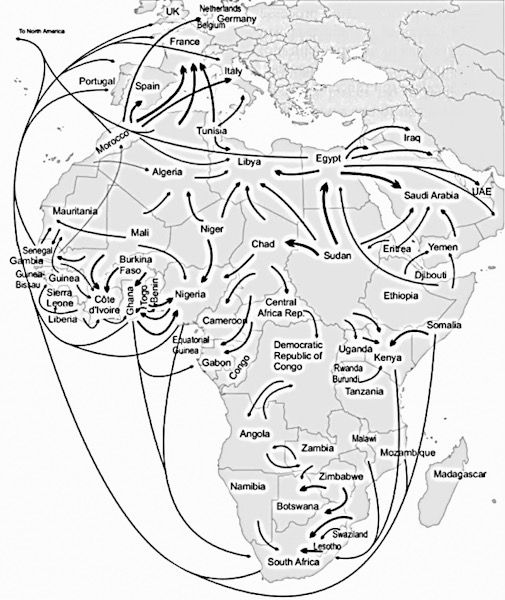
Why Africa?
So why are we looking at African migration? Africa has a population of nearly 1.4 billion.7 That is the same as the population of the entire world 150 years ago. It is more than the United States, China, and Brazil combined. The continent constitutes over twenty percent of the world's landmass. Incredibly, her population is expected to double in the next 30 years.8 It is no wonder that Africa is a continent on the move. The United Nations has estimated that over 200 million persons, roughly one in five, do not live in their city or village of birth.9 These represent voluntary movements where individuals made a conscious decision to migrate. Another 27 million have moved off the continent and continue to do so at a staggering rate of 1.8 million per year.10 That is roughly 35 every ten minutes!
We could find similar statistics in Asia or the Americas. But Africa holds some unique research opportunities. We chose Africa because we have a history with the continent, relationships with the churches in the region, and a love for the African people. I am convinced that almost every form of migration can be identified and illustrated among SSA migrants. If we can understand them, perhaps we can understand much of what is happening globally. That has value for every pastor and missional strategist seeking to engage their neighborhood for Christ.
And so, we began a journey to describe how Africans move. Specifically, we began to focus on those moving away from the African continent. But that is still a big picture. Consequently, we narrowed the discussion again and focused only on those moving toward Europe. Their pathways are relatively easy to trace, the processes of movement are being studied by many, and their stories are often in the news. Most importantly, we could describe those movements and relate their consequences in a way a local church could use.
Sub-Saharan peoples use three primary routes to gain entry to Europe. They are the Eastern, Central, and Western Mediterranean Routes.
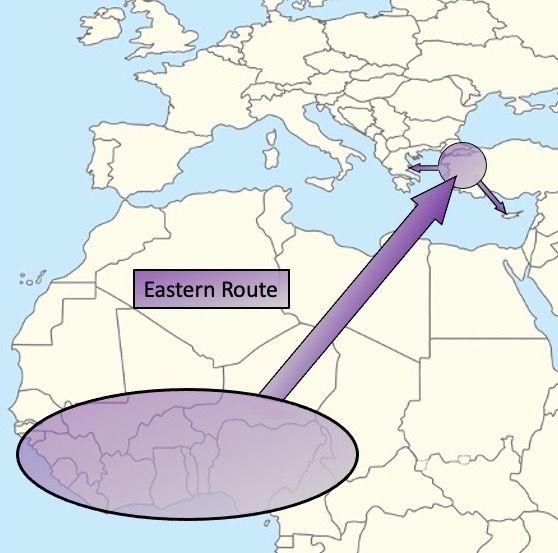
The Eastern Mediterranean Route (EMR)
The EMR is a route that takes migrants through Turkey and into Greece. Although we have spent considerable time in the region, we have yet to focus on this route. That is due to the fact that it is the route with the greatest financial cost and has the smallest percentage of SSA migrants. The only way to make this work for a sub-Saharan is to secure a visa and purchase an airline ticket. One then must then pay a smuggler for a boat into Greece. The smaller numbers, however, do not mean that this pathway is by any means insignificant. This is the route of choice for university students and those engaged in commerce. They then create networks for others to follow.
The EMR is unique in several aspects. First, unlike much of the EU, Turkey is interested in building economic relationships with continental Africa. This means that business and educational opportunities are growing, creating more pathways for migration. Significant numbers of legal migrants are making their homes in Turkey. This, then, opens the door for SSA migrants to arrive in Turkey for one purpose and then cross into Europe for another. Such explains the large number of SSA migrants landing in Greece. But the Turkey / African relationship creates another unique opportunity. Since African churches are already present in Turkey, they can create opportunities for African missionaries to follow.
We will begin our review of the Eastern Mediterranean Routes in a few months.
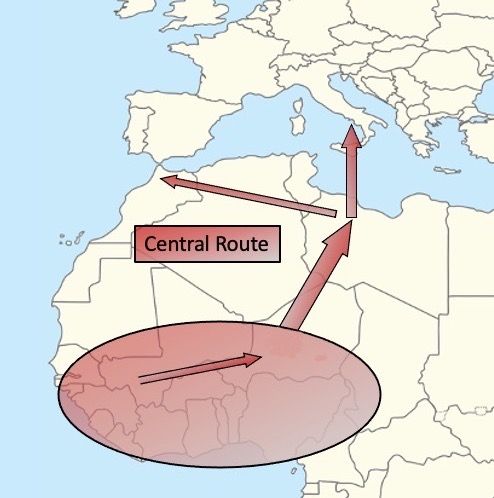
The Central Mediterranean Route (CMR)11
We have already covered this route in some detail. This is the path that takes migrants through Libya and into Italy. One must be rather desperate to make this choice. Why? Because the journey through the desert, the time in Libya, and the Mediterranean crossing can be horrific. This is the route of smugglers, traffickers, and organized crime. Those who go this way will face extortion, imprisonment, forced labor, sex trafficking, and death. If they arrive in Europe, they then face a tremendous struggle to escape the control of those who facilitated their journey.
And yet the church, indigenous and African, is growing in places like Mali, Niger, Lybia, and particularly Italy. Many who follow the CMR are believers, and those who survive the journey are often strengthened in their faith. As they encounter European and African churches, they begin to mature. These believers then go into the southern Italian farms and fields closed to outsiders and plant their own churches.
The Western Mediterranean Route (WMR)12
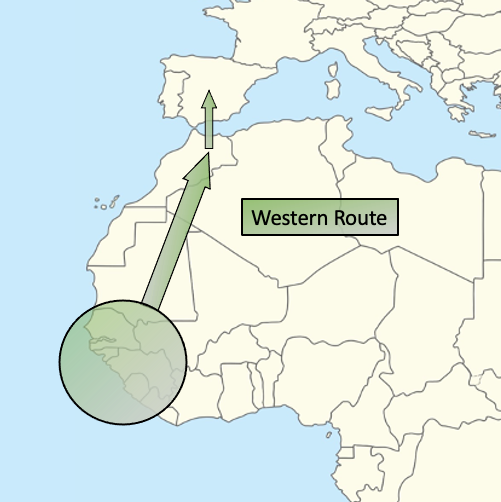
If we (my wife and I) were looking at a map, we would find ourselves at this place. If we were looking in the rearview mirror, the context would be familiar. Technically speaking, this path takes migrants from West Africa, through Mauritania or Algeria, into Morocco, and then across the Straits of Gibraltar into Spain. It is a preferred route. Why? Because although it may be more expensive, it takes less time and holds much less risk than the CMR. Unfortunately, in the same way that migrants become trapped in Libya, hundreds of thousands have become blocked in Morocco. The majority will never get across the Mediterranean to their desired destination. Those who do are often greatly disappointed. Things along this route are seldom as they perceived, and most have only found a life of hard labor, trafficking, and poverty.
But there is encouraging news. As elsewhere, the church in Morocco and Spain is vibrant and has open doors to minister to their neighbors. There are large numbers of legal migrants on both sides of the Mediterranean. They have formed churches in almost every major urban area, and many are effectively sharing the gospel, discipling their members, and leading them to do ministry in their communities. Due to their “near-culture” status, these African believers have direct access to their illegal, undocumented African migrant neighbors. Through those relationships, many are coming to faith.
The Atlantic Route (AR)
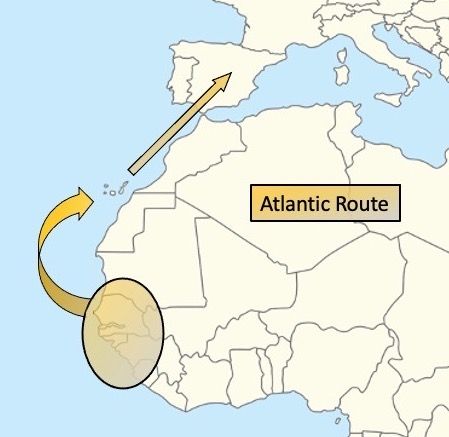
We can now view yet another migratory pathway. It is a pathway that sees migrants attempt to land in the Canary Islands. They believe that because the islands are a Spanish protectorate, they will be given asylum status in the European Union. You can get there in two ways. The first is from Morocco. The Canaries are only 100 kilometers from the continent. Those who go this way are “technically” a part of the Western Mediterranean Route; they have just made a “left turn” into the Atlantic. Literally! So, in that respect, the AR is a subset of the WMR. But since the United Nations and most refugee agencies do not make that distinction, neither shall we.
The second way to arrive, and the reason why this route has gained so much attention, is that the migrants make their way to the Canaries directly from West Africa. This is a sea passage of over a thousand miles, bypassing any North African transit countries. As one can imagine, this route is the most dangerous of all the routes we will examine, losing as many as one in three people along the way. We will spend the next 8-10 blog posts describing this pathway.
Conclusion
And so we have just summarized over 50 posts which, in themselves, were a summary of a library of information. You can imagine why it can be such an effort to keep things simple. As we move forward, perhaps this summary will help to maintain the context of the M2M3 blog series. For those who are new, it may set a foundation for what you will find in the days ahead and may create curiosity to probe some of our past articles. There is an archive page on the blog site. It can be accessed at the top of this page, or by going here. I would also encourage everyone to also dig further by following the notes at the end of each article. They are often linked to reports, news articles, and videos that help to further explain the subject at hand.
Thank you to all who take the time to read the posts on the website. As you do, pray for the migrants and the churches along their pathways. Pray for us as well. Know that your subscription gives you access to all the posts and allows you to help support the work. May our Lord bless you immensely, and may He guide the effort to make His work among sub-Saharan migrants known.
1 Photo Courtesy of: Caroline Wilkinson; Maria Castaneyra-Ruiz, "The Current Status of Migrant Disaster Victim Identification in the Canary Islands," Journal of the British Academy 9 (2021): 117.
2 The term “Majority World” refers to countries where most of the world’s population resides. On the other hand, the “Minority World” are the nations more commonly considered “developed” where a smaller percentage of the earth’s population lives. See Philip Jenkins, The New Faces of Christianity: Believing the Bible in the Global South (Oxford: Oxford University Press, 2006), ix. See also, Lemuel Ekedegwa Odeh, "A Comparative Analysis of Global North and Global South Economies " Journal of Sustainable Development in Africa Volume 12, No.3, 2010 (2010).
3 UNDESA, World Urbanization Prospects 2018: Highlights (Geneva, 2018).
4 Mitch Hamilton, "A Search for the Principles Behind Migration", M2M3 https://m2m3.org/11-a-search-for-the-principles-behind-migration-2/ (accessed December 7, 2022)
5 Mitch Hamilton, "23 - Summary: A Window of Opportunity", M2M3 https://m2m3.org/23-summary-a-window-of-opportunity/ (accessed April 8, 2023).
6 See map in Blessing Mberu and Estelle Sidz, "The Hidden Side of the Story: Intra-African Migration," in Out of Africa: Why People Migrate, ed. Giovanni Carbone (Milano: LediPublishing, 2017), 84.
7 UNDESA, World Population Prospects 2019 Vol. 12019.
8 United Nations, "Population", United Nations https://www.un.org/en/global-issues/population (accessed July 24, 2021).
9 UNDESA. Informal estimates place the number much higher, at perhaps 50-80%.
10 World Bank, "World Bank Open Data", Word Bank Group https://data.worldbank.org/.
11 Mitch Hamilton, "South to North Movements: The Choices Are Not Always Easy", M2M3 https://m2m3.org/24-south-to-north-movements-the-choices-are-not-always-easy/ (accessed December 7, 2022).
12 Mitch Hamilton, "40 - Introduction - the Western Route", M2M3 https://m2m3.org/40-introduction-the-western-route/ (accessed April 8, 2023).