56 - Introduction to the Atlantic Route
2023 No 56
The LORD hurled a great wind on the sea and there was a great storm on the sea so that the ship was about to break up. Then the sailors became afraid and every man cried to his god, and they threw the cargo which was in the ship into the sea to lighten it for them. But Jonah had gone below into the hold of the ship, lain down and fallen sound asleep.
—Jonah 1:4-5
If you have been following this blog series, then you know that our goal is to understand how and why sub-Saharan Africans are arriving in Europe. Some 1.8 million Africans migrate off the continent every year.² Most are legal movements, but many seek to take more clandestine routes. They are known by their geographic directions. There is the Eastern Route (EMR) through Turkey and into Greece, the Central Route (CMR) through Libya/Tunisia and into Italy, and the Western Route (WMR) through Morocco and into continental Spain.
Then there is also the Atlantic Route(AR). As noted in our last post, it is an offshoot of the Western Migratory Route. The AR gains special designation because, for some, it involves taking a boat from the West Coast of Africa directly to the Canary Islands.3 For them, there are no countries of transition, only a vast expanse of ocean. Because the islands are a protectorate of Spain, they enjoy status as a member of the European Union. That means for many sub-Saharans, it is their closest point of contact with Europe. To place things in context, in 2021, there were over 110,000 entries into Europe by the sea… one-fourth by this route.4 The Atlantic Route comprises two separate pathways. The first originates from Senegal/Gambia fishing villages. The second departs from the Mauritanian, Western Saharan, and Moroccan coastlines.5
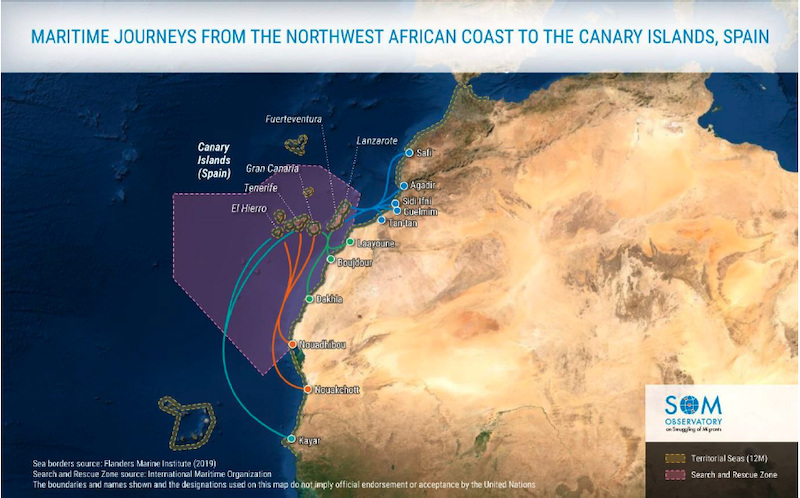
The Canary Islands, a Spanish archipelago off the coast of Morocco, have been a destination for West Africans for decades. Because they are a part of the EU, they have historically been one of the closest places Africans could go to seek refugee status. The islands are only 67 miles (105km) from the continent. As such, it was not difficult for sub-Saharans to find a way north to Morocco and then take a rubber raft or a patera west to the Canaries.6 Generally, the boats would be filled with Moroccans, but smugglers could easily fill empty slots with sub-Saharans.7 These are the same smugglers who transport migrants across the Mediterranean along the WMR to Spain.
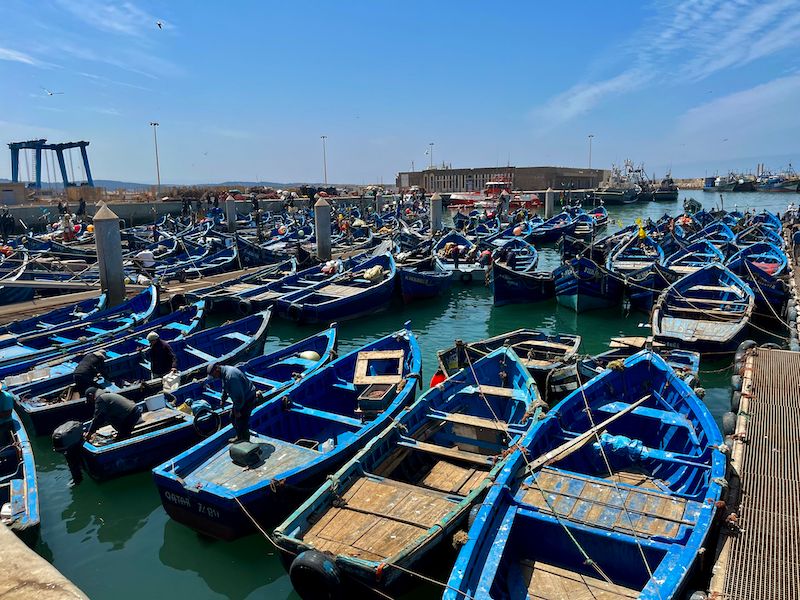
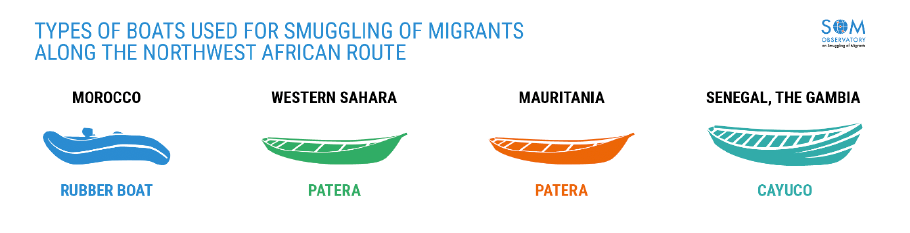
Conversely, Senegal is nearly 1,000 miles (1,500km) to the south of the Canaries. As economic conditions changed at the turn of the century, more Africans began to take this long journey to the islands. While hard to imagine the rationale, it has been the best option for many. As we progress through this series of posts on the Atlantic Route, the logic of these movements may become evident. Regardless, tens of thousands of SSA migrants have followed this southern, more direct pathway. Many would lose their lives.
The voyage from Senegal to the Canary Islands is one of the most dangerous of all migration routes. By some estimates, the risk of death is six times that of the journey across the Mediterranean. Migrants tell me that the trip across the Straits of Gibraltar, an endeavor of only eight miles, can easily lose one out of five boats. The same level of risk, one in five, is true from Laayoune to Fuerteventura. The losses from Senegal to the Canaries rise to as many as one out of three. Many of these “invisible shipwrecks” simply vanish into the Atlantic.8 Since there is no way to monitor how many boats may leave Senegalese beaches, there is no quantifiable way to know how many have perished.
Of all the migratory routes we have examined, this one carries perhaps the most emotion for the sending communities and holds the greatest risk for the migrants. But… it also holds the greatest reward. Our goal in this next series of posts will be to understand how and why so many young men and women are seeking this means of escape, and what happens when they arrive. Ultimately, we desire to equip pastors, church leaders, and missional strategists to take what we know and better serve our new neighbors with the hope of the gospel.
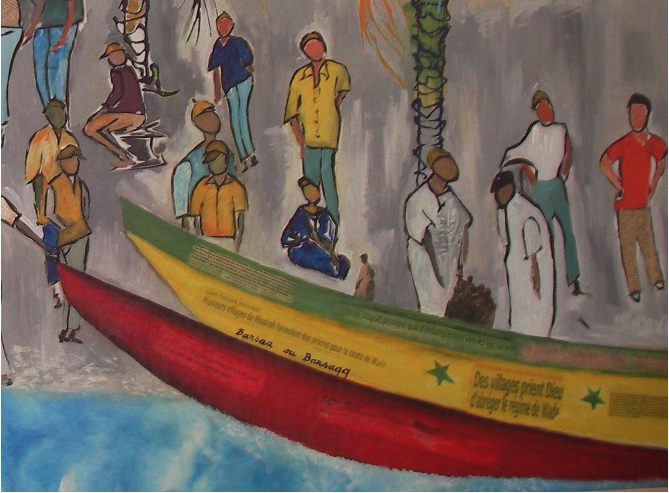
The First Wave of 2005
Senegal has always had a long history of migration to Europe. As discussed in prior posts, many have made the trip independently as a response to employment and educational opportunities. Others have used their family and social networks to find a way North. But many did not have such options, particularly those who were a part of the vast fishing industry of Senegal.
Movement along the Atlantic Route is directly tied to the contemporary struggles of local fishermen. During the latter part of the 20th century, there was a significant decline in fish stock due to foreign overfishing. This, in turn, led to a higher poverty rate along the coast.10 As the industry collapsed, boat owners would simply divert their boats north. Consequently, fishermen were some of the first migrants to the Canary Islands. They had the equipment and the knowledge of the sea to make the journey.11 And they could sell a seat on their boat to compensate for their losses. Consequently, they could make more money by sacrificing their boat for a migrant trip than they possibly could by selling it.
In the early 2000s, Spanish authorities would process five to six hundred migrants per year on the islands. This was not a small number, but it was certainly manageable. Once again, they were mainly from North Africa; that is, they were crossing from Morocco. As such, they were habitually repatriated to Morocco. However, that would dramatically change as sub-Saharans began to arrive. 2005-2006 became known as the “Cayuco Crisis," when some 40,000 Senegalese came to the Canaries.12 This completely overwhelmed the island's border enforcement and their capacity to house the migrants in their typical retention centers.13 In some respects, this was one of the first European migrant crises, and it led to multiple changes in how the EU sought to manage its borders.
Many of those changes were effective. As controls were implemented to reduce the tide of migrants to the Canaries between 2006 and 2008, smugglers redirected SSA migrants to move north along the Central Mediterranean Route in increasing numbers. Remember, one of the principles of migration is that water always flows downhill, and migrants always take the pathway of least resistance.14 Consequently, the number of arrivals on the islands returned to previous levels, becoming once again predominantly Moroccan in origin.15
But, as previously examined, the Central Route became much more difficult with the civil war in Libya in 2011 and the region's collapse in 2012.16 Many who had relocated to North Africa for work were faced with a choice of returning home or moving forward toward Europe. As we know, many sought to use existing routes toward Italy, leading to the crisis of 2015. But, as Europe gained control of the Mediterranean routes in the years following, the focus returned to the Canaries as an option for entry into Spain.
The Second Wave of 2020
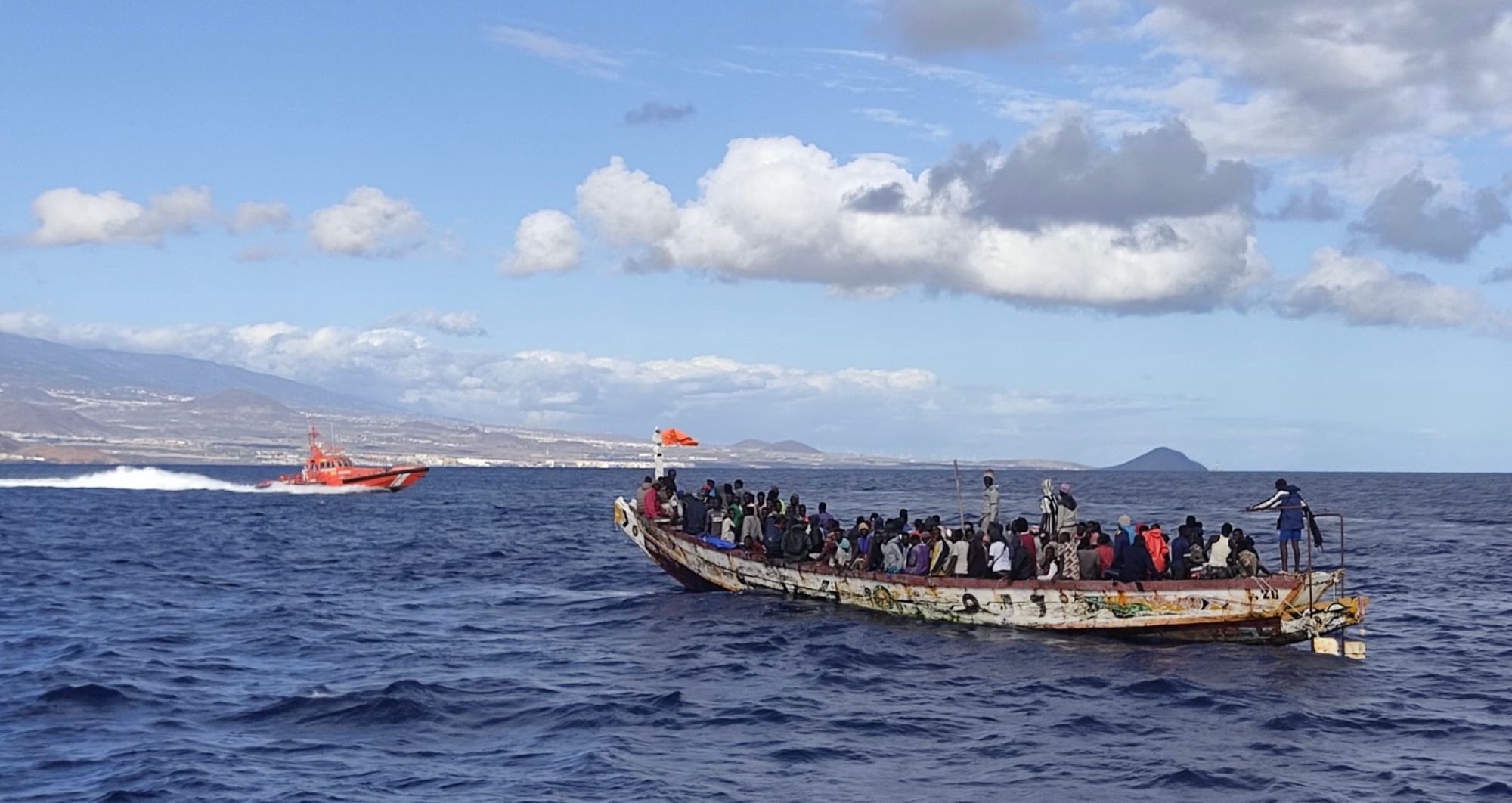
A second “cayuco crisis” began to emerge in 2020. As the Central route became much more difficult and far too dangerous, sub-Saharans once again began to make the long sea voyage to the Canary Islands. This coincided with increased movements from southern regions of Morocco. Note the following progression.
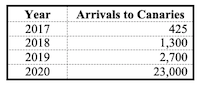
Note that in 2020, arrivals increased ninefold to 23,000... with 21,167 arriving in the last five months of the year!18 Between January 2018 and August 2021, nearly 1,200 boats arrived on the islands.19 On average, 51% were North Africans (mainly Moroccan), with the rest hailing from the Sahel.20 The numbers were similar in 2022. Twenty percent of those who arrived were unaccompanied minors.21 Once again, the system on the islands became overwhelmed as the government and social agencies sought to accommodate the needs. The most recent arrivals corresponded with the COVID-19 pandemic, making things even more difficult for the island residents to manage. Border closures in Europe now prevented departure, and many immigrants overflowed into the streets.
In an effort to manage the influx, authorities built new detention facilities. Due to COVID, tourism was at a standstill. Thus, the government paid for empty hotels to house the immigrants, but such was a temporary solution. Ultimately, it was a catastrophic move for the hotel owners, bringing the island economy to a near-breaking point. As borders reopened, the government had little option but to forward the migrants to mainland Spain.22 Today, most are housed on the islands just long enough for processing and then flown directly to Barcelona, Valencia, or Madrid. In some cases, that occurs in less than a week. This, however, has only served to validate the hopes of the migrants and fuel the smuggling networks that recruit from the poorest African populations.
Horrific Losses
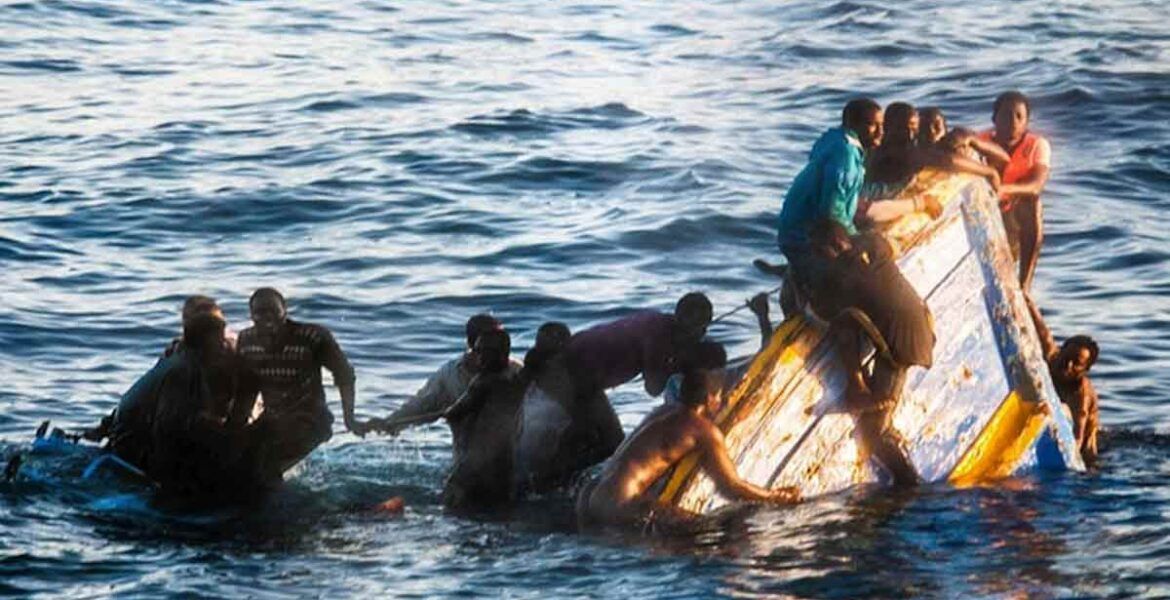
More attention will be given to this in a later post, but by way of introduction, there is no other way to describe the loss of life than horrific. Try to imagine 200 boats lost in the Atlantic, with a hundred men, women, and children in each boat. Multiply the Titanic by thirteen or a modern cruise ship by six, and you will get close to the number of people who have perished. That was from 2005 to 2006, when most boats were built for the sea and captained by experienced fishermen.24 Today, the boats are hastily built, seldom tested by time, and led by inexperienced mariners. It truly is unknown how many are lost.
Even successful voyages will have many on board who suffer greatly and often die. Dehydration and hypothermia are the primary culprits. But other factors also come into play. Migrants testify of those who fall overboard, suffer from panic attacks and jump overboard, or because of non-compliance are thrown overboard. Mechanical failures are common. Only the fortunate ones will be found by Spanish authorities when that happens.
The Atlantic route is by far the most terrifying route and leaves the most lasting scars on the migrants. For many, it was their first time in a boat, much less in the middle of the ocean. I have spoken with migrants who have made the attempt, some two or three times. While they have failed in each effort, they have defied the odds and survived. However, the stories they tell are always filled with grief and death. If we can learn anything from the situation on the Greek Islands, those who arrive in the Canaries often carry guilt in their survival, suffer from post-traumatic stress, and experience extreme anxiety about the future.25
Why It Matters
It is important to understand the Atlantic Route. Why? Because it is available to much of West Africa, for the least amount of cost, with the greatest amount of risk. It is also a route that occurs in the shortest timeframes and has the most definitive results. When a young man decides to leave his home, he can be on a boat within a few days. A week or two after that, he has either arrived in the Canaries, has been forced back to Senegal or Morocco, has washed up on an African beach, or has perished. Things happen quickly, and news of success spreads like wildfire. This pathway is truly a perceived route of opportunity and hope, one that only empowers and enriches the smugglers who arrange the details.
The window to engage these migrants is relatively narrow. For the church in Africa, it is difficult. By the time a pastor knows that someone is contemplating the trip, they have typically already left. For those churches, it becomes a matter of engaging the despair that leads to such risks. For the church in the Canaries, their time is also very short. Migrants come and go at an incredible pace. Often their contact with a survivor is very brief… if at all. Most are prohibited from leaving the governmental camps and will remain inaccessible to anyone outside the system. For the church on the Spanish continent, it is a matter of engaging those who have such great needs and so little trust in anyone. For the migrants who are believers, they must overcome the scars that steal their joy in Christ. For the unbelievers, it is those very scars that hinder their access to the gospel.
And yet ministry to these migrants is just as important to the heart of God as any other effort to engage poor and displaced people. The greatest challenge for the gospel is not the defense mechanisms of the migrants. Rather, it is the lack of attention by the people of God. Care must be taken, that like Jonah, those with a message of hope are not sleeping while those around them are perishing.
1 Banner photo courtesy of Diana Rodriquez Pretel, "The Lies of the Mafias in Senegal", Atalayar https://atalayar.com/en/content/lies-mafias-senegal (accessed April 9, 2023).
2 World Bank, "World Bank Open Data", Word Bank Group https://data.worldbank.org/.
3 Julia Black, Maritime Migration to Europe: Focus on the Overseas Route to the Canary Islands (Geneva: International Organization for Migration, 2021), 10.
4 Jan-Philipp Scholz; Ismail Diko, "More African Migrants Eye the Canary Islands", Deutsche Welle Akademie https://www.dw.com/en/more-african-migrants-eye-the-canary-islands/a-61096472 (accessed May 4, 2022).
5 Maria Martin; Javier Bauluz, "Canarias, Un Año Despuès", El Pais https://elpais.com/espana/2021-12-03/canarias-la-crisis-migratoria-un-ano-despues.html. (According to this report, 72.5% come from Morocco and Western Sahara, 23.5% from Mauritania, and only 4% from Senegal and the Gambia – See graphic in photos.) See also AlarmPhone, "Border Business - How the EU’s Militarisation Fuels Smuggling Networks between North Africa and Spain", Watch the Med https://alarmphone.org/en/2022/03/31/border-business/?post_type_release_type=post (accessed May 4, 2022). By their estimates, only 20% come from Mauritania or further south towards Senegal. See also UNODC, Northwest African (Atlantic) Route: Migrant Smuggling from the Northwest African Coast to the Canary Islands (Vienna, 2022), 19.
6 A patera is a Spanish term for small wooden or fiberglass fishing vessel. It is a very common Moroccan fishing boat.
7 Luna Vives, "Unwanted Sea Migrants across the EU Border: The Canary Islands," Political Geography 61 (2017): 181.
8 ANSA, "Corpse-Laden Boat Found in Caribbean 'Drifted from Africa'," InfoMigrants https://www.infomigrants.net/en/post/32818/corpseladen-boat-found-in-caribbean-drifted-from-africa (accessed May 4, 2022). See also Emma Wallis, "Dying to Reach Europe: The Atlantic Crossing", InfoMigrants https://www.infomigrants.net/en/post/34189/dying-to-reach-europe-the-atlantic-crossing (accessed May 4, 2022).
9 Painting by Hélène Neveu Kringelbach… see Hein de Haas, The Myth of Invasion: Irregular Migration from West Africa to the Maghreb and the European Union (University of Oxford: International Migration Institute, 2007).
10 Vives, "Unwanted Sea Migrants across the EU Border: The Canary Islands," 182.
11 Ibid.
12 Miranda Poeze, In Search of Greener Pastures? Boat-Migrants from Senegal to the Canary Islands (Enschede: Ipskamp Drukkers, 2010), 3. Note, a “cayuko” is a common fishing boat in Senegal. It is also called a pirogue, a longer boat capable of making a sea voyage. They can be 20 meters long and 3 meters wide. Many can hold over 100 people.
13 Carolyn Dudek; Carmen Pestano, "Canaries in a Coal Mine: The Cayuco Migrant Crisis and the Europeanization of Migration Policy," Revista Española de Ciencia Política 49 (2019): 92.
14 Mitch Hamilton, "Principle Four: Money Directs the Way", M2M3 https://m2m3.org/21-principle-four-money-directs-the-way/ (accessed January 24, 2023).
15 José Maria Rodriguez, "Spain’s Handlingof the Cayuco Boat Crisis", Euractiv https://www.euractiv.com/section/justice-home-affairs/news/spains-handling-of-the-cayuco-boat-crisis/ (accessed May 4, 2022).
16 Mitch Hamilton, "The Central Route: The Historical Context of the Maghreb", M2M3 https://m2m3.org/27-the-central-route-the-historical-context-of-the-maghreb/27 – (accessed September 24, 2022).
17 Photo courtesy of Gunn Klevin, "Tenfold Increase in the Number of Boat Refugees in the Canary Islands This Year", Canaria Journalen https://www.canariajournalen.no/Nyheter/Tidobling-av-antallet-baatflyktninger-paa-Kanarioeyene-i-aar (accessed April 9, 2023).
18 Vincente Hernández, Irregular Maritime Migration and Managing Arrivals in the Canary Islands (Tenerife: OBITen, 2021), 6.
19 Ibid.
20 Jessamy Garver-Affeldt; Mackenzie Seaman, A Gateway Re-Opens: The Growing Popularity of the Atlantic Route, as Told by Those Who Risk It (Mixed Migration Center, 2021), 14. Keep in mind that these percentages change daily. At one point, some 35% were arriving from Mali. See Renata Brito, "Migrants Trying to Reach Europe Pushed to Deadly Atlantic", Pulitzer Center https://pulitzercenter.org/stories/migrants-trying-reach-europe-pushed-deadly-atlantic (accessed May 4, 2022).
21 Hernández, 14.
22 Poeze, In Search of Greener Pastures? Boat-Migrants from Senegal to the Canary Islands, 44. It is very difficult to claim "asylum" from a West African country in many respects. What happens is that they are incarcerated upon arrival for 40 days. If, during that time, they can be identified as having come from a country that has a repatriation agreement, they are sent back. If they can hide their identity through lies or silence for those 40 days, they must be legally accepted and sent to Spain.
23 Stories of tragedy abound. See Souka Rochdi, "Sénégal: Au Moins 14 Migrants Meurent Dans l’Incendie d’Une Pirogue", News Gemina https://feminanews.com/senegal-au-moins-14-migrants-meurent-dans-lincendie-dune-pirogue/ (accessed April 9, 2023). See also Benjamin Bathke, "At Least 13 Migrants Die as Boat Catches Fire Off Senegal", InfoMigrants https://www.infomigrants.net/en/post/41574/at-least-13-migrants-die-as-boat-catches-fire-off-senegal (accessed April 9, 2023).
24 Black, 10.
25 ANSA, "Damning Report on Migrant Mental Health in Greece Released", InfoMigrants https://www.infomigrants.net/en/post/29225/damning-report-on-migrant-mental-health-in-greece-released (accessed April 19, 2022). See also, Martha Roussou; Niamh Carthaigh, The Cruelty of Containment: The Mental Health Toll of the Eu’s “Hotspot” Approach on the Greek Islands (International Rescue Committee, 2020).