57 – A Historical Context of Senegalese Migration to the Canaries
2023 No 57
When your wares went out from the seas, you satisfied many peoples; with the abundance of your wealth and your merchandise, You enriched the kings of the earth. Now that you are broken by the seas in the depths of the waters, your merchandise and all your company have fallen in the midst of you.
—Ezekiel 27:33-34
There was a day when Tyre was a seafaring capital to the North of ancient Israel. But things changed over time. The Babylonians were coming, and their armies would reduce this great city to economic ruins. The sea had made her wealth, and it would be by the sea that she would be broken. In so many ways, the same is true for the fishing industry of Senegal.
The Atlantic Route out of West Africa is primarily a pathway for fishermen. Or better said, no one would be going this way towards the Canary Islands if it were not for the fishermen. It is a dangerous route that must follow a very narrow corridor that stretches some 1,500 miles to the south of the islands. Stray too close to the African coast, and border control will intercept you. Stray too far into the Atlantic, and winds and currents will push you into oblivion. Navigational skills can only do so much. Mechanical failure, poor provisions, or unpredictable weather can easily push the best boats into a precarious situation. Such is why as many as a third leave the coast and are never heard from again.
So why would someone engage on such a pathway? In many respects, most do not have much choice. I know that is hard for someone from a Western context to comprehend, but desperation is a recurrent theme of migrant testimonials. And… it has a history.
The Economic Fishing Crisis
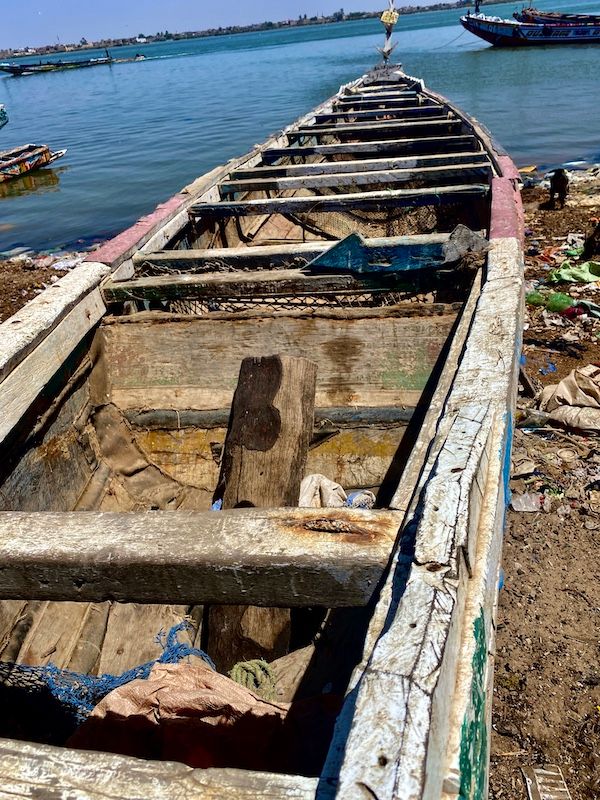
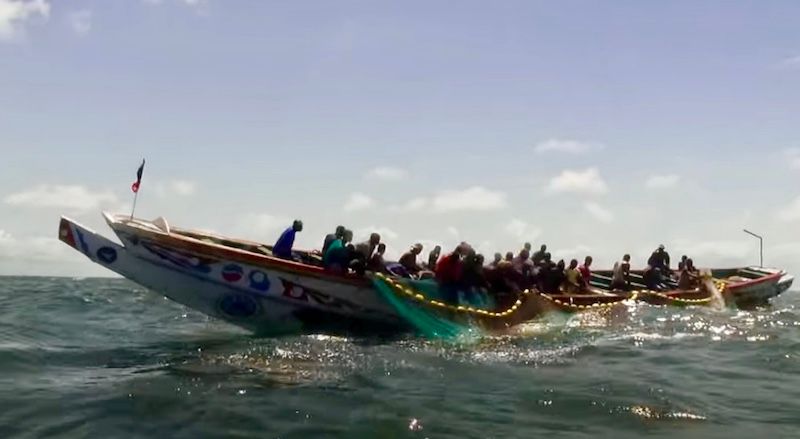
In the 1980s, drought in Senegal pushed many farmers, or at least their children, into the fishing sector.2 In those days, one could go out for a day, and catch enough fish for the family and enough to sell at the market to earn a decent living.3 The abundance served the fishermen well and catapulted many boat owners into a new middle-class lifestyle. It also created employment opportunities for many, who soon became dependent upon the work.
The robust fishery, however, was also attractive to foreign interests. Soon, outsiders would sign offshore fishing agreements with the Senegalese government that would forever change the industry. The European Union and Asian countries came in force, and their efforts would quickly diminish the fish stocks.4 Legal fishing would soon lead to illegal exploitation. Some 60% of the fish caught along the Senegal coast went to Europe, and much of the remaining was carried to China. Thus, the tonnage of fish landed at Senegalese ports fell from 95,000 to 45,000 between 1994 and 2005.5 China has a fleet of over 2,600 vessels. Some ships are so large that they can catch more fish in one week than all the Senegalese fishermen can see in a year.6 As the fish stocks diminished, local fishermen were pressed to build bigger boats, so they could go further out in an effort to catch more fish.
Today, the good fish are gone. The focus of much of this exploitive fishing industry is now focused on producing fishmeal... and is financed by Spanish, Russian, Chinese, and Korean interests. Five kilograms of fish can create one kilogram of fishmeal. It is a powdered protein that is shipped back to Asia to feed livestock. Those exports expanded from 990 tons in 2006 to 6,300 tons in 2015 and now stand at about 12,000 tons annually.7 The damage done by these industries is catastrophic. They harvest anything in the ocean that can provide protein. Thus, they often illegally target juvenile stocks, which deplete future generations. It is now estimated that some 90% of Senegal's fisheries are either fully fished or facing collapse.8
Today, there is little reason for most Senegalese fishermen even to try. One can go out for several days and not catch enough to pay for the gas in the outboard motor. Families may own the boats and the nets, but they are of little value in the present… and mean nothing to the next generation. There may be a few who can scratch out a living, but for most, it is simply a way of life that has quickly passed. Like the merchants of Tyre above, outsiders have come and destroyed their means of living. Those who were once prosperous are now broken by the sea.
The Memory of Past Success
It is, therefore, not difficult to understand that those with both the equipment and knowledge are willing to consider using their skills to make money in other ways. Why not help smugglers deliver clients to the Canary Islands? Especially since these people are willing to pay. And why would they pay? Because many people in Senegal and the Gambia are also struggling with poverty… and there is a taste of prosperity in their recent memories. That prosperity once came from fishing; it now comes through migration. It is visible when they walk down the streets, look at their neighbors' possessions, and visit with their friends on social media. A sense of hopelessness plagues an entire generation, and many of the youth will take any risk... if it means a better life.
Once again, we must remember that migration has been a part of sub-Saharan culture for generations. If you remember previous posts, many went to Europe for reconstruction efforts after each world war. They sent their remittances back home to build houses and to have a place to live during their retirements. Those houses were subsequently passed down to the next generation. Others went to live and work in Europe via legal routes, and they also sent their money back home to buy cars and material goods to sustain their families.
A new, younger generation can see the fruits of these labors, talk to relatives in other places, and have a sincere conviction that the same "good fortune" can happen for them if they can only get to Europe themselves.9 And... there is a lot of pressure for them to do so. Despite the risks, the honor of the attempt greatly surpasses the shame of staying behind. Consequently, many will go to the sea if they can scratch together enough resources to buy a place in the boat. We have spoken with several migrants who have made this choice. They tell stories of horrendous experiences. Yet, many of them tell us that had the journey failed and had they survived, they would try again.
Even more so, popular culture supports this kind of migration. In 2006, an extremely popular Senegalese musician named Mapenda Seck recorded the music video "Barca Wala Barsakh ." It focused on boat migration and utilized a play on words in Woolf that mean “one either arrives in Barcelona, or one dies."10 It was not far from the truth. One can die at home… or one can die in the water… or one can arrive in Spain and find life. In many respects, he validated the effort of migration before his audience and perpetuated the idea that migration to the Canaries is not only possible but would carry honor in the effort.
The Mechanics of Movement
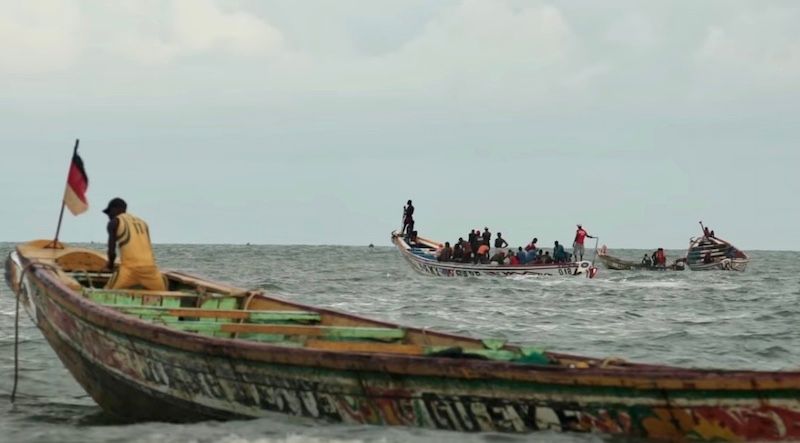
So how do people get from Senegal to the Canaries? It begins with social networks that facilitate the movement. In many respects, they mirror much of what happens in other migration contexts. In the early days, voyages were organized locally. A boat owner might plan a trip, recruit a captain, and word would get around the community.11 Neighbors would raise the money, and places in the boat would be secured. The risks were somewhat mitigated because the pirogue was a proper offshore fishing vessel, and it was captained by an experienced pilot who understood the sea. The stakes were still high, but success was profitable for the owner, and his esteem in the community was elevated.12 There were undoubtedly losses, but the fishing community was acclimated to the risks of the open sea.
In the latter days, during this second wave of migration, the organization of the trip has become much more complicated. The pool of available seamen and boats has been reduced dramatically. Recruiting migrants to fill empty seats now extends into other cities and, at times, other countries. Many now come from the interior, from farming communities. Sophisticated smuggling networks have been developed to facilitate these processes. They use social media and word of mouth to make their appeal to a broader audience and to arrange the trip. These networks are often likened to organized crime. Many are indeed connected to criminal networks but... tend to be less structured and less violent than those found further south in Nigeria.13
In many respects, the efforts of both the Spanish and Senegalese governments have made this route much more difficult. After the first wave in 2006, border patrols increased. Between 2006 and 2007, national coast guards intercepted some 13,000 migrants along the routes and were returned.14 Modern radar systems and satellite surveillance allow border control to detect ships leaving the continent. These technological advances have made it very difficult to facilitate movement without detection. Frequently, it becomes necessary to bribe local officials to create windows for movement. All of this requires a much higher level of coordination... and a lot more money.
Our recent time in Senegal allowed us the opportunity to visit with several migrants who had attempted the voyage or knew someone who had. They report that the conditions in the boats are much more difficult today than in earlier years. Today, a single vessel may have individuals from several regions of Senegal or the Gambia. There will be men and women, different languages, and people of other faiths. For many, it will be their first time in a boat, much less in the ocean. Seasickness quickly leads to dehydration, and those from interior villages develop hypothermia much faster than those acclimated to the coast.
Additionally, smugglers have to purchase or steal boats of much lower quality, meaning structural failure and mechanical problems have become more frequent. Those who are lost or who wash up on a beach somewhere can create severe problems for the reputation of the smuggler. Like any businessman, he needs successful clients to aid in recruitment for future trips. To achieve this, it means that the costs of the trip must go up to cover the increase in quality. Those costs are now approaching $1,000 to $2,000 per person, or even higher. As a result, the endeavor remains highly profitable, particularly in a boat with 50-75 people.
Conclusion
There is most certainly a context for why West Africa is migrating toward the Canary Islands. Poverty, cultural expectation, and access to a seat in a boat combine to overcome the known risks of the voyage. In some respect, there are increased flows along the Atlantic Route because of restrictions in other areas. Remember, water typically flows downhill and follows the path of least resistance. The movements of people are similar. And while two boats out of three may not be the best of odds, one cannot argue with 40,000 successful arrivals in less than two years.
And yet the losses are indeed profound. Thousands die at sea every year. Think about that above number. If 40,000 arrived, then perhaps as many as 60,000 left the beach. Even as you are reading this post, there are boats in the water that will never see land again. Men, women, and children are drowning, dying of dehydration, hypothermia, and exposure at this very moment. Those who do arrive face an uncertain future. Many will land in Spain, only to become forced laborers on the farms or in the sex trade.
Brokenness has a way of drawing people to God. I know their suffering is in the eyes and on the heart of our Lord. I pray that their plight is a burden for your soul. Sometimes the first step towards helping change situations like this is found in understanding... and prayer.
1 See Andrea Marchegiani, "Kayar, Senegal’s Biggest Fishing Harbour", Any Place is Home Travel Blog https://www.andreamarchegiani.it/travel-blog/en-senegal/kayar-senegal-fishing-harbour/ (accessed April 9, 2023). Special thanks to Andrea Marchegiani for the use of this photo. He spent time in Senegal and gave attention to this very subject. I would encourage you to visit his professional photography site at https://www.andreamarchegiani.it/en-travel-photography/en-senegal/
2 Laurence Grun; Pierre Vanneste, "The Senegalese Fishermen Trapped Between Hunger and Exile", Equal Times https://www.equaltimes.org/the-senegalese-fishermen-trapped#.Yl7Kh5PP3UI (accessed April 19, 2022).
3 Shola Lawal, "As Ocean Empties, Senegal’s Fishermen Risk Seas for New Life in Europe", The Christian Science Monitor https://www.csmonitor.com/World/Africa/2021/0114/As-ocean-empties-Senegal-s-fishermen-risk-seas-for-new-life-in-Europe (accessed April 19, 2022).
4 Ifesinachi Okafor-Yarwood, "African Countries Must Protect Their Fish Stocks from the European Union: Here’s How", The Conversation, University of St. Andrews https://theconversation.com/african-countries-must-protect-their-fish-stocks-from-the-european-union-heres-how-177095 (accessed April 19, 2022).
5 Vanneste.
6 Andrew Jacobs, "China’s Appetite Pushes Fisheries to the Brink", The New York Times https://www.nytimes.com/2017/04/30/world/asia/chinas-appetite-pushes-fisheries-to-the-brink.html (accessed April 19, 2022).
7 Sebastien Dacard-Heid, "A Drop in the Ocean", France 24 https://webdoc.france24.com/odyssey-senegal-fishermen-france/chap5.html (accessed April 19, 2022). See also Thiao Djiga and Stewart Bnting, Socio-Economic and Biological Impacts of the Fish-Based Feed Industry for Sub-Saharan Africa (Rome, 2022).
8 Chidinma Nwoye, "Chinese Trawlers with an Illegal Fishing Record Have Been Licensed by Senegal", Quartz Africa https://qz.com/africa/1915624/senegal-okays-chinese-boats-with-illegal-fishing-record-greenpeace/#:~:text=Up to 90%25 of Senegal's,the seas off West Africa. (accessed April 19, 2022).
9 Florian Trauner and others, The Role of Narratives in Migratory Decisionmaking: Analysing the Impact of Eu-Funded Information Campaigns in the Gambia (2023), 45.
10 Many have used this theme to create other YouTube videos documenting their migration attempts. Here is just one. https://youtu.be/Z_1qvaIB8kg
11 Luna Vives, "Unwanted Sea Migrants Across the EU Border: The Canary Islands," Political Geography 61 (2017): 182.
12 Julia Black, Maritime Migration to Europe: Focus on the Overseas Route to the Canary Islands (Geneva: International Organization for Migration, 2021), 10. The risk of death at sea remained high, with some estimates that a third of the boats would be lost. But, the loss was generally due to uncontrollable issues, not boat failure or inexperience. The fishing communities understood these risks, and most of those purchasing the seats were fishermen themselves.
13 See Francisco Javier vélez Alcalde, "Pateras, Cayucos and Cross-Border Mafias in Africa: Profiting from the Atlantic Routes to the Canary Islands", ELCANO https://www.realinstitutoelcano.org/en/analyses/pateras-cayucos-and-cross-border-mafias-in-africa-profiting-from-the-atlantic-routes-to-the-canary-islands-ari/ (accessed April 19, 2022).
14 Jørgen Carling; María Hernández Carretero, Kamikaze Migrants? Understanding and Tackling High-Risk Migration from Africa (Sussex: University of Sussex, 2008), 4.