M-Moments: We Didn’t Send Them… But God Did!
“Therefore, those who had been scattered went about preaching the word.” — Acts 8:4
This reflection stems from a message I will be sharing at a conference of pastors and missionaries in Nigeria, where we are grappling with what it means to complete the unfinished task of gospel witness in North Africa. As we gather to strategize, pray, and dream, I’m convinced that God is already doing something remarkable through people we did not formally send, but whom He has sovereignly scattered.
____________________
Already in the Field
They didn’t come with funding, fanfare, or formal training. But in the sweltering apartments of Morocco, they’re preaching Christ with nothing but courage and a Bible on their phone.
It raises a marvelous question: What if the next great missionary to North Africa is already there, and we just haven’t seen him yet?
For decades, when we’ve prayed for the gospel to reach the nations, we’ve imagined a certain kind of missionary: one who is sent, supported, trained, and accountable. Someone who raises funds, learns a new language, and crosses borders with a clear strategy. But what if God is answering our prayers in a very different way?
What if the missionary didn’t come with a plan… but with a prayer? What if he didn’t carry a support letter… but a student visa?
Across the Maghreb, from Mauritania to Egypt, and from Turkey to Spain in Southern Europe, a quiet, Spirit-led movement is unfolding. Sub-Saharan Africans are filling the cities, ports, universities, and job sites. Many are driven by economic hardship or educational dreams. They arrive with legal status, humble means, and, in many cases, deep faith. And they are not silent.
I remember walking up the stairwell of a crumbling apartment block above a phone repair shop in North Africa. The walls were cracked, the fan barely worked, and the chairs didn’t match. But the worship shook the plaster. The preacher that day was a Nigerian student—bright, articulate, and raw with conviction. He closed his Bible, looked out across a mismatched room of migrants, and said, “I came here to go to school. God was sending me to be a shepherd. I just didn’t know it yet.”
That moment said everything.
These believers were never commissioned by a mission agency. They weren’t celebrated at a church sending service or featured in a prayer bulletin. Many of them are invisible to the Church back home. But they are still preaching Christ, albeit in whispered conversations, through WhatsApp prayer chains, and in makeshift worship spaces tucked behind hardware shops and train stations.
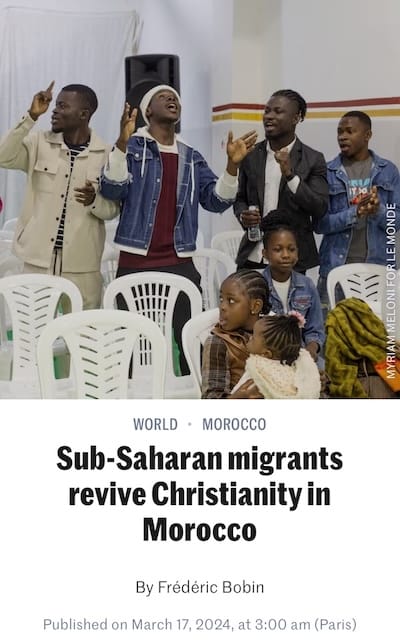
Even secular journalists have noticed: Sub-Saharan Migrants Revive Christianity in Morocco reported that these believers are planting quiet fellowships that are reshaping the spiritual landscape of the Maghreb.
It’s time we broadened our understanding of mission.
Scripture is full of stories not just of those who were sent, but of those who were scattered. Joseph didn’t choose Egypt. Daniel didn’t apply for exile. Esther never signed up for palace politics. And yet, every one of them became an instrument of God in the place they landed.
So why do we ignore the scattered today?
Pastors and mission leaders, what would it look like if we began to take the migrant church seriously? Not as a "side project" or a “ministry of mercy,” but as a frontline expression of the Great Commission? What if, instead of only asking, “Who can we send?” we also asked, “Who have we already sent?”
There is a movement underway. It doesn’t wear matching t-shirts or carry PowerPoint slides. It carries scars. It sings in three languages. It meets behind closed doors but with the windows open. It doesn’t wait for permission. This movement is legal. It is local. And it is already bearing fruit.
We don’t need to manufacture momentum… we jut need to recognize it.
Let's be careful not to focus so much on raising new missionaries that we overlook the ones already in the field. We need to encourage them, disciple them, equip them, and walk with them. They are not the “pre-field.” They are the harvest force. And they are already at work.