M-Moments: Why Diaspora Mission Begins in the Church
Historically, these M-Moments have been written for a general audience. Today, I want to speak directly to my fellow missiologists.
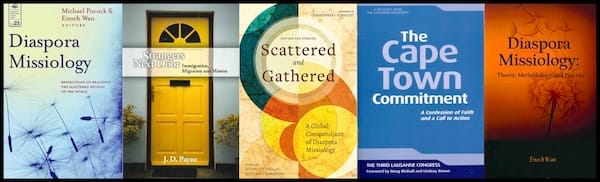
Over the past two decades, diaspora missiology has become one of the most dynamic areas of global mission thought. Building on the pioneering work of Enoch Wan, the catalytic influence of Lausanne’s Cape Town Congress (2010), and the landmark publication of Scattered and Gathered (2020), the approach of ministering to, through, and beyond diaspora communities has been established as a key paradigm.1
Framing the Opportunity
This model rightly recognizes the unprecedented possibilities created by global migration, highlighting diaspora as both a mission field and a missionary force.
The opportunities are genuinely real. There was a time when sending missionaries to the unreached corners of the world was necessary. With the mandate (and capacity) to go, Western churches delivered the gospel to unreached people, and today we see churches in nearly every major city around the globe.
“Missions is no longer across the ocean—it’s across the street.”
But times have changed. The world is no longer just a place where we go... it's now coming to us. Today, most of our churches find themselves surrounded by large and diverse diaspora communities. Mission is no longer “over there”; it is "right here", at our very doorstep.
As J. D. Payne reminds us in Strangers Next Door, the Great Commission is now literally across the street.2 This reality presents a twofold opportunity. First, we have the chance to share the gospel with almost anyone, from anywhere. Second, those who already believe... or who come to faith while in motion... become ambassadors of Christ.
Through them, the gospel spreads among fellow migrants, back to countries of origin, and into new communities of settlement. Many will, by God’s grace, embrace a vision of mission that looks beyond their own people, carrying the gospel into the local contexts where they finally reside.
Let’s put this into perspective. The United Nations reports there are slightly over 300 million international migrants today.3 Pew Research estimates that half of them... 150 million people... identify as Christian.4 If only ten percent of these believers are serious about their faith, that still means fifteen million influential witnesses for Christ. That number is thirty times larger than the entire known global missionary force.5
The disparity in those numbers reveals a gap not yet fully explored: the formative role of the local church as both nursery and launchpad for diaspora mission.

A Second Look
Contemporary diaspora paradigms have shaped conferences, publications, and networks throughout the evangelical world. However, they carry an implicit assumption: that migrants are often spiritually mature and mission-ready when they leave home. And if not, that these migrants can quickly achieve those marks through traditional delivery systems.
Several years ago, I met a young man from West Africa who had traveled to southern Europe. He grew up in church and was eager to share his faith. However, when I asked about his understanding of the gospel, he struggled to explain even the basics. His church back home had taught him to be zealous, but failed to ground him in Christ. The church he found abroad, along with local missionaries, expected him to be ready to witness among other migrants, yet his faith remained weak, and the pressures of survival left little space for growth.
Many migrants, like this young man, begin their journeys with only a modest foundation of biblical knowledge and faith, with few tools to guide their witness. Once abroad, the practical demands of survival… securing legal status, finding work, learning a new language, and supporting family… leave little space to strengthen what is already fragile. Those who come to faith during migration often face even greater gaps.
Much of diaspora discourse has emphasized mobilization at points of arrival, portraying migrants as ready agents of gospel expansion. What is often missing, however, is a careful recognition of how such readiness is developed: how faith is nurtured, roots are established, and maturity unfolds over time.
Toward a Missional Ecclesiology
Diaspora believers are not merely a missionary force to deploy; they are members of Christ’s flock… brothers and sisters in need of care, nourishment, and growth. The fruit we desire in their lives is not automatic; it is cultivated patiently, like young trees in the orchard of the church, tended with care until they bear fruit in due season.6
The Great Commission and the sending narratives of Acts are central to missiology.7 Yet alongside them stand Jesus’ shepherding commands and the apostles’ equipping mandate. Peter was instructed to feed the flock before being called to send them.8 The church at Antioch prepared and worshiped before commissioning.9 Even in Acts 8, when persecution scattered the believers, those who went preaching had already been shaped by the apostles’ teaching in Jerusalem. Mission advances when the church tends its flock… feeding, guiding, training, and strengthening its members… so that whether scattered by crisis or sent with purpose, they go as rooted, fruit-bearing witnesses.10
Missiological vision without the church’s foundational development lacks durability. What we need is a missional ecclesiology. We need to see the church as both a nursery and an orchard: the place where spiritual life is born, nurtured, and matured before it extends outward in mission.
That church is the environment where believers are built up in relationship, worship, and discipleship. If churches neglect this role, diaspora mission suffers from shallow roots and fragile growth. But when churches embrace their calling as cradles of faith, they raise mature disciples whose lives naturally overflow into evangelism and mission.
This is not new to me. This principle builds on the argument from Strategically Planted (2024), which emphasized that mission is the result of maturity, naturally developing as believers grow into the full image and stature of Christ.11 Paul affirmed this in Ephesians, where leaders are appointed “to equip the saints for the work of ministry, for building up the body of Christ.” Likewise, he instructed Timothy to entrust the faith “to faithful men, who will be able to teach others also.”
The same is true for the diaspora. Missionary capacity does not increase solely through training programs in the field; it grows through consistent discipleship before departure. It develops through faithful tending of the flock and through cultivating fruitful lives within the church community.
Every Church in Every Domain
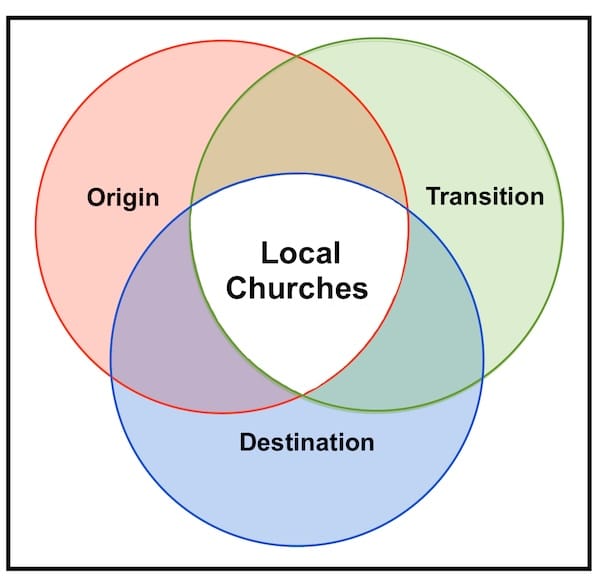
Migration studies often divide the world into geographical places of origin, transition, and destination. It responds to the questions of “Where are you from? Where are you going? How are you going to get there?”. Missiologists (myself included) have followed this pattern, imagining different types of churches for travelers at each stage: national churches in places of origin, immigrant and international congregations in transition, and new or renewed churches in destination areas.
While this framework highlights some essential distinctions, it overlooks a key reality: every local church engages in all three domains at the same time.
“Every church is, at once a place of origin, transition, and destination.”
For one believer preparing to leave, a congregation serves as the church of origin. For another passing through, the same group of believers becomes a church of transition. For yet another arriving to stay, it is the church of destination.
This means that training cannot be divided into separate categories; it must instead prepare every church to be faithful in its calling to disciple, send, care for, and receive. As Peter urged, “shepherd the flock of God that is among you”.12 The local church, wherever it is located, influences the entire migration process.
It might be tempting to reply, “Then simply provide the material.” However, this approach is often ineffective. Churches are unlikely to accept resources created outside their own context or culture, especially when those resources don't meet their specific needs. A better approach is to help church leaders see the great opportunity before them and encourage them to create their own discipleship materials, using shared biblical principles and tailoring them to their communities.
Conclusion
Diaspora missiology has painted a powerful picture of global opportunity. However, vision without proper preparation can lead to disappointment. If we want the to–through–beyond model to succeed, we need to look deeper into the sending church that cultivates the fruit of discipleship upon which ministry, evangelism, and mission rely.
After three decades in pastoral ministry and ten years working with diaspora pastors, one conclusion becomes clear. A missional ecclesiology should see the church as both a nursery and an orchard. It is where discipleship takes root and spiritual maturity is nurtured, preparing believers for mission in every context where they are sent. Since every congregation functions as a church of origin, transition, and destination, training must equip each to be faithful in all three roles.
Only when churches embrace this calling will diaspora missions reach its full potential.
1 Michael Pocock and Enoch Wan, Diaspora Missiology: Reflections on Reaching the Scattered Peoples of the World, Evangelical Missiological Society Series (Pasadena, CA: William Carey Library, 2015)., See also Enoch Wan, Diaspora Missiology: Theory, Methodology, and Practice (Portland, OR: Institute for Diaspora Studies, 2011)., and, Lausanne Movement, The Cape Town Commitment: A Confession of Faith and a Call to Action (Peabody: Hendrickson, 2011)., and, Sadiri Joy Tira, Tetsunao Yamamori, and Christopher J. H. Wright, Scattered and Gathered: A Global Compendium of Diaspora Missiology, Revised and updated ed. (Carlisle, Cumbria, UK: Langham Global Library, 2020).
2 Jervis David Payne, Strangers Next Door: Immigration, Migration, and Mission (Downers Grove, Ill.: IVP Books, 2012).
3 UN DESA, "International Migrant Population (Stocks)," Migration Data Portal, accessed September 11, 2025. https://www.migrationdataportal.org/themes/international-migrant-stocks-overview?utm_source=chatgpt.com.
4 Stephanie Kramer and Yunping Ong, The Religious Composition of the World’s Migrants (Pew Research Center, 2024), https://www.pewresearch.org/wp-content/uploads/sites/20/2024/08/PR_2024.08.19_religious-composition-migrants_report.pdf.
5 Lausanne Movement, State of the Great Commission: A Report on the Current + Future State (Lausanne Movement, 2024), https://lausanne.org/report.
6 Psalm 1:1–3; John 15:5; James 1:1-3
7 Matthew 28:18-20, Acts 1:8; Acts 8:1–4; Acts 13:1–3
8 John 21:15–17
9 Acts 13:2–3
10 Acts 8:4
11 M. Augustus Hamilton, Strategically Planted: The Pathway to Spiritual Maturity (Denver: M2M3, 2024).
12 1 Peter 5:2–3