The Line You Cannot See
How Europe’s Shifting Borders are Redefining Migration... and Ministry
When the Most High gave the nations their inheritance... when He separated the sons of man...He set the boundaries of the peoples. Deuteronomy 32:8
One of the hardest realities in diaspora missiology is coming to terms with borders. Scripture is clear that God has set the boundaries of peoples, yet on the ground, those boundaries are not always clear. In today's world, crossing them changes everything.
I remember traveling by canoe down the Senegal River. We paused on a sandbar and soon realized we were on the wrong side. I was standing in Mauritania, and if I had been stopped, I could have been charged as an illegal immigrant. It is an odd memory. It reminds me that for most people, borders are just lines, until they are not.
Take refugees, for example. According to the UN, a person is not considered a refugee until they cross a border. But when does that happen? Does the "how" matter? In the West, following the rules is important. But what if you don't know the rules... or even more challenging... don't know when or where they apply?
Sometimes, borders are easy to spot, like a river, a fence, or a police checkpoint. Other times, they are much harder to notice. For example, a boat leaving North Africa for Crete just sails toward the horizon. When do they actually enter Europe? By the time they see land, they have already arrived.
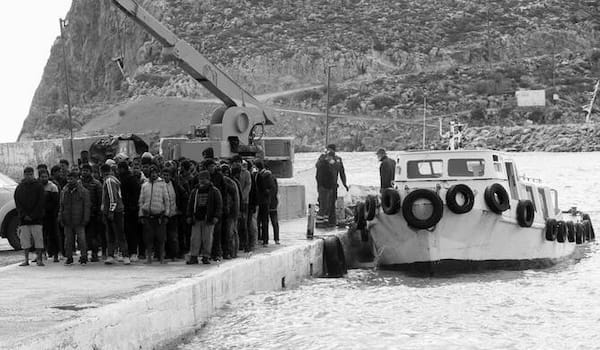
Not long ago, a rubber boat left Tobruk, Libya, and drifted south of Crete for six days with almost no food or water. By the time someone decided that a border had been crossed and that they were responsible for the rescue, only twenty-six people survived, while twenty-two had died. For those on board, the border was not a fence or a checkpoint. It was an invisible line somewhere beyond the horizon, a line many never reached. This is the problem with maritime borders: they stay hidden until they turn deadly.1
For over a decade, the front line in Europe’s immigration battle has been its borders, and the boots on the ground… or boats in the water… have been Frontex. But where is the line in the vast expanse of the Mediterranean? Who becomes responsible for whom? And more importantly, where?
It is not only the EU's border patrol that deals with this uncertainty. Refugee ministries face it too. Most cannot step in until authorities decide who qualifies for aid. People inside the line can get help, but those outside or with denied status are left on their own. And, it is the government who sets the lines.
Once again, that line is shifting.
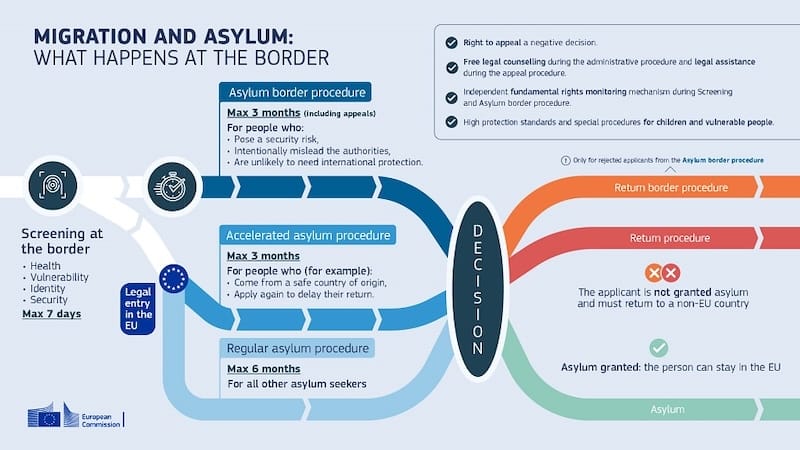
In June 2026, the EU will put its 2024 Pact on Migration and Asylum into full play.3 Its goal is to make the migration system more proactive, efficient, and focused on borders. Instead of allowing many irregular arrivals to enter and wait a long time for decisions, the new system aims to identify, register, screen, and process them much faster. It includes:
Pre-entry Screening: Irregular arrivals are to undergo identity, security, health, and vulnerability checks at or near the EU’s external border.
Expanded Eurodac System: The EU is expanding its registration and tracking database to ensure arrivals are recorded more consistently across member states.
Reduced Secondary Movement: The framework is intended to make it harder for migrants to enter one country and then move onward through Europe before their cases are settled.
Mandatory Solidarity: Frontline states still bear the brunt of pressure, but other EU states must contribute through relocation, financial support, or operational assistance.
In short, the "Pact" moves the EU from reacting to migration to a more controlled approach. Arrivals will be screened sooner, registered more carefully, processed faster, have less freedom to move, and returned more quickly if they do not qualify for protection.
A key element of the 2026 framework is a stronger focus on safe countries of origin and safe third countries of transit. This aims to speed up decisions and limit access to long asylum procedures in Europe.
A safe country of origin is a country that the EU considers generally safe for its own nationals. This means that claims from citizens of those countries can be handled more quickly and then returned to their countries of origin.
A safe third country is different: it refers to a non-EU country through which a migrant passed, or with which an arrangement exists, and where protection is considered available. This allows EU states, in some cases, to declare an asylum claim valid yet inadmissible. That, in turn, facilitates the return of those individuals to that third country.
In practice, these ideas help advance the Pact’s main goals: fewer people move deep into Europe before their asylum cases are decided, and non-EU neighbors are expected to take on more responsibility. Ultimately, this creates a buffer zone along the EU’s border, where migrants can be kept so they do not become the EU’s responsibility.
At a recent conference in Spain, I was asked to consider how the Pact will affect those who want to minister to refugees. I am not a prophet, but some effects are clear.
First, these changes will affect new arrivals more than refugees and migrants already living in the EU. The migrants that churches work with every day probably will not change much. Most of the diaspora you see around you arrived legally. Those who did not are already in the system. Faith-based organizations serving these groups will continue to do so, perhaps with greater clarity.
Second, ministries that help new refugees will probably face more barriers. Processing will happen more often inside controlled-access centers, out of public view. That is where decisions will be made about whether someone can move further inland or must return to a third country.
Third, one could expect that the pressures will build in those third countries. Like building a dam across a river, stopping entries to places of destination does little to stem the flow from places of origin… at least not in the short term. We can expect to see an increase in migrants in historic places of transition. Unfortunately, that means that they will experience additional exploitation and suffering. Historic “inside the border” ministries will have to adapt and develop strategies to engage beyond their traditional spaces in those third countries of transition.
Fourth, smuggling groups will adjust their methods. There is too much money involved for them to stop. If I had to guess, smugglers will start to use land crossings more often. Right now, when a migrant boat leaves Africa, the hope is to be rescued and then processed as a refugee. The Pact will make that route much riskier, increasing the chance of being caught and sent back. Most migrants get information from social media, so fewer will risk that journey. Land routes, such as those through the Balkans, allow migrants to avoid border controls and reach the interior directly.
Fifth, Europe may become a pass-through region. Rather than arriving in Europe to seek asylum, migrants may try to pass undetected and make their way into informal markets or all the way to the United Kingdom.
Here is a truth about migration ministry… it is always adjusting to governmental policies and smuggler-dictated routes. In the end, the changes coming on June 12, 2026, are nothing more than government policies meant to manage diaspora movements. We do not yet know if they will work. That is the worry of politicians and the fodder for the tabloids.
What the Pact does not change is our calling as followers of Christ to love our neighbors and help bring them closer to the gospel. In the world of diaspora missiology, it just means we have to stay on our toes.
1 Yekkirala Akshitha, “30 Migrants Dead or Missing off Greece in Latest Mediterranean Tragedy,” The Morning Voice, February 25, 2026. https://tmv.in/article/30-migrants-dead-or-missing-off-greece-in-latest-mediterranean-tragedy
See also International Organization for Migration, “Over 180 Feared Dead as Mediterranean Death Toll Nears 1,000 in 2026,” International Organization for Migration, April 7, 2026. https://www.iom.int/news/over-180-feared-dead-mediterranean-death-toll-nears-1000-2026
2 European Commission, “Infographic on Border Procedures,” Migration and Home Affairs, April 2025. https://home-affairs.ec.europa.eu/sites/default/files/2025-04/Infographic on border procedures.jpg

3 European Commission, “Pact on Migration and Asylum,” Migration and Home Affairs, accessed April 7, 2026, https://home-affairs.ec.europa.eu/policies/migration-and-asylum/pact-migration-and-asylum_en