67 - Introduction: Eastern Mediterranean Route
2023 No 67
The beginning of wisdom is… acquire wisdom; and with all your acquiring, get understanding.
—Proverbs 4:7
Introduction:
Titles can be deceptive. We often use Western, Central, and Eastern descriptors to describe Mediterranean migration routes. But these are labels that evolved from a Euro-centric perspective. If you are a European country looking south… or an African country looking north, the Mediterranean becomes your point of reference. But most of those who take the Eastern Mediterranean Route, some 90%, are from the Middle East. They call the path for what it is, a Balkan Route, which is the territory they must traverse to get to Europe.1 Unfortunately, that title is already taken, and assigned to a sub-route through the Balkan States. As you can tell, this series of articles could get complicated! My goal is to help sort it all out.
Foundationally, God has called His church to minister to those outside her doors. Such is true for the church in Istanbul, Athens, Belgrade, and beyond. The typical pastor does not have the time to dig through the vast amounts of information to sort out the relevant details. They simply need the wisdom to know how to love their neighbors best. If I understand the above proverb correctly, wisdom requires wisdom… and that kind of wisdom requires understanding. Such is our goal, to help our readers understand what is happening along the "Eastern Mediterranean Route." We trust that such understanding, guided by the Holy Spirit, will result in wisdom. And we pray that such wisdom will lead to men and women, boys and girls, finding faith in Christ.
The Eastern Migration Route (EMR) is often in the news. The route hosts the largest number of actual refugees and has historically created some of the most significant challenges for the European Union. This route stands alone because it is primarily a route for Middle-Eastern peoples. In other words, the vast majority come from Arab and Persian states. The Africans on the route are primarily opportunists, filling empty seats as they become available.
Our journey will be in two parts. The first will describe the Eastern Mediterranean Route in terms of its primary participants, refugees. The second will explain the African presence along the EMR, which is clearly one of opportunity. Together, I pray that you may gain a clearer picture of the EMR and a more profound compassion for those who follow its pathways.
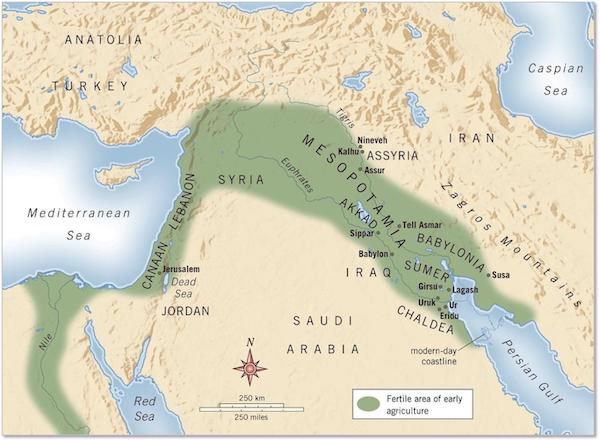
Path One: Eastern Route for Refugees
Understanding the Eastern Mediterranean Route does not have to be complicated. A simple who, what, when, where, why, and how formula may help to put some things in order.
Who:
If we think about the places of origin for the Eastern Mediterranean Route, we will recognize a region known as the "fertile crescent" of the Bible. It is considered the cradle of human civilization and is populated today by both Arabs and Persians. It is a northern border to the geographically hostile Arabian Peninsula. People have lived in this region for millennia due to the lush river systems. It has a rich history, serving as the birthplace of vast empires. Because of that, it has also served as the primary pathway from East to West.
The EMR is composed mostly of people from this region. If you look at the map, you will see that any natural movement from the "fertile crescent" to Europe requires passage through Turkey. Because Turkey shares a long border with her arab neighbors, Iraq and Syria, it has historically been easy for those citizens to cross her borders. Many are ethnic Turks and have been welcomed since the fall of the Ottoman Empire. Their neighbors from Jordan, Lebanon, and Palestine have capitalized on these connections and have been able to follow similar pathways. Turkey also shares a smaller border with Iran. Despite their ethnic differences, frequent conflicts have pushed Persian refugees into Turkey. Networks have evolved that now allow those from Pakistan and Afghanistan to transit through Iran and make their way west.
What:
One of the images that helps us to understand migratory movements is water. Water at rest doesn’t move unless something pushes it, or there is a shift in elevation. When you see moving water, you have to ask, “What happened?” In the case of the EMR, the “what” was conflict. There has been instability in Iran for over 40 years. Recent wars in Iraq, Syria, Pakistan, and Afghanistan have created millions of refugees. It is as if a dam burst and the flood was inevitable. The EMR is nothing more than the canyon below the dam. Since the civil war began in Syria, over 12 million people have been displaced, with three and a half million fleeing to Turkey. Over the last thirty years, a million and a half Iranians have also fled to the West, and those movements continue today. Wars in Iraq, Pakistan, and Afghanistan have displaced millions more. All these people have flowed into that canyon, and there is literally nowhere for most to go but toward Europe.
When:
Understanding the Eastern Mediterranean Route is also a function of time. The EMR has always had its travelers, but things ramped up dramatically with the Arab Spring of 2010-11. Before that conflict, Turkey processed ten to fifteen thousand migrants a year. When civil war erupted in Syria in 2012, millions of refugees flooded north into Turkey. Many would then cross the Adriatic Sea to Greece in boats. In those early days, hundreds of thousands of refugees were received with compassion in Greece, could secure passage across the Balkans, and were unilaterally welcomed by wealthy EU countries. But with time, receiving countries became overwhelmed and began closing their doors. Soon the routes through the Balkans into Europe were fenced off, and Greece ceased to be a place of transition and became a holding center. Turkey negotiated with the EU to control migrant departures in 2016 and gained billions of euros for their efforts. Most of these movements were facilitated by "travel agents", and to remain successful, they had to become much more clandestine… and the routes became much more dangerous.
Today, the number of migrants transiting Turkey into Europe is a fraction of what it once was. But that does not mean that their volume has become inconsequential. The evolution of time has allowed for the development of sophisticated criminal smuggling networks that now draw from a much larger region than just the Middle East. Most are advertising a ticket to the EU, which in many cases only means from Turkey to Greece. The problem is that people are now stranded in those locations. To borrow from our water analogy above, placing a dam downstream does nothing to change the volume entering a canyon. Eventually, with time, the water will back up and create incredible pressure on the dam. If nothing is done to correct the situation, there will come a time when the water will either top the dam, or the structure will once again collapse.
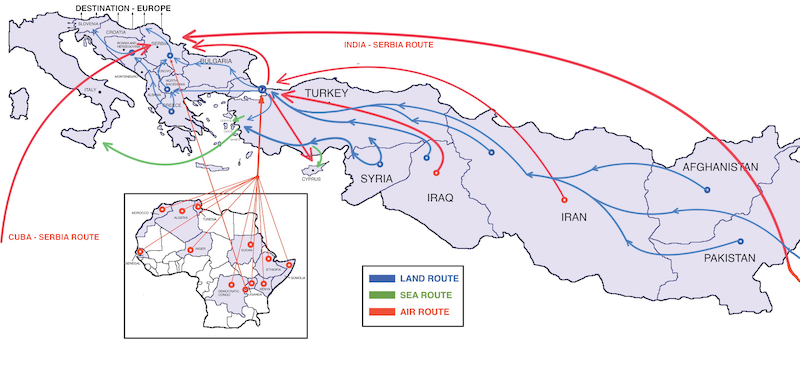
Where:
This is where the Eastern Mediterranean Route becomes complicated. Turkey may be the springboard, but the sub-routes into Europe are diverse and ever-changing.
Turkey: Obviously, the first step of the journey is to arrive in Turkey. Those who live next to the border simply walk across. Everyone else must cross heavily patrolled border stations by bus or fly into one of several international airports. For those with money, this may not be that difficult. Those who are refugees, coming from war zones, need help. They will often secure the services of smugglers who can get them into the country and settle them in the larger metropolitan areas along the coastline. From there, they have options for how they will make their way to Europe.
Transit By Boat To A Greek Island: The most common route over the years has been to take a boat to Greece. There are a series of Greek islands within a stone’s throw of Turkey. The larger ones are Lesvos, Chios, Samos, and Rhodes. Then there are nearly 150 smaller Dodecanese islands, a sixth of which are populated. Needless to say, it is not difficult for a smuggler to use a boat, if not an inflatable raft, to move people to Greece. Such movements can be challenging to prevent, and even more difficult to intercept. In the early days of the migrant crisis, genuine refugees on the islands were quickly processed and moved on to the mainland. Today, that process has stalled, and many are left stranded where they landed.
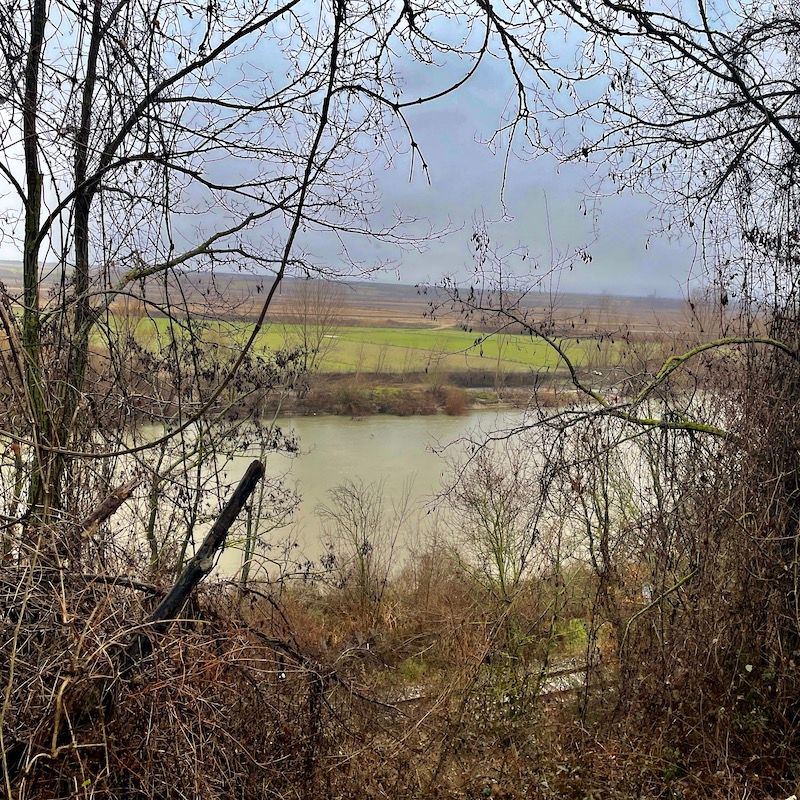
Transit By Foot Across the River: The Evros River flows southward from the Balkans, marking the divide between Turkey and Greece. It is a border of about 120 miles, a third of which is protected by a high fence.4 The entire length is heavily patrolled on both sides. When the water is low, one can wade across and enter Greece. As one might imagine, politics and money can create gaps on both sides of the border, allowing for easy… or very difficult passage. For years, smugglers favored this route because it allowed direct access to mainland Greece.
Transit Through The Balkans: Regardless of how one enters Greece, there is still a geographical separation from the rest of Europe. The Balkan mountains stretch across Bulgaria and Serbia, and the region to the south is called the Balkan Peninsula. That includes Greece. From the earliest days of the crisis, migrants were forced to cross the Balkan states by foot into the Schengen area. This would then give them access to EU countries such as Germany. In 2015, there may have been over 800,000 individuals who took this pathway. As the Balkan countries began to secure their borders, the number of migrants dropped dramatically. In 2018, only 43,000 were thought to have passed by this route. Sophisticated smuggling networks quickly evolved, created pathways departing from Northern Greece, and have even capitalized on direct flights to Bosnia and Serbia. Consequently, the number of on this route has swelled significantly in recent days, reaching somewhere between 145-190,000 in 2022.5
Transit By Yacht to Italy: The bottleneck of the EMR is due to the question of how to get around the geographical isolation of Greece. The Balkan route is not the only option. Where possible, migrants are looking for ways to enter Europe directly. Stories abound of young men sneaking onto container ships and ferries destined for Italy, France, or Spain. Recently, smugglers have been stealing larger yachts and sailing them around Greece to Italy. Once there, migrants can travel along various pathways to the North. Despite the appearance of luxury, these passages are extremely dangerous.6
Transit to Cyprus: A final pathway for migrants is by plane or boat to Cyprus. The history of Cyprus is unique and will be probed in a later article. In short, it is divided into two territories, one governed by Turkish authorities and the other by Greek Cypriots. Although the latter half joined the EU in 2004, it is not a part of the Schengen Agreement. That means that refugees in Cyprus cannot travel to Europe and do not have the right to family reunification. Adding to the problem, Cyprus is too far away to be considered a transit country. Consequently, those who arrive are often at a dead end.7
How:
How the Eastern Mediterranean Route works is a topic that will be described in detail in the posts to come. For now, it is sufficient to know that people cannot do this independently, and that consequently takes money. The elements are simply too complex, the costs are too high, and the risks are significant. A principle previously detailed is that no one moves alone.8 In this case, three networks are often at play… relational networks, smuggling networks, and trafficking networks. Once again, we will dive into these elements in more detail as we progress.
As with much of modern migration, the EMR is not a pathway for the poorest of the poor. The costs are significant, often exceeding $10,000 US dollars per person. People experiencing poverty do not have these kinds of resources and are forced by their circumstances to stay where they are. The more money one has, the greater the chances of success. Governmental pressures and diminished migrant numbers have pressed smugglers to raise prices and become more selective of their clients. Those with less money either stay home or must pay as they go, making them much more vulnerable to traffickers.
Path Two: African Route of Opportunity
Turkey as a Destination
As outlined above, the Eastern Mediterranean Route was not developed for Africans, nor do they currently sustain it. That falls to Middle Eastern refugees. Africans are merely hitchhikers, who, along with others, are taking advantage of a unique opportunity afforded by smuggling networks. It is, therefore, important to differentiate between those Africans who travel to Turkey to be a part of the EMR and those who travel to Turkey for legitimate educational or economic purposes. These are valid reasons to make Turkey a destination. In many ways, Turkey is recruiting from some of Africa's brightest minds and most gifted entrepreneurs. Last year (2022), some 1.3 million Africans arrived legally in Turkey, the majority of whom were from the Maghreb. But... over 330,000 were from sub-Saharan Africa.9
Turkey as a Transition
This ease of access creates a pathway for Africans who desire to go to Europe, but cannot do so legally. In African culture, the ability to migrate is an honor. It represents an opportunity to do more than just improve one's financial status; it is the chance to better the entire family. Successful migration, in this case, means finding a job in Europe and sending remittances back home. Those who can pull it off are revered in their community, gain incredible influence, and it places them in the top tier of their culture. Thus for these migrants, Turkey is something more than a destination; it is a place of transition.
Because the EMR is a primary route for refugees from the East, it is managed by smuggling networks. Their objective is to make a profit, and anyone with money becomes a potential customer. For the Africans, this is not an inexpensive option. Those who take this route have an economic advantage over their peers. One could choose the path through Libya, but why take that risk? One could go through Morocco and into Spain, but those routes are some of the most dangerous. Or, in this case, one could fly to Turkey and join the hundreds of thousands of refugees fleeing from the East into Europe. The flights and visas are easy to secure, and the journey to Greece is relatively easy. One may have to pay as much as fifteen thousand dollars for the entire trip, but it becomes worth the extra expense if the money is available.
Conclusion: Why It Matters
After nearly seventy blog posts on sub-Saharan migration, one may ask why this matters. If so many of these sub-Saharan movements are voluntary, why not just focus on the actual refugees and leave the opportunists to their own ways? After all, everyone has a right to make a bad decision. I hear this fairly often, and each time it weighs heavy on my soul.
If we have learned anything from this blog series, it would be that 99% of all migratory decisions are made for the right reasons. Most of those who migrate will do so legally, with a passport, visa, and invitation in hand. These legal migrants are scattered across large urban contexts around the world. Those who choose to migrate following irregular pathways are a much smaller number. Still, they are driven by the same… appropriate motivations as those who have the ability to do so legally. And if you think about it... bad choices by well-intended people seem to be common... to all of us.
Perhaps half of all African migrants are Christians. Those of faith, who are growing to maturity, are in the best position to introduce others to the hope of Christ. This makes the church's role in places of origin, transition, and destination critical to the salvation of many. Our standard for engagement is not just humanitarian, that is, addressing the degree of heartache and suffering in the community. Our objective is to engage lostness with the gospel. We have been called to love our neighbor. To do that, we must begin to understand the stranger next door.10 That means understanding the bigger picture of migration, recognizing the place our neighbor falls within that landscape, and taking what we know to strategically introduce them to our Lord. If such can be achieved, then the effort to understand the Eastern Mediterranean Route will have been worth it.
1 Loring Danforth, Richard Crampton, and John Allcock, "Balkans", Britannica https://www.britannica.com/place/Balkans (accessed July 8, 2023).
2 KSS, "Land of the Bible: Image of Fertile Crescent", Kehilat Sar Shalom https://rabbiyeshua.com/articles/land-of-the-bible (accessed July 8, 2023).
3 IOM, Displacement Tracking Matrix: Migration Trends in the Western Balkans in 2022 (Geneva, 2022), 3.
4 Deutsche Welle, "Greece Expands Fence Along Border with Turkey" https://www.dw.com/en/greece-expands-fence-along-border-with-turkey/a-64477858 (accessed July 8, 2023).
5 IOM, 7. See also FRONTEX, "EU’s External Borders in 2022: Number of Irregular Border Crossings Highest Since 2016", Frontex https://frontex.europa.eu/media-centre/news/news-release/eu-s-external-borders-in-2022-number-of-irregular-border-crossings-highest-since-2016-YsAZ29 (accessed July 8, 2023).
6 Lorenzo Tondo, "The €8,000 Ticket: The Migrants Crossing the Mediterranean by Yacht", The Guardian https://www.theguardian.com/world/2017/sep/14/luxury-landings-the-migrants-crossing-the-mediterranean-by-yacht (accessed July 8, 2023).
7 Tania Karas, "Why Migrants Are Going to Great Lengths to Avoid Cyprus", Ekathimerini.com https://www.ekathimerini.com/news/201968/why-migrants-are-going-to-great-lengths-to-avoid-cyprus/ (accessed July 8, 2023). See also Marie Jégo, "Cyprus, A Dead End for Migrants Seeking Asylum in Europe", Le Monde https://www.lemonde.fr/en/international/article/2023/02/27/cyprus-a-dead-end-for-migrants-seeking-asylum-in-europe_6017428_4.html (accessed July 8, 2023).
8 Mitch Hamilton, "Principle Three: No One Moves Alone – Local Networks", M2M3 https://m2m3.org/18-principle-three-no-one-moves-alone-local-networks/ (accessed December 7, 2022).
9 Republic of Turkiye, Border Statistics 2022 (Ankara, 2022).
10 Jervis David Payne, Strangers Next Door: Immigration, Migration, and Mission (Downers Grove, Ill.: IVP Books, 2012).