25 - The Central Route: The Genesis of Crisis
2022 No 25
For nation will rise against nation, and kingdom against kingdom, and in various places there will be famines and earthquakes.
—Matthew 24:7
For those who are new to our site, allow me to grant a bit of background. In 2015, we were in the middle of a research project to understand how migration affected one’s receptivity to the gospel. We were studying a specific Muslim people group known as Soninke from Mali. Very few had made the decision to follow Christ, but among those who did, their step of faith was directly related to migration. Little did we know that moving to Bamako would place us at ground zero for what has become widely known as the Central Migration Route (CMR). Over the next two years, some five and a half million migrants would enter Europe through Greece and Italy. Those who came through North Africa were often sub-Saharan, and many would have to pass through Mali on their journey to the Mediterranean Sea. They were the genesis of what we now refer to as the European Migrant Crisis of 2015-16.1
As we have discussed in earlier posts, people move for a reason. Those who followed the CMR were often displaced due to conflict, poverty, or simply a desire for a better life. War had plagued Mali since 2012, and radical ideologies were extending south towards Northern Nigeria and Burkina Faso. Droughts had pushed many from their homelands, exacerbating the financial hardships of many. The Arab Spring had become an Arab Summer, and many sub-Saharans took advantage of the pathways that were opened to Europe.²
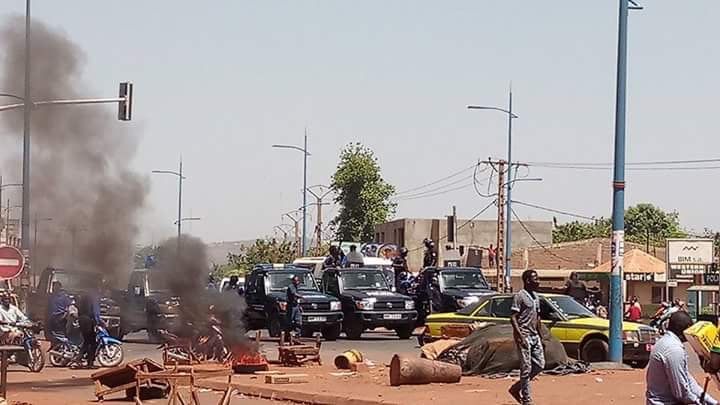
Of all the routes someone could take to Europe, the CMR has proven to be the most difficult, the most time-consuming, creates the most suffering, and has the lowest levels of success. It is a journey of over 5,000 kilometers and can take up to three months… assuming everything goes according to plan. Many will become stranded along the way, and it is not uncommon for the trip to take over a year. Once in Libya, a boat must be secured to cross the water to Italy, adding additional time and expense to the journey. Most who follow this route will never make it to Europe, and far too many will die along the way.
How many are choosing this Central Route is challenging to ascertain. Why? Because we only know about those who arrive in Europe. Those who are unsuccessful or lost.. are not ever counted. Between 2014 and 2017, nearly 100,000 SSA migrants arrived each year in Italy via the CMR. Those numbers dropped dramatically in 2018-20, averaging roughly 23,000 annually. But, in 2021, the number rose again to nearly 67,000 crossings.3
In 2016, the top five countries crossing the Mediterranean were sub-Saharan, comprising 42% of all arrivals to Italy. By 2021, however, the demographics had again changed. Only one country, Côte d’Ivoire, was on the list and represented only 6% of the arrivals.4 But don’t let these statistics fool you. Neither of these numbers represents the actual headcount from SSA, simply because the majority seek to conceal their points of origin to better their chances of being granted asylum upon arrival. In other words, it is difficult to know how many are coming... or from where. For the moment, however, the predominant users of this route are not sub-Saharan. Most appear to be either North African or Asian.5 But that could easily change in a matter of weeks.
The Migrants: Who?
Of all the routes we will explore, the migrants on the Central Mediterranean Route are perhaps the most homogeneous. By this, I mean to say that they are from similar backgrounds, hold similar financial capacities, and share similar testimonies as to why they are seeking passage to Europe. As we have already discerned, migration takes the pathway of least resistance, and money always dictates the duration, degree of suffering, and risks encountered. This route has always been long, but it has only recently become so perilous. Thus, it stands to reason that it would not be the first choice for those with resources or relational networks who could help pave the way.
So, who are the sub-Saharans making this journey today? For beginners, they are not the poorest of the poor. It costs a minimum of $1,500-2,000 to get to Europe on the CMR. In other words, the cost of the trip exceeds the annual income of all but 10% of the entire African population.6 Those who take this route typically borrow money from family, making the endeavor a communal event. As such, it creates significant financial risk for all involved. Is it fair to ask that if these migrants have access to this kind of money, why take this route? Certainly! It may be that they do not have enough money upfront or the connections within their social networks to follow other routes. More likely, they fell into a stream of movement and simply went where the currents took them.
The Means: How?
The Central Mediterranean Route is built upon a pay-as-you-go model. Some from the poorer sectors will gather enough money to go partway, say to Bamako or Niamey, and then pause to work… saving money for the next leg. The challenge is that work becomes more difficult to find and less profitable as the journey progresses, often leaving migrants financially stranded. Others, who have access to enough money for the entire journey, will still only carry enough money to get them to the next stop. Someone then sends them additional resources for the next segment. Otherwise, they would risk having everything stolen by bandits or confiscated by border guards.
Those who run out of money can become easy targets for traffickers. At almost every junction, there are those who will offer to finance the journey, only to be paid back later at an impossibly high rate of interest… or by their labor. Many do not realize that they are often being recruited by those who will later sell them into slavery in North Africa or the farms and brothels of southern Europe. It is indeed a bait and switch, drawing many into its net. Among this group of migrants, some of the most heart-wrenching stories of abuse and suffering are found.
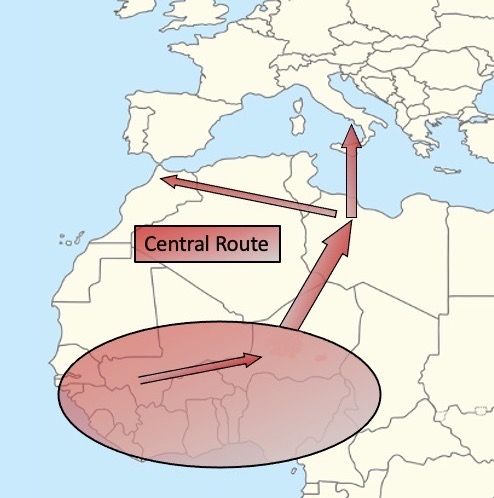
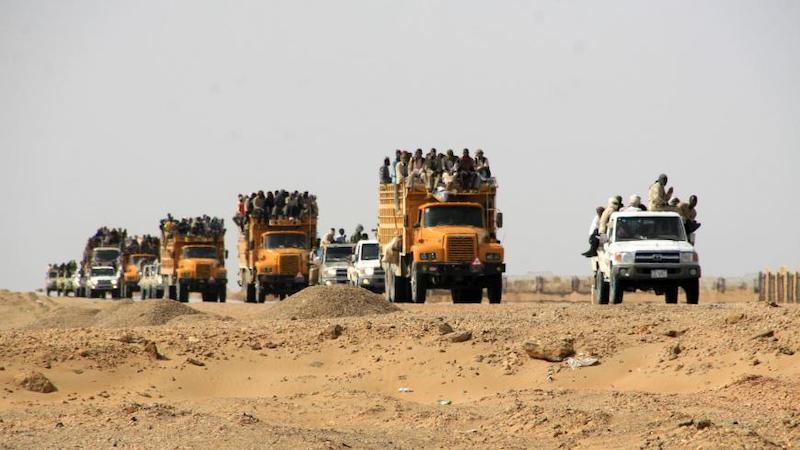
Logistically, the Central Migration Route is not overly complicated when viewed on a map. Even so, identifying all the facets involved can be incredibly difficult. (Although we will certainly try in future posts.) In essence, public transportation can be used to make one's way to either Mali or Niger. From there, smugglers will transport paying migrants to the very edge of the Sahara Desert. At that point, they are placed in trucks for the five-day journey across the sand. Upon arrival in Libya, Tunisia, or Algeria, they then are placed in boats for the trip to Europe.
As noted above, many will never make it this far. It is estimated that over half a million migrants are trapped in Libya alone, not having the resources to pay for a seat in a boat. But even if they could, it is not a guarantee of success. Remember that the trip from North Africa to Italy is over 400 kilometers, much too far for an inflatable boat with a motor. Their primary objective is to get into international waters, call for help, and then be rescued by Frontex (the EU Coast Guard). The lucky ones will then be transported (in theory) to the European mainland.
The Mediators: Smugglers and Traffickers
The Central Mediterranean Route is a pathway entirely dependent upon others. Networks exist that provide transportation, housing, border crossings, and protection. Very few people could make the journey without the help of these smugglers.7 And while these activities are illegal, they are often facilitated by everyday people who simply take the opportunity to survive. We must remember that law and order have currently collapsed on both sides of the Sahara Desert. Consequently, these “smugglers” see themselves more like “travel agents” who provide a service to paying customers who desire transit to Europe.
But not everyone lands in Italy in this way. As noted above, criminal trafficking networks between North Africa and Europe transport more than just people. Much of the illicit drug trade comes through the Maghreb. Cocaine, heroin, and cannabis are routinely brought across the Mediterranean, along with human cargo, in astonishing numbers.8 Their victims will never pass through European control centers and, upon arrival, are taken directly to the fields or the brothels. In these cases, it is difficult to know the actual number of migrants entering the EU.
Conclusion: Why Does It Matter?
As we have already mentioned, the risks along the Central Migration Route are high, and getting stranded at any point along the way is easy. The danger is real. Thousands have perished in the Sahara Desert when their trucks broke down. If no one hears your distress call while floating in the Mediterranean, you will soon die of dehydration. And, of course, we cannot erase from our minds the images of boats that were not seaworthy, having deflated or capsized with the loss of hundreds at a time.9
But the news is not all bad, and hope can be found along the way. Whether at points of origin, transition, or destination, one can often find a local church seeking to minister to those in her community. From the doorstep of the church, and often from the pulpit, a pastor can look into the faces of struggling people. Some are weighing their options and considering the CMR as a way to get to Europe. Others, having arrived in places like Italy, are struggling to cope with the trauma they were subjected to along the way. And then, those churches in transitional spaces seek to care for those who have become stranded. One may disagree with the decisions made by the migrants, but as followers of Christ, we cannot ignore their suffering.
Compassion demands ministry, and ministry requires understanding. As we begin our journey along the Central Mediterranean Route, it will be important that the readers attempt to separate themselves from their own culture and circumstances and try to walk in the shoes of these migrants. Jesus told us in Matthew 24 that the end days would bring struggles, not of our making. The consequence of those struggles is often displacement. Often, the only difference between “us” and “them” is that the struggles that drive this kind of migration have not yet reached our doorsteps. As we have witnessed in Ukraine, things can change very quickly.
This post helps to introduce a new section in our journey to understanding sub-Saharan migration. In the weeks ahead, we will continue that journey by seeking to understand the context in which the Central Mediterranean Route is situated. We will take three posts to examine the historical context of each point of origin, transition, and destination (Sahel, Maghreb, and Italy). We will then spend considerable time recounting the stories of the migrants themselves. Seeing the route through their eyes is perhaps the best way to gain a deeper understanding of the various dynamics. We will then close the section with a discussion of how God uses the church along the way.
In the end, we pray that the picture we paint will be helpful to all as we seek to understand and engage people on the move.
1UNHCR, "Refugee Crisis in Europe", USA for UNHCR https://tinyurl.com/2yepyjek (accessed June 25, 2022).
2Greg Myre, "The Hopeful Arab Spring Turns into a Roiling Arab Summer", NPR https://tinyurl.com/3zp532su (accessed May 18, 2022). See also Patrick Kingsley, "Arab Spring Prompts Biggest Migrant Wave since Second World War", The Guardian https://tinyurl.com/kvhvjmue (accessed May 17, 2022).
3Roberto Forin; Bram Frouws, "What’s New? Analyzing the Latest Trends on the Central Mediterranean Mixed Migration Route to Italy ", Mixed Migration Center https://tinyurl.com/3aujkh42 (accessed May 17, 2022).
4Ibid. Do keep in mind that this only represents the top five countries entering Italy. There are other SSA migrants from other countries who arrive. It is simply that they were not a majority.
5Ibid. In particular, this report shows that the top countries are Tunisia, Egypt, Bangladesh, and Iran.
6World Bank, "ProvcalNet: An Online Analysis Tool for Global Poverty Monitoring", World Bank https://tinyurl.com/a8tvsdr2 (accessed November 25, 2021). Keep in mind that 90% of Africa live on less than $5.50 per day, and 40% live on less than $2.00 per day.
7Human Trafficking vs Human Smuggling, (Washington D.C.: United States Immigration and Customs Enforcement, 2017). See also a previous post on this site entitled No One Moves Alone: Criminal Networks
8George Kraehe, "Contested Terrain: The New Geography of Drug Trafficking in North Africa and the Sahel Since the Arab Spring", Small Wars Journal https://tinyurl.com/mr342m9d (accessed May 18, 2022). See also INTERPOL, Overview of Serious and Organized Crime in North Africa (Lyon, France: INTERPOL, 2018), 5.
9Adam Taylor, "Why the Number of Refugees Drowning in the Mediterranean Keeps Rising", The Washington Post https://tinyurl.com/mr2jk487 (accessed June 23, 2022)