CMR Update 2 - Points of Passage
The European Theatre of Human Migration
2024 No 27B
When they had been safely through, then we found out that the island was called Malta. The natives showed us extraordinary kindness…they also honored us with many marks of respect; and when we were setting sail, they supplied us with all we needed…after we put in at Syracuse.
—Acts 28:1-2, 10-12
Introduction
In our past few posts, we have been taking a second look at the Central Mediterranean Route. Our attempt to understand sub-Saharan migration towards Europe has taken over two years, during which time we have physically crisscrossed the region multiple times. Staying current has been one of our most significant challenges. We can visit an area and gain an understanding of the context from migrants and local workers, only to see the situation evolve and change entirely within six months. Some places are inaccessible due to security reasons. Yet other regions require multiple trips, visits to departure and landing zones, and repeated efforts to communicate directly with the migrants. Ultimately, valid information is only transmitted in an environment of trust… which simply takes time. We have been fortunate in that we have been able to dedicate such time to that task.
Migration poses real challenges for the European Union and her border countries. The stakes are high. It is a competition for culture, resources, and public opinion. Everyone seems to be vying for a seat at the table, and all are negotiating for their own best outcome. Gaining a tactical advantage requires control of the narrative. As the primary receiving country along the Central Mediterranean route, Italy does this very well. Preventing migrant flows is, by nature, very difficult. However, channeling those flows to achieve particular goals is possible and has evolved into quite an act of theatre.
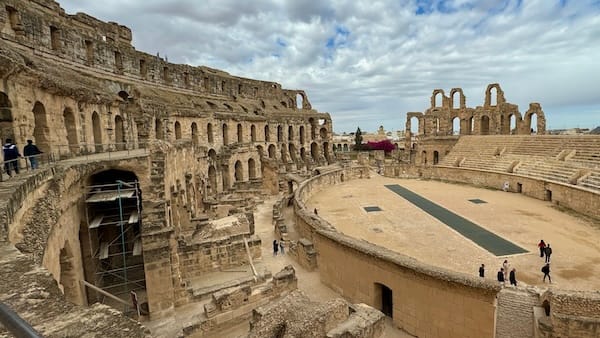
Perhaps there is no better place to understand such theatre than in the birthplace of the ancient Roman empire. Much of their culture was played out on the stages of the grand colosseums, open amphitheaters, and intimate odeums. In these spaces, the empire could easily control the narratives of public opinion. Much of what the people understood about distant events was graphically played out with great fanfare. That message was carefully scripted long before it was presented in a strategically controlled context. As a “citizen,” you only saw what the “state” wanted you to see. As we shall discover, not much has changed in 2,000 years. In our modern world, we might define this “theatre” as propaganda.2
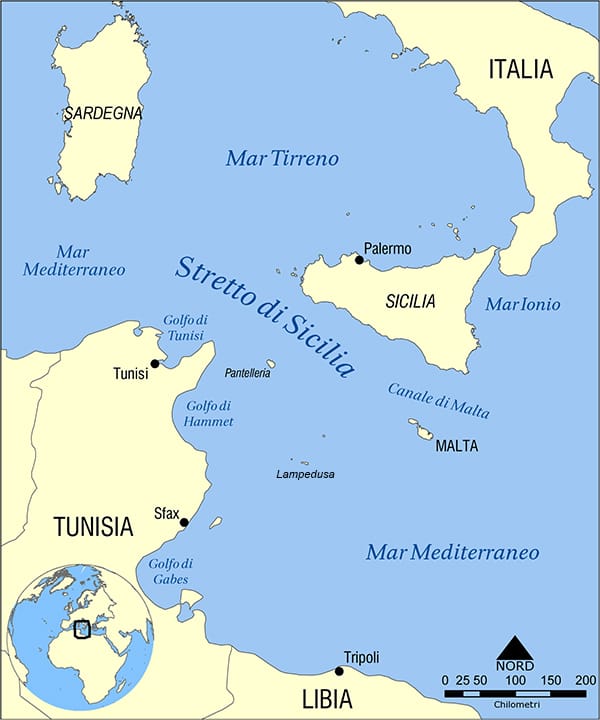
Our goal in this update on the Central Mediterranean Route is to help understand the drama of migration that is being presented to a watching world. Although the opening acts takes place in the countries of origin and the Maghreb, much of the action occurs on three islands between Italy and North Africa. They are Malta, Pantelleria, and Lampedusa.
Malta
Malta is a small island nation fifty miles south of Sicily, two hundred miles north of Libya, and 175 miles east of Tunisia. It is home to some of the oldest freestanding manmade structures in the world, predating both the pyramids and Stonehenge. It lies halfway between the Strait of Gibraltar and the mouth of the Nile River. This central Mediterranean location has given the island historical naval importance, having been ruled by the Phoenicians, Carthaginians, Greeks, Romans, Arabs, Normans, Aragonese, Knights of St. John, French, and the British. At only seven miles wide and 17 miles long, it has been perhaps one of the most strategic locations in all of the Mediterranean. It is no wonder that the Maltese have learned to live with diversity and, through the centuries, developed a keen us/them dichotomy.4
Such diversity… and separation continue to this day. The population of Malta stands at nearly half a million, and almost a quarter of those residents are foreign-born and present legally. Given its small size, the island has a population density of 1,260 inhabitants per square kilometer. The city of Silema, outside the capital, has almost 20,000 inhabitants per square kilometer… rivaling that of Paris. Needless to say, there is not much room for growth, especially for those who may arrive illegally. Yet, despite its prime location in the Mediterranean, Malta has avoided much of the migrant pressures coming from the African continent.
Understanding the migrant situation in Malta requires a bit of historical review. After WWII, the new United Nations ratified what became known as the 1951 Convention. This, in essence, meant that member states were required to accept refugees from the war. It was a key piece of legislation that qualified what it meant to be a refugee, and much of the language endures today.5 The 1967 Protocol updated the Convention by removing restrictions on both date (WWII) and geographic location (Europe). This allowed refugees from anywhere to seek asylum in Europe and required member states to accept them.
After the war, Malta had been under British control. They gained their independence in 1964. The government sought admission to the EU and they would ultimately be accepted in 2004. As a prelude, they ratified the 1967 Protocol mentioned above. At that point, migrant boats from Libya began to arrive. Why? Simply, as a member of the EU and under the Schengen Agreement, refugees who landed in Malta now had open pathways to the continent. Those numbers only ranged between 1,500 and 3,000 each year before the revolution in Libya in 2011.
During this season, Malta, as a member of the EU, was required to receive migrants rescued in its territorial waters. The challenge was that while many of these migrants would seek asylum, they were not refugees. Because Malta was geographically separated from the continent, there were no actual agreements for migrants (not refugees) to be transferred beyond the island. As political unrest grew in the Maghreb, it was not difficult to imagine how the island could soon be inundated with migrants leaving Libya. Italy, perhaps unwillingly, created an alternative pathway.
When the migrant crisis finally exploded during the Arab Spring, Italy began rescuing migrants off the coast of Libya according to the provisions of Operations Mare Nostrum and Triton.6 Most of these were taken to Italian soil, which generally meant Lampedusa. This, by nature, took the pressure off of Malta, and such has continued to this day.7 When the EU brokered a deal with Libya to curtail movements in 2017, the number of migrants arriving in Malta dropped again, with only 380 migrants recorded as having arrived in 2023.8 For now, smugglers have found it difficult to launch boats from Libya due to the cost of bribing the local National Coast Guard and Frontex pushbacks.9 It is now more profitable to send migrants to Tunisia and launch there.
Pantelleria
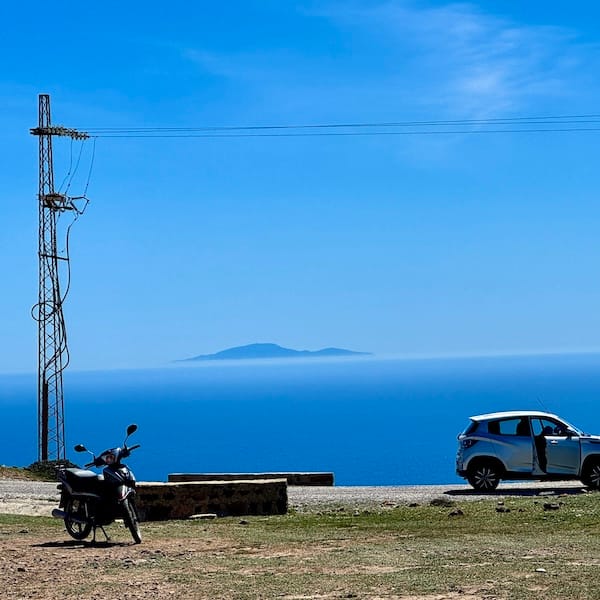
Pantelleria is a small volcanic island with only 32 square miles of land mass. It is located just 63 miles Southwest of Sicily and only 40 miles west of Tunisia. It also lies just under one hundred miles to the north of Lampedusa. The highest peak on the island, the volcanic cone, is 2,750 feet. On a clear day, the island is visible from Tunisia, making it attractive to migrants and a prime target for smugglers. The island is a part of Italy, meaning it is in the European Union. That makes it a participant in the Schengen agreement and responsible for following the rules of the Dublin Regulations.10 For the migrants, that simply means that if you can get there, you will have arrived in Europe. On paper, the authorities are required by law to process your asylum application. That, at least, is what the smugglers say.
In 2022-23, over ten thousand migrants landed on the island of Pantelleria.11 But, you will seldom hear their stories. Arrivals were a mix of Tunisians and other non-black nationalities. Why? In our last post, you will see that most sub-Saharans have been pushed further south in Tunisia, in a region below Sousse.12 Smugglers for those SSA migrants tend to set their sights on Lampedusa directly. However, one must recognize that the Pantelleria Reception Center at the former Via Arenella Army Barracks was designed to hold only fifty individuals.13 That is intentional. The last thing the EU and Italy desire is for Pantelleria to become a destination. This is one of the reasons why sub-Saharans have been pushed south by the Tunisian government. It also explains why Frontex pushbacks to Tunisia are frequent in this area. The message is clear… do not go this way!
Obviously, smugglers send migrants this way. Generally, it is a coordinated effort intended to overwhelm the system, as happened last year. We were able to spend time on the island and visit with some of the residents. Most never saw any of the above waves of migrants. Once on the island, however, migrants are processed quickly and then transferred to Lampedusa. All of this happens behind closed gates, and media coverage is significantly limited. Ultimately, these migrants are generally lumped into the Lampedusa statistics… protecting the accepted narrative.
Lampedusa
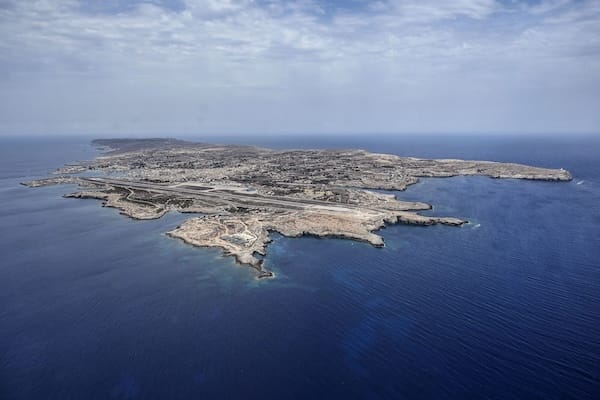
Lampedusa is another Italian island situated 85 miles East of Tunisia and 130 miles South of Sicily. It is a fourth the size of Pantelleria, at only eight square miles, and is relatively flat. The highest point on the island is only 435 feet. That means it is invisible beyond 25 miles… on a very clear day. Finding this island can be difficult for even a skilled navigator with modern equipment.
Her size, location, and lack of a deep harbor have made the history of Lampedusa obscure. Various foreign actors have occupied the island from time to time, but there was little strategic benefit to holding the territory. Ultimately, the island fell into possession of Sicily and would continue as a territory of Italy.15 For many years, this island and its people were nearly forgotten. And yet, this island has become the center stage, the ”Odium” as it were, of the Central Mediterranean Route.
Lampedusa has a population of only six thousand, all of whom have become experiential experts on migration. Anyone who has lived there for more than two decades can tell stories of each phase of migration from Africa to Europe. In the early 2000s, North Africa was relatively stable, hospitable, and profitable for migrants. Lampedusa would see arrivals from Libya, but they were rare. What was more common was movements from the other direction as Italy was deporting irregular migrants back to Libya.16 In those days, Lampedusa was just a waypoint on that journey.
However, between 2006 and the Arab Spring, thousands began to pay fishermen to take them to the island. In those days, migrants would either be processed and sent forward to Italy or would be deported back to North Africa. Following the rebellion of 2011, tens of thousands, then hundreds of thousands, began to arrive. During that season, the island was overrun. Migrants lived on the streets, filled the business district, and were very much in the public eye. Lampedusa became the center of the media world and the hub of the “Central Mediterranean Route.” The humanitarian image was appalling, and the story was not positive.
Much has changed since then, and the EU has sought to do a much better job of controlling the narrative. If you remember, Mare Nostrum was the Italian search and rescue (SAR) operation that began in October 2013. It was replaced one year later by Operation Triton, a European effort in 2014 that lasted another four years.17 In that second effort, the search and rescue area was dramatically reduced. In those days, non-government organizations such as Migrant Offshore Aid Station (MOAS) and Médecins Sans Frontières (MSF) launched their own SAR missions in the Central Mediterranean.18 As the politics changed, those rescues were deemed to be criminal facilitation of smuggling. It sounds horrific, but understand that the goal was to send a message that rescue would not happen, intending to reduce the number of boat launches.
I propose that it is hard to evaluate whether the message is working without understanding the migrant potential in North Africa. What is known is that over 900,000 people are reported to have departed Libya and Tunisia in the last ten years, with almost all passing through this small island.19 Over 100,000 migrants are reported to have landed in 2023 alone.20 Take a moment to process those numbers! As with the island of Pantelleria, the processing center on Lampedusa is small. It began as a reception center back in July of 1998. It was remodeled in 2015 to have a capacity of four hundred. It can expand, if necessary, to double that capacity today.21 Yet, in October 2023, over 11,000 arrived in less than a week.22 If the narrative had not been carefully controlled, Lampedusa would have become an even more attractive target for the smugglers. As it was, it remained a public relations nightmare for the European Union. This is why the island can be described as an Odeum, or a theater of the European Union.
More on Lampedusa 23
Conclusion
The European Union considers Lampedusa to be one of the front lines in the battle of illegal migration. Most would say that it is not a battle against people but rather an offensive against those elements that facilitate movement—people smugglers. There are not enough enforcement measures that can stop a hundred ships from launching in a single night. There are not enough humanitarian resources to save thousands from drowning in that darkness. The weapon of today is information. Why? Because controlling the message has a significant impact on the interactions between the smugglers and their paying customers. We will examine this reality in our next update.
We must remember that the Central Mediterranean has been a route of passage for thousands of years, and many have made this crossing. As a prisoner, Paul traveled this route on his way to Rome. He knew what it was like to face the waves, see his boat break apart, and swim for his life. Despite the journey's hardships, God gave him favor in the eyes of the locals and his captors. Such is the impact of a Christian migrant.
We also recognize that many of those traveling the CMR are believers. I have met them, attended their churches, and heard their stories. Most began with a decision that they now regret. The challenge is that once they stepped into the river of migration, the currents took them to places they could have never imagined. For many, there is no escape, no turning back. All they can do is move forward and pray for God’s favor in the eyes of the locals and their captors.
As the governments are seeking to manage movements, God is at work in the movements to win another battle... lostness. In the most amazing ways, these Christian migrants can be very effective conduits of God's love and Christ's gospel. When they are amid the storms, fellow passengers in the boats can see their faith and hear their prayers. Time and again, I hear the testimonies of those who came to Christ because they were in a boat with another believer. It is a message you will not hear in the coliseums, theaters, or odeums of public discourse. But it is a present reality in the migrant community. And it is a message that they have asked us to share with you.
1 See Wikipedia, "Odeon (Building)", Wikipedia https://en.wikipedia.org/wiki/Odeon_(building) (accessed May 25, 2024). An “Odeon” was a building similar to an ancient Greek and Roman theatre, but it had a roof and was much smaller.
2 See Dan Kuehl, "Propaganda in the Digital Age," in Propaganda and American Democracy, ed. Nancy Snow (Baton Rouge: Louisiana State University Press, 2014), 12. Kuehl states that “NATO's 2011 guidance for military public affairs defines propaganda as "information, ideas, doctrines, or special appeals disseminated to influence the opinion, emotions, attitudes, or behavior of any specified group in order to benefit the sponsor, either directly or indirectly".
3 Lampedusa Pantelleria Malta Photo: Adrian Grima, "Lampedusa Nei Racconti Dei Pescatori Di Lino Psaila", AdrianGrima https://adriangrima.org/2018/01/11/sorelle-alla-deriva-le-connessioni-fra-lampedusa-e-malta/ (accessed May 25, 2024).
Lampedusa Boundary Photo: Chiara Dorbolò, "The Invisible Wall of Lampedusa: Landscaping Europe’s Outer Frontier", FA Failed Architecture https://failedarchitecture.com/the-invisible-wall-of-lampedusa-landscaping-europes-outer-frontier/ (accessed May 25, 2024).
4 Uwe Jens Rudolf, Warren G. Berg, and Warren G. Berg, Historical Dictionary of Malta, 2nd ed., Historical Dictionaries of Europe, vol. no 76 (Lanham, Md.: Scarecrow Press, 2010), 3.
5 UNHCR, The 1951 Convention Relating to the Status of Refugees and Its 1967 Protocol (Geneva: United Nations High Commissioner for Refugees, 2011).
6 Miriam Laux, "The Evolution of the EU’s Naval Operations in the Central Mediterranean: A Gradual Shift Away from Search and Rescue", Heinrich Böll Stiftung https://us.boell.org/en/2021/04/16/evolution-eus-naval-operations-central-mediterranean-gradual-shift-away-search-and (accessed May 25, 2024).
7 Mark Micallef, Malta: The Challenge of Normalising the Media’s Migrant Crisis Machine (Geneva: Euromed Migration, 2017), 52.
8 See Elisa Vari, "Italy-Libya Memorandum of Understanding: Italy’s International Obligations " Hastings International and Comparative Law Review 43, no. 1 (2020). See also Neville Borg, "Fact-Check: Are Migrant Arrivals to Malta the ‘Lowest We’ve Ever Had”?", Times Malta https://tinyurl.com/ftf9cuvb (accessed May 25, 2024).
9 See Libya Review, "IOM: 567 Mitrants Interecepted and Returned to Libya", Libya Review https://libyareview.com/43174/iom-567-migrants-intercepted-returned-to-libya/ (accessed May 25, 2024). See also Libya Update, "Iom: 2,738 Migrants Intercepted and Returned to Libya in 2024 So Far" https://libyaupdate.com/iom-2738-migrants-intercepted-and-returned-to-libya-in-2024-so-far/ (May 25, 2024).
10 See M. Auguatus Hamilton, "Destination: Arrive in Europe", M2M3 https://m2m3.org/36-arrive-in-europe/ (accessed May 25, 2024). See also M. Auguatus Hamilton, "European Migration: We Were Refugees", M2M3 https://m2m3.org/7-european-migration-we-were-refugees/ (accessed January 11, 2024). 7
11 TP24, "Pantelleria Faces Surge in Migrant Arrivals: Over 200 Land in Two Days", TP24 https://tinyurl.com/4m2wf5mu (accessed May 25, 2024).
12 M. Auguatus Hamilton, "CMR Update 1 - Tunisia", M2M3 https://m2m3.org/27a-cmr-update-1-tunisia/ (accessed May 25, 2024).
13 AIDA, "Country Report Italy: Types of Accommodation", Asylum Information Database https://asylumineurope.org/reports/country/italy/reception-conditions/housing/types-accommodation/ (accessed May 25, 2024).
14 Stefania D’Ignoti, "An Island Thrives by Welcoming Migrants", Bloomberg https://www.bloomberg.com/news/features/2023-12-01/lampedusa-migrant-island-welcomes-the-unwanted-crossing-the-mediterranean (accessed May 25, 2024).
15 Albert Ganado, "Lampedusa’s Strong and Long-Standing Relationships with Malta", Times of Malta https://tinyurl.com/7h6ckmjw (accessed May 25, 2024).
16 Rutvica Andrijasevic, "Lampedusa in Focus: Migrants Caught between the Libyan Desert and the Deep Sea," Feminist Review 82 (2006). See also Statewatch, "Statewatch News Online: EU-Italy: The Eu Adopts a Resolution Condemning the Mass Expulsion of Migrants from Lampedusa and the “Lowest Common Denominator Approach” to Asylum" https://tinyurl.com/43j925ay (accessed May 25, 2024).
17 "Operation Triton", Wikipedia https://en.wikipedia.org/wiki/Operation_Triton (accessed May 25, 2024).
18 Eugenio Cusumano and Flora Bell, "Guilt by Association? The Criminalisation of Sea Rescue NGOs in Italian Media," Journal of Ethnic and Migration Studies 47, no. 19 (2021).
19 ReliefWeb, "Italy Sea Arrivals Dashboard (January 2024)", UNHCR https://reliefweb.int/report/italy/italy-sea-arrivals-dashboard-january-2024 (accessed May 25, 2024).
20 See UNHCR, "Italy Sea Arrivals Dashboard", UNHCR https://tinyurl.com/4bczk8jd (accessed May 25, 2024).
21 Ministero Dell’Interno, "Il Modello Lampedusa", Italia.gov.it https://tinyurl.com/mwkxwh59 (accessed May 25, 2024).
22 Federica Marsi, "Italy’s Lampedusa Caught between Solidarity and Survival as Migration Rises", AlJazeera https://tinyurl.com/29u9hfme (accessed May 25, 2024).
23 Priyanka Shankar, "Lampedusa: Operational Emergency, Not 'Migration Crisis", Deutche Welle https://www.dw.com/en/lampedusa-operational-emergency-not-migration-crisis/a-66830589 (accessed May 25, 2024). See also Priyanka Shankar, "How Is Italy Coping with the Sudden Influx of Migrants on Lampedusa?," (YouTube, 2023, Video).