M-Moments: The Boats We Never Saw
May 2025
This week, a sobering story emerged from the Caribbean that deserves our full attention.
A migrant boat was discovered on the beaches of Canouan, which forms part of St Vincent and the Grenadines. It’s origin was the West Coast of Africa, having drifted across the Atlantic, a journey of nearly 3,000 miles, its motor long silent, its passengers already gone.
The remains of 11 people were found onboard—men and women who had set out with hope but never made it to shore. Due to its size, the pirogue likely started out with over 100 people, mostly from Mali. The BBC article describes a scene almost too heavy to bear: a boat, unnoticed for weeks, holding the remains of people whose identities can only be determined by their tattered passports. The others will never be known.
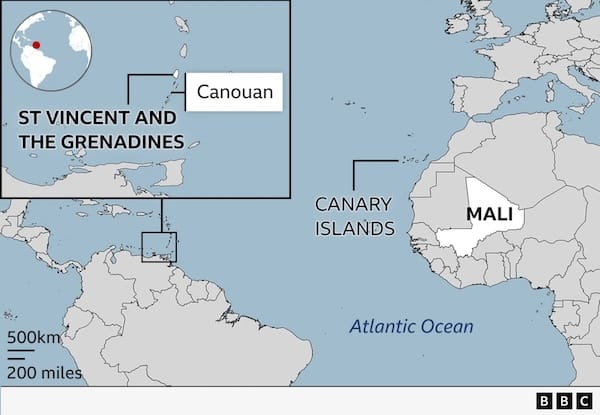
It’s a painful reminder that tragedies at sea often occur far from the public eye. When they do surface, they raise quiet but searching questions: Who were they? What made them risk everything? Was anyone waiting for news that never came?
Over a year ago, I wrote about a young man named Babacar. His story—part fictionalized, part based on dozens of real conversations—is the kind of story that could easily have ended with a headline like the one above.
Babacar was a Senegalese university graduate with no job prospects and a family depending on him. As the oldest son, he carried the hopes of his household. With the encouragement of relatives and the help of a local “agent,” he secured passage on a boat to the Canary Islands. It wasn’t a luxury vessel. It was a fishing pirogue—like the one found this week—overloaded with people, supplies stretched too thin, and uncertainty as its only guarantee.
In Babacar’s case, the journey was brutal. Days turned into weeks. Food ran low. The engines failed. Many around him did not survive. When he was finally rescued, over a third of the passengers had perished, including children. He was lucky. But the experience changed him forever.
If you’ve never read the full account, I invite you to do so here. It won’t leave you unchanged.
The connection to this week’s news is more than coincidental—it’s soberingly familiar. The same route. The same desperation. The same fragile hope. And the same silence when things go wrong. For every boat that is found, there are others that never are.
We often hear statistics—how many people arrive, how many are turned away, how many boats capsize. But behind those numbers are real lives, real families, real dreams. Every person on that boat had a story, a mother, a hometown. Some had children of their own. All of them were hoping for a future they believed was just over the horizon.
In the face of news like this, it can be hard to know what to say—or even whether to say anything at all. But silence isn’t the answer. As people of faith, we are called to bear witness, to weep with those who weep, and to carry each other's burdens, even when the people involved are strangers to us.
In Romans 12:13, Paul exhorts believers to “contribute to the needs of the saints and seek to show hospitality.”
This call is not abstract—it’s a direct invitation to engage the person in front of us, to open our hands, our hearts, and often our homes.
Stories like Babacar’s or the recent tragedy in the Caribbean can feel far away. But the truth is: the migrant is not far. In many neighborhoods, migrants live next door, work down the street, or attend school with our children. They’re shopping in our grocery stores, waiting at our bus stops, and—increasingly—walking through the doors of our churches.
If we are moved by these stories, let us be moved to compassion and personal engagement.
Here are three tangible ways to respond:
- Look around. Who are the migrants or newcomers in your community? Learn their names. Ask their stories. Listen more than you speak.
- Build bridges. Invite someone into your home. Bring a meal. Offer a ride. Help navigate local services or schooling. A simple gesture can become a turning point.
- Stay informed and intercede. Read Babacar’s full story here. Pray for those still making dangerous journeys—and for those already among us, still trying to find their footing.
The sea holds both beauty and sorrow. For many, it has become a place of tears.
Let us welcome those who have made it through the storm.
They are here, today, and they need to know that they are loved.